
My son-in-law knocked my cane aside right in front of everyone, then smiled like it was no big deal. He thought I’d stay quiet and the whole room would let it slide. I didn’t yell, and I didn’t argue. I just steadied myself, looked him straight in the eye, and said one sentence, “Let’s review the footage.” When the screen lit up, the laughter stopped cold. I didn’t have to say anything else, because the truth spoke for me.
“Let’s review the footage.”
When the screen lit up, the laughter stopped cold. I didn’t have to say anything else, because the truth spoke for me.
It started earlier that same day, in a way so ordinary it could have been dismissed as nothing if you weren’t paying attention. He picked up my cane with two fingers like it was something dirty and tossed it into the trash bin by the door, not angrily, casually, as if he were throwing away an empty cup. I remember thinking very clearly that this was the exact moment when he stopped seeing me as a person.
I am sixty-eight years old. I walk with a cane because my right hip does not always obey me, especially in the mornings. The doctors call it age-related complications. I call it my body reminding me that I have lived a full, difficult life and paid for it honestly. The cane is not a weakness. It is a tool, or at least it was until my son-in-law decided I no longer deserved it.
We were standing in the hallway of their house. Their house. The word still tasted strange in my mouth, like someone else’s medicine. I had moved in after my fall last winter when my daughter insisted I shouldn’t live alone, for now. That “for now” stretched quietly into months, the way a temporary thing becomes permanent when no one wants to name it out loud. I learned how to take up less space. I learned which floorboards creaked and which doors annoyed him when they closed too loudly. I learned to speak softer, to move slower, to apologize before anyone accused me of anything.
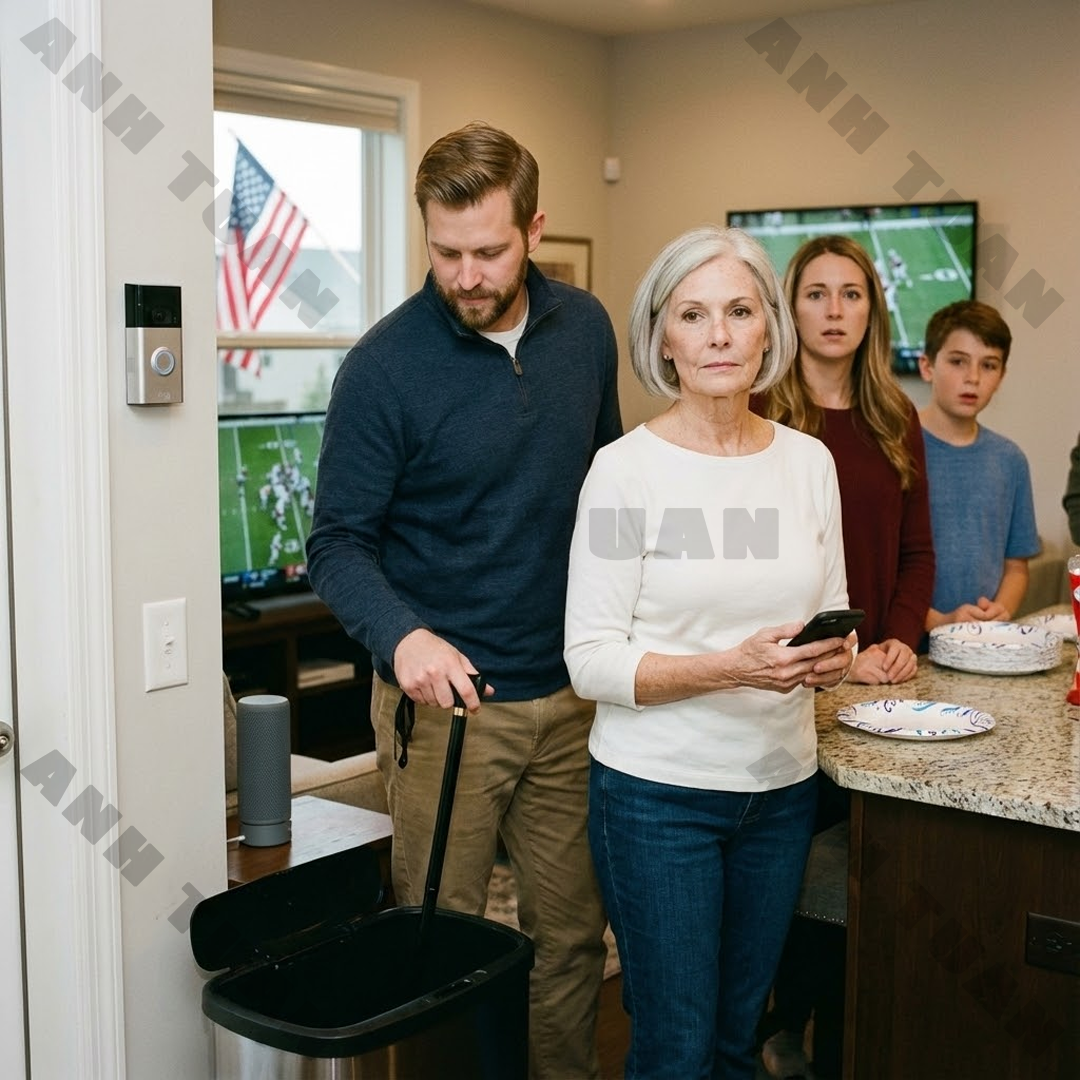
That morning, I had leaned my cane against the wall to take off my coat. It slipped, tapped the floor once, a small sound, barely anything. My son-in-law looked up from his phone with that familiar expression, irritation mixed with superiority, like my existence was a minor inconvenience he had to tolerate in order to keep his life looking decent to the outside world.
“Do you really need that thing all the time?” he said.
I didn’t answer. I rarely answered anymore. Silence kept the peace better than words.
That is when he grabbed it.
I watched him open the bin, drop the cane inside, and close the lid. One smooth motion. My balance shifted instinctively, my hand reaching for something that was no longer there. The wall was cold against my palm.
“You’ll manage,” he said. “You’re not that helpless.”
My daughter, Clare, was in the kitchen. She heard it. I know she did. The kitchen was open to the hallway, all bright counters and stainless steel, the kind of remodel people do when they want their life to look clean, even if the truth is messy. She stayed quiet anyway.
In that moment, I felt something settle inside me. Not anger. Not shock. Clarity, the kind that comes when all doubt finally leaves. This wasn’t about a cane. It wasn’t even about respect. It was about power, and he believed he had all of it.
He turned and walked away, already done with me, already finished with the problem he thought he’d solved.
I stood there longer than necessary, steadying my breathing, my leg trembling slightly. I did not reach for the trash bin. I did not say a word. I simply memorized the way the hallway looked, the position of the bin, the time on the clock above the door. Some habits never leave you. I have always paid attention. I have always noticed details. And I knew, with the same certainty that told me not to cry, that this house remembered everything even when the people in it pretended not to.
After that morning, I became more careful with my body. Not because I was afraid of falling, but because I understood something important. In this house, my safety was optional.
I learned how to move by holding on to furniture. The back of a chair. The edge of the counter. The door frame leading into the bathroom. I timed my steps so I wouldn’t need to rush. Rushing had become dangerous anyway, not just for my hip, but for my dignity. A woman who rushes looks unsure. I no longer allowed myself to look unsure.
Living with my daughter and her husband had taught me many quiet lessons. The first was that being welcomed is not the same as being wanted.
They never said I was a burden. They didn’t have to. It was in the pauses when I entered a room, in the way conversations stopped and restarted without me, in how my presence was tolerated, not included. Clare still called me “Mom” with the same voice she used as a child, but now it sounded thinner, stretched between loyalty and fear. Fear of conflict. Fear of choosing. Fear of what her husband might say if she defended me too openly.
I didn’t blame her the way younger people blame. I had lived long enough to understand how dependence reshapes people.
Her husband, Victor, liked control, not the loud kind, the quiet kind that wears clean shirts and smiles at neighbors. He controlled the thermostat, the grocery list, the television volume. Eventually, he controlled the atmosphere itself. You could feel it when he came home, the air tightening, everyone adjusting. I adjusted too. I stopped watching the news in the evenings because it annoyed him. I stopped calling my old friend Margaret because he said I talked too long. I stopped making tea after nine because the kettle was too noisy. Each small surrender felt harmless on its own. Together, they built a cage that looked like consideration.
Before my fall, I lived alone for eleven years. I paid my bills. I cooked my meals. I decided when to sleep and when to wake. Independence does not disappear overnight. It erodes when you’re told repeatedly, and gently, that you are lucky someone puts up with you.
The cane had been my last visible reminder that my body had limits. Limits make people uncomfortable, especially men like Victor. Limits interfere with schedules, with expectations, with the fantasy that everyone should function smoothly for his convenience.
After he threw it away, I noticed something else. He never looked at my face when he spoke to me anymore. He spoke over me, passed me, as if I were furniture that might answer back by mistake.
I began to understand that staying quiet would not protect me. It would only teach him how much more he could take. That realization did not make me brave. It made me patient.
I had raised a child alone after her father died. I had worked forty years without anyone noticing how tired I was. I knew how to endure. And I knew something Victor didn’t.
Women like me don’t explode. We endure. We observe. And when the moment comes, we act without noise.
Victor liked to present himself as a reasonable man. That was his favorite role. Calm voice, measured gestures, polite smile when others were around. If someone met him for the first time, they would describe him as “solid” or “reliable.” Men like him rely on that. It becomes their armor.
To me, he was different, not openly cruel. That would have required effort. Instead, he practiced something far more efficient. Erasure.
It started with small corrections.
“No, the cups go here now.”
“You’re using too much water.”
“That’s not how Clare likes it.”
He said my daughter’s name often when speaking to me, as if borrowing her authority made his words heavier. He never raised his voice. He didn’t need to. His disappointment was always implied, never stated. It hung in the air like a smell you can’t quite locate but can’t escape either.
When guests came over, he transformed. He pulled out chairs for me, asked if I was comfortable, told stories about how lucky we were to have Grandma with us for a while. He laughed easily. Then people nodded, smiled at me, and I smiled back because correcting the illusion would have taken more strength than I wanted to spend.
The moment the door closed behind the last guest, he exhaled, literally, as if my presence alone required recovery.
I began to notice patterns. He never asked me questions unless someone else was listening. He never thanked me for anything, even when I folded the laundry or watched their son so they could go out. He never said my name. I was “she” or “your mom,” spoken in a tone that suggested inconvenience rather than relationship.
Once I overheard him on the phone. He was standing in the kitchen, back turned, thinking I was asleep.
“She’s old, not sick,” he said quietly. “She plays it up. It’s manipulation. Clare feels guilty.”
I sat in my room and listened to the house breathe around me. The refrigerator humming. Pipes clicking. A place filled with proof that I existed. Yet somehow I was being rewritten into a problem that needed managing.
The worst moments were not the sharp ones. They were the ordinary ones. Dinner conversations where my words floated unanswered. Decisions made about my schedule without consulting me. Jokes that landed just short of insult, leaving me no clean way to object without looking sensitive.
“You know how she is,” Victor would say lightly, and everyone would laugh, even Clare sometimes, especially Clare. Laughter is a shield for people who don’t want to choose sides.
I watched my daughter shrink in ways she didn’t notice. How she checked his face before responding. How her apologies came faster than her opinions. I saw myself in her years ago before life taught me what silence costs.
The cane incident wasn’t a surprise. It was a summary.
Victor didn’t throw it away because it annoyed him. He threw it away because it reminded him that I existed independently of his permission. Because it symbolized limits he couldn’t control. Because he believed I would swallow it the way I swallowed everything else.
And for a moment, he was right.
I said nothing. I did nothing.
But silence is not always surrender. Sometimes it is inventory, and by then I had counted more than enough.
That evening, no one mentioned the cane. It was as if the object and the act itself had been erased by mutual agreement. Victor moved through the house with his usual confidence. Clare cooked dinner. Plates were set. The television murmured in the background. Normality was restored, or at least the version of it that required my silence.
I ate slowly, carefully, keeping my right leg angled just enough to ease the ache. Balancing without the cane required constant attention. Every movement had to be planned. Every shift of weight negotiated. Not one of them offered to help. Clare glanced at me once quickly, then looked back at her plate. Guilt flickered across her face and disappeared just as fast. Guilt is uncomfortable. People either act on it or bury it. My daughter had learned to bury things very well.
Victor talked about work, about a colleague who didn’t pull his weight, about how difficult it was to manage people who expected special treatment. I listened without comment. Men like him often confess without realizing it. They believe their words describe others, never themselves.
After dinner, I stood to clear my plate. The chair scraped slightly against the floor. Victor winced.
“Careful,” he said. “You don’t want to fall again.”
I looked at him then, not sharply, not accusingly, just long enough to let the moment stretch.
“I don’t,” I said.
That was all.
Later, in my room, I sat on the edge of the bed and allowed myself to feel the day settle into my bones. The house was quiet, too quiet. I thought about the trash bin by the door already emptied. My cane gone with the rest of the day’s waste. Something useful reduced to nothing because it no longer suited someone else.
I remembered another time years ago when a supervisor told me I was slowing the team down after I asked for shorter shifts following surgery. I had thanked him for his honesty and gone home to think. Three months later, I left that job with my pension secured and a letter from the labor board he hadn’t expected.
I have never reacted quickly. Speed favors the confident, not the careful.
That night, I slept poorly. Pain wakes you in layers. First the body, then the mind. I lay there listening to the house. Footsteps above me. The low hum of electronics. The faint click of a door opening and closing. Victor going to check something or someone. He liked to make sure things were where he left them.
In the early morning, I woke with a thought so clear it felt placed there deliberately.
He threw away the cane because he thought I had no proof. No witness. No leverage.
I smiled faintly in the dark because while Victor controlled many things in that house, he did not control its memory.
He had forgotten about the small black cameras he installed last year after a package went missing. One by the front door, one facing the hallway, one angled just enough to catch the trash bin. He had bragged about them then, about being prepared. He had said it like he was the kind of man who couldn’t be caught off guard.
I lay still, letting the idea settle, letting it grow roots. For the first time since my fall, I didn’t feel unsteady. I felt ready.
I didn’t rush to check the cameras. Urgency clouds judgment. I had learned long ago that the best decisions come when the pulse is steady and the hands don’t shake. So I waited. I made breakfast as usual. I wiped the counter. I folded a load of laundry that wasn’t mine. Victor passed me twice in the hallway without looking at me once.
Good, I thought. Let him stay comfortable.
It wasn’t until the house emptied, Clare at work, Victor gone shortly after, that I moved.
I didn’t go straight to the living room where the monitor was. I went to my room first and sat on the bed, letting my body settle. Sixty-eight years teaches you respect for your own limits. Righteous anger means nothing if your back gives out halfway through.
The cameras were connected to an app on Victor’s tablet. He never bothered to password-protect it properly. He believed privacy was something other people needed, not him.
The tablet sat on the sideboard exactly where it always was. Some people lock doors. Others rely on arrogance.
I carried it carefully like something fragile and placed it on the dining table. Then I sat down and breathed for a moment before touching the screen. I wasn’t nervous about what I would see. I was nervous about what I would feel.
The footage loaded slowly. Front door camera. Timestamp. There I was, coat half off, cane leaning against the wall. The angle was unflattering. It made me look smaller than I am, older. That surprised me. I had never seen myself the way others saw me on bad days, not posed, not prepared, just existing.
Then Victor entered the frame.
I watched his face as if it belonged to a stranger. The casual impatience. The flick of his wrist as he grabbed the cane. The absence of hesitation. He didn’t look around, didn’t check if Clare was watching. He didn’t even glance at me.
That was what struck me most.
To him, the act didn’t require acknowledgement.
The cane disappeared into the bin. The lid closed. I paused the video.
For a moment, I sat very still. Not because I was shocked, but because something deep inside me had finally aligned. Doubt has weight. When it lifts, you feel lighter than you expect.
I rewound and watched it again. Then again.
On the fourth viewing, I noticed details that mattered. The way he said, “You’ll manage.” The way my hand reached out instinctively and found nothing. The way my body adjusted without permission, already compensating.
That mattered.
It told a story without words.
I checked the hallway camera next. It showed what came after. Me standing there longer than necessary. Victor walking away. Clare appearing briefly in the background, stopping, then turning back toward the kitchen.
She had seen it.
That knowledge hurt more than I anticipated. Not sharply, dullly, like pressure behind the eyes that never quite becomes tears. I didn’t blame her yet. Blame is lazy. Understanding takes more work.
I saved the clip. Not dramatically, just calmly. I sent it to a private folder, then backed it up twice. Old habits. You only get one chance to be prepared.
When I put the tablet back, I wiped the screen clean of fingerprints. I left the room exactly as I found it. Evidence means nothing if the other side knows you have it too soon.
That afternoon, Victor came home early. I heard him moving around, opening cabinets, checking things. He stopped at the dining table, then at the sideboard.
“Have you seen my tablet?” he asked.
“It’s where you left it,” I said.
He found it and frowned, checking the screen. My heart didn’t race. Fear depends on uncertainty, and I had none left.
That evening, he was unusually polite. Asked if I needed anything, spoke more softly. Control wavers when intuition senses a shift. He didn’t know what had changed, only that something had.
And that was just the beginning.
The next few days passed quietly, and that worried me more than open hostility ever could. Victor became careful, not kind, careful. He closed doors more gently. He asked before moving things. Once he even asked if my hip was “acting up,” the words placed in his mouth like coins he didn’t want to spend.
Clare noticed it too. I saw confusion in her eyes, hope mixed with suspicion, the way people look when the weather changes without warning and they can’t decide whether to trust it. I didn’t change my behavior at all. That was important. I thanked him when he held a door. I answered when spoken to. I moved slowly, deliberately, still without a cane.
Let him believe his small correction had worked. Let him believe I had adapted.
Inside, I was working.
Every morning after they left, I returned to the recordings, not just the one with the cane. I widened the timeline, days, weeks, ordinary footage most people never watch. It turns out ordinary is where patterns live, and once you see a pattern, you can stop calling it an accident.
Victor had a habit of standing too close when correcting me, his body angled forward, mine backing away. He had a habit of rolling his eyes when my back was turned, then smoothing his face when Clare entered the room. He had a habit of speaking in the same tone he used for customer service calls, polite on the surface, sharp underneath, like a blade hidden in a napkin.
Nothing dramatic. Nothing a stranger would label as cruelty after a ten-minute visit. But together it formed a rhythm.
Pressure applied, then hidden.
I clipped several moments and labeled them neutrally, date, time, camera angle. It wasn’t a vendetta. It was documentation. At my age, I no longer trusted feelings alone when the people around me were invested in calling them exaggerations.
What surprised me most was my own expression on the recordings. I looked smaller than I felt. Shoulders slightly rounded. Hands folded like I was waiting to be told what to do. A woman constantly bracing for impact that never quite came and therefore came every day.
Seeing yourself from the outside is not easy at any age. At sixty-eight, it is brutal and clarifying at the same time. I didn’t recognize myself fully, and I didn’t like that.
One afternoon, Clare came home early. She found me sitting at the dining table with papers spread out in careful stacks, medical statements, insurance notices, old bank documents, the kind of life paperwork you ignore until ignoring it starts costing you.
“What are you doing?” she asked.
“Organizing,” I said.
She hovered, unsure whether to press further, and that hesitation told me how trained she had become. She finally sat across from me, fingers wrapped around the back of a chair as if she needed something to hold.
“About the other day,” she began, then stopped.
I looked at her and waited. Silence is uncomfortable. It makes people reveal more than they intend.
“I should have said something,” she said finally. “About the cane.”
“Yes,” I replied.
The word came out simple, factual. She flinched anyway, as if truth was louder than anger.
“I didn’t want to make things worse,” she said.
That sentence told me everything. Worse for whom, not for me, not for herself, worse for him, worse for the version of peace he controlled.
“I understand,” I said, and I meant it. Understanding does not mean acceptance. It simply means you see the whole picture.
That night, Victor asked Clare if everything was okay between us. I heard him from the hallway, his voice pitched into concern, his tone polished. His eyes kept drifting toward me, measuring. Clare said it was fine.
I went to bed early and lay awake thinking about timing, about leverage, about how men like Victor operate. They don’t fear confrontation. They fear exposure, not to the world necessarily, to themselves, reflected back without distortion.
I was no longer invisible to myself, and that was dangerous for him.
The cane was still gone. My hip still ached. But something else had shifted into place. A steadiness that had nothing to do with balance. I wasn’t preparing to argue. I wasn’t preparing to accuse. I was preparing to stop participating in a version of my life that required my erasure.
And once you see that clearly, there is no going back.
The decision didn’t arrive like a thunderclap. It came the way most truths do at my age, quietly, without ceremony, and impossible to ignore once it settled. I stopped thinking in terms of endurance.
For years, endurance had been my answer to everything. Endure the bad marriage until it ended. Endure the double shifts. Endure loneliness after my husband died. Endure pain, noise, disappointment, silence. Somewhere along the way, endurance had started to masquerade as virtue, as if surviving something automatically made it right.
But endurance is not the same as living, and it is certainly not the same as dignity.
That realization came to me one afternoon while I was standing at the kitchen counter waiting for the kettle to boil. My leg throbbed, a dull, persistent ache. I shifted my weight, misjudged the distance, and had to grab the edge of the counter to steady myself.
The movement was small, but it startled me.
Not because I almost fell, but because no one noticed.
Clare was scrolling through her phone. Victor was at the table typing on his laptop. Two people close enough to touch, neither of them looking up. I could have fallen hard.
And the room would have stayed exactly the same.
That was the moment endurance stopped feeling noble and started feeling dangerous.
I finished my tea and took it into my room, closing the door behind me. The click of the latch sounded louder than usual. Final. I sat on the bed and looked around at the space that had been assigned to me. Neutral walls, a borrowed lamp, a dresser with only half my things.
Temporary, they had said, as if temporariness excused everything that happened inside it.
I thought about my life before this house, the small apartment I sold, the furniture I gave away because it wouldn’t fit here, the independence I folded up neatly to make myself easier to accommodate.
No one had forced me. That part was important. I had volunteered out of love, out of fear of being alone, out of that old stubborn belief that mothers are meant to adjust.
Victor sensed the change before I spoke a word. Men like him always do. Control depends on predictability, and I had become unpredictable simply by withdrawing my effort to please.
He began hovering, asking where I was going when I stood up, offering help I hadn’t asked for, correcting me more gently, as if softness could erase history.
One evening, he said, “You seem distant lately.”
“I’m thinking,” I replied.
That unsettled him more than anger would have.
Later that night, I opened a folder I hadn’t touched in years, insurance documents, property records, beneficiary forms, the dull paperwork of a life lived responsibly. I read slowly, carefully, line by line.
It turns out that even at sixty-eight, there are parts of your life that still belong entirely to you, if you bother to remember them.
I realized something then that made me sit back and exhale. I was not trapped. I was inconvenienced. I was uncomfortable. I was disrespected. But I was not powerless.
The house was theirs. The control was his. But my choices were still mine.
The footage sat quietly on my phone, backed up and waiting. Not as a weapon, not yet, more like a mirror. Proof that what I felt was real, measurable, undeniable.
I didn’t plan revenge. That word is too loud, too dramatic. I planned correction. Correction of a narrative that said I was fragile. Correction of a dynamic that said I should be grateful for mistreatment. Correction of my own habit of accepting less just to keep the peace.
When you reach a certain age, you understand something younger people don’t. Time is not something you waste on teaching grown adults how to behave. You simply decide what you will no longer tolerate and adjust your life accordingly.
The next morning, when Victor and Clare were out, I drove myself to the drugstore on the corner, the kind with a small photo counter and a rack of greeting cards that always looked slightly sun-faded. I bought a cane. Not because I needed to prove anything, but because I refused to be unsafe in my own body for the sake of anyone’s pride.
It was plain, adjustable, with a rubber tip that smelled faintly like new tires. I carried it out to my car and set it in the passenger seat like a quiet companion.
On the drive home, the radio played a talk show about the weather shifting, late spring storms rolling in over the Midwest. The host joked about people panicking at the grocery store for milk and bread. I smiled once, not because it was funny, but because it reminded me how Americans prepare for storms. Not by praying them away, but by filling their basements with flashlights.
Preparation is not fear. It is self-respect.
That evening, I walked into the house with the new cane. I didn’t announce it. I didn’t wave it like a flag. I simply used it the way I was meant to.
Victor’s eyes landed on it immediately.
His mouth tightened, and for a second, I saw it, the flash of irritation, the quick calculation.
He did not comment. Not then. Control doesn’t always strike the first time it itches. Sometimes it waits for witnesses.
The witnesses arrived two days later.
It was a Saturday, the kind of bright American Saturday that makes suburban streets look like postcards. Fresh-cut lawns. Flags hanging from porches. Neighbors washing cars in driveways like it was a ritual of cleanliness and belonging.
Clare had invited people over for her son’s birthday. Balloons. A store-bought sheet cake. A few families from the neighborhood, parents from school, Victor’s sister and her husband, a couple of coworkers from his office. A backyard gathering with plastic chairs and paper plates, the kind that looks harmless until you remember how many things can happen in a “harmless” setting.
I had offered to stay in my room. Clare insisted.
“Come sit with us,” she said. “It’s just family and friends.”
Just.
That word makes people careless.
I dressed carefully. Soft slacks, a clean blouse, a cardigan because the air still had that spring bite. I brushed my hair and put on the earrings my husband bought me the year before he died, small pearls, nothing flashy, just a reminder of who I was before I was reduced to a complication.
I walked out with my cane steady beneath my hand.
The living room was loud, full of voices and laughter. The smell of grilled burgers drifted in from outside. Someone had a game on the television, muted, as background. Kids ran through the hallways like they owned the place, because they did, in the way children do.
Victor’s mother, Lorraine, hugged me with the tight, polite embrace of a woman who believes affection is something you demonstrate for the audience. She complimented my blouse. She asked how I was “holding up.” I gave her a calm smile and said I was well.
Victor moved through the room like a host, shaking hands, telling jokes, leaning close to men he wanted to impress. His voice was warm, his posture open, his smile practiced.
He was in his element.
That is what made what happened next so revealing.
It happened in the hallway, just inside the front door, where the camera still watched. People were heading out to the backyard. Someone’s child had left a scooter near the entryway. I adjusted my grip on the cane and took a careful step to avoid it.
Victor was behind me. I didn’t know that until I felt his presence, close, impatient.
“Oh, come on,” he said, light, as if we were sharing a joke. “You’re fine.”
And then, with the casual flick of a man brushing a crumb from his sleeve, he knocked my cane sideways.
Not hard enough to be called assault. Not obvious enough for a stranger to immediately protest. Just enough.
The cane skittered across the hardwood floor and hit the baseboard with a sharp sound. My balance shifted. My heart rose into my throat in a quick, animal panic.
I caught myself on the wall, palm flat against the cool paint, and stood there for a second with my breath held, aware of the sudden hush that rippled through the people nearest us. A couple of kids stopped. Someone’s laugh died halfway out.
Victor smiled like it was no big deal.
“See?” he said. “You’re steady.”
A few people laughed, uncertainly. The kind of laughter that asks permission to stay comfortable.
I turned slowly. Not dramatic. Not rushed. I looked him straight in the eye.
The hallway light made his face look clean and ordinary, the way so many dangerous dynamics look on the surface. He expected me to swallow it. He expected me to smooth it over. He expected me to be grateful he hadn’t “made a scene.”
I did not yell. I did not argue.
I steadied myself, reached down, and picked up my cane.
Then I said one sentence.
“Let’s review the footage.”
The words landed softly, but they changed the air.
Victor’s smile stiffened.
Clare, standing near the kitchen doorway, went pale.
“What?” someone said, half-laughing, like they thought I had made a joke.
Victor’s sister blinked, confused. “Mom… what does she mean?”
I didn’t move quickly. I didn’t need to. I walked into the living room with my cane in hand, my spine straight, my steps careful but firm. Behind me, voices followed, lower now, curious.
Victor stepped in front of me once, smiling too widely.
“Let’s not do this,” he murmured, keeping his tone friendly, the way people do when they’re trying to control the story without letting anyone see them doing it.
“We’re not doing anything,” I said. “We’re watching.”
The television was still on. The game muted. The living room full of people, suddenly paying attention in the way people do when they sense real tension, the kind they didn’t come for but can’t look away from.
Victor’s coworker, a man in a polo shirt with a company logo on the chest, chuckled nervously.
“Is this about the cameras?” he asked, trying to keep it light.
Victor had bragged about the cameras before. Of course he had. The front door, the hallway, the driveway, “for safety,” he’d said. “You can’t be too careful these days,” he’d said, like the world was always threatening him and never the other way around.
Clare swallowed hard and looked at me.
“Mom,” she whispered.
I didn’t answer her right away. Not because I didn’t love her, but because love is not a steering wheel I hand to someone who has been driving me into walls.
Victor reached for the remote.
I reached first.
Not aggressively, just faster.
I held my phone up.
“I have it,” I said.
His eyes narrowed. “This is unnecessary.”
“That’s an opinion,” I replied. “The camera has facts.”
Someone laughed again, but this time it was shorter, sharper, because they heard the edge underneath my calm.
Victor’s mother shifted in her seat. “I don’t understand what’s happening,” she said, and I believed her. People like her rarely understand until the truth is placed directly in front of them where they can’t pretend not to see it.
I connected my phone to the screen. It took a moment, the kind of pause that makes a room hold its breath. The television flickered, changed inputs, and then the footage appeared.
The hallway.
The timestamp.
The angle that showed the trash bin by the door.
There I was, coat half off, cane leaning against the wall. I looked smaller on screen, older, more vulnerable. The room shifted as people took that in.
Then Victor entered the frame.
Somebody’s hand went up to their mouth.
Victor’s coworker’s smile vanished.
Victor’s mother sat very still.
On screen, Victor grabbed the cane and dropped it into the bin. The lid closed. His voice came through the speakers, too clear to be mistaken.
“You’ll manage. You’re not that helpless.”
The room went quiet in the way a church goes quiet when the organ stops.
Then the second clip played. The hallway camera from a different angle. It showed Clare appearing, stopping, watching, and turning away.
A sound came from Clare’s throat, small, involuntary, like a swallow that hurt.
Victor’s sister stared at her brother as if she had never met him.
Someone in the back said, “Oh my God,” not loudly, but with enough weight to change everything.
Victor’s face on the couch was not angry.
It was blank.
Blank is what happens when a man realizes his narrative has been taken out of his hands.
I let the clip finish. I didn’t pause it mid-way for commentary. I didn’t add dramatic music in my head. I didn’t need to. The footage did what truth always does when it’s allowed to stand on its own.
It spoke.
The laughter that had tried to protect him stopped cold. It didn’t drift away. It snapped, like a thread cut clean.
Victor leaned forward, remote clenched in his hand.
“You went through my tablet,” he said, and even now, in front of a room full of people, he reached for the one kind of accusation he could still form.
I looked at him steadily.
“No,” I said. “I watched you go through my life.”
Clare stood up so fast her chair scraped the floor.
“You did that?” she asked him.
Victor’s head turned toward her, and the mask reappeared, softer voice, practiced concern.
“It’s not what it looks like. I was frustrated. It was a stupid moment.”
“It looks exactly like what it is,” Victor’s sister said, her voice shaking with anger she didn’t know where to put.
Victor’s mother’s eyes were glassy now. She didn’t speak. She didn’t defend him. She looked, for the first time, like a woman seeing a crack in the story she had raised him to believe.
A child ran through the room, laughing, not understanding. The normal sound felt wrong in that moment, like someone playing a happy song in a hospital corridor.
Victor’s coworker cleared his throat.
“Maybe we should,” he began, and stopped, because there wasn’t a polite way to fix what had already been seen.
I stood slowly, carefully, and in that movement I felt every year of my age in my bones.
None of it embarrassed me.
“I’m not here to perform pain,” I said. “I’m here to end it.”
Victor’s eyes cut to me, sharp.
Clare whispered, “Mom,” again, but her voice was different now, not pleading, not warning, just stunned.
“I’ve spoken to a lawyer,” I said, and the room tightened at the word. Americans understand lawyers the way they understand storms. You don’t have to like them to respect what they can do.
Victor’s jaw flexed.
“I’m making arrangements to leave,” I continued. “And I will be formalizing the money I contributed to this house. That will be handled legally, without discussion.”
Victor opened his mouth.
I didn’t let him fill the silence with excuses.
“And if I ever hear my age used as an excuse for your behavior again,” I said, still calm, “this footage will not stay private.”
The air was so still you could hear the refrigerator hum.
Victor’s breathing was short, uneven. Clare looked at me, then at him, as if seeing both of us for the first time.
“You told me she was imagining things,” Clare said quietly, and that quiet was the most dangerous sound Victor had ever heard from her.
Victor said nothing.
He didn’t have anything left that could erase what a roomful of people had just witnessed.
I picked up my phone and slid it back into my pocket.
“I won’t be speaking about this again,” I said. “I will be leaving on my own terms, and I will not be minimized in the meantime.”
Then I walked past him.
He moved out of the way without thinking.
That was how I knew it was over, not because the footage existed, but because his body obeyed the truth before his mouth could argue with it.
The party did not continue.
It dissolved the way gatherings dissolve when the illusion breaks. People found reasons to leave, suddenly remembering errands and early mornings and forgotten obligations. They hugged Clare awkwardly. They avoided Victor’s eyes. They offered me soft, guilty looks, the kind that say, I didn’t know, and also, I’m glad it wasn’t me.
Victor’s mother stood in the kitchen for a long time with a glass of iced tea sweating in her hand, staring at nothing. When she finally looked at Victor, her voice came out thin.
“Is that how you speak to her when no one is looking?” she asked.
Victor tried to laugh. The laugh came out wrong.
“Mom, please,” he said.
She shook her head slowly, like the motion hurt.
Clare walked out to the backyard and stood near the grill, hands pressed to her mouth. Her son’s birthday cake sat untouched on the table, bright frosting under the afternoon sun. A child’s joy paused because adults had finally told the truth.
I did not feel proud. I did not feel triumphant.
I felt finished.
When the last car pulled out of the driveway, the house sounded different. Not quieter, smaller. As if the walls had moved in closer to the man who had relied on them to hide what he did.
Victor didn’t explode. Men like him rarely do when witnesses exist.
He withdrew.
He moved through the rooms like someone searching for the part of the story where he could still be in control. He checked the camera monitor. He stared at the hallway as if the lens itself had betrayed him. He avoided being alone with me.
Clare didn’t speak to him for hours. She moved through the kitchen slowly, mechanically, washing plates that were barely used, wiping counters that were already clean.
When she finally turned to him, her voice was flat.
“You threw away her cane,” she said.
Victor’s shoulders rose. Defensive.
“I didn’t throw away her cane,” he said. “I moved it. She was leaving it everywhere. It was a hazard.”
“You put it in the trash,” Clare replied.
He opened his mouth, closed it, and then tried again with a softer tone, the tone he used to smooth things.
“I was trying to help,” he said.
Clare laughed once, and the laugh sounded like grief.
“Help who?” she asked.
Victor looked at her as if she had asked the wrong question.
That was the problem. For years, Clare had been asking the wrong questions. Not because she was stupid, but because she was afraid of the answers.
That night, I stayed in my room. I heard their voices behind their bedroom door, low and sharp. I didn’t strain to listen. I didn’t need to.
Some things announce themselves without words.
The next morning, Victor avoided me entirely. Clare brought me coffee without being asked. Her hands trembled slightly when she set the cup down.
“I don’t know what’s going to happen,” she said.
“I do,” I replied softly. “Change.”
She nodded, tears in her eyes.
This time she didn’t wipe them away.
Victor tried once, later that day, to approach me as if we could rewind. He hovered near the doorway of my room, not stepping in, because something in him understood that crossing thresholds mattered.
“You didn’t have to do that,” he said, voice controlled.
I looked up from the papers I was sorting, the ones that now felt like a map out of a maze.
“Yes,” I said. “I did.”
He stared at me, and I could feel his anger trying to rise, bumping against the memory of a living room full of witnesses.
“You embarrassed me,” he said.
I nodded once.
“You embarrassed yourself,” I replied.
His mouth twitched as if he wanted to deny it. He couldn’t. Not cleanly.
“You’re tearing this family apart,” he tried again, the old line.
“No,” I said evenly. “I stopped holding it together for you.”
He looked at me like I had spoken a foreign language.
He left without another word.
In the days that followed, consequences arrived quietly, the way grown things do. No shouting, no slammed doors, just shifts. Victor stopped pretending. The politeness vanished. He no longer offered help or forced concern. Instead, he withdrew, as if distance could restore control.
Clare changed too, but not in an instant. Real change is slower than that. She didn’t suddenly become fearless. She didn’t suddenly become loud. But she began noticing, asking questions she had trained herself not to ask, pausing before agreeing with him.
Silence redirected becomes resistance.
One morning, Victor didn’t go to work. He sat at the table, laptop open, phone pressed to his ear, voice low and tense. I didn’t need to hear the words to understand the tone.
Damage control. Explanation. Reassurance.
Men like Victor don’t panic over morality. They panic over exposure.
Later that day, Clare told me what I suspected.
“He’s been put on administrative leave,” she said, eyes red. “There was a complaint. Unrelated, but… it’s happening at the same time.”
I nodded.
Timing always does matter.
Victor worked in management, leadership, “people skills,” a reputation built on calm authority and clean narratives. A man like that cannot afford questions, not at work, not at home. The footage never left my phone. It didn’t have to. Once doubt enters a system, it spreads on its own.
Victor became irritable, careless. He snapped at colleagues, missed details, overcorrected in meetings. His confidence, the thing he had relied on most, began to fray.
Authority, when unsupported, collapses inward.
At home, he tried once to regain ground.
“You think this ends well for you?” he asked me late one evening when Clare was upstairs.
His voice was sharp now, stripped of its polish.
“I think it ends honestly,” I said.
That frightened him more than any threat could have.
Two days later, my lawyer called. Everything was moving forward cleanly, legally. No drama, just corrections entered into records that don’t forget. I wasn’t asking for permission. I was reclaiming what was already mine.
Victor knew. He felt it in the way men feel loss before it’s finalized. He became restless, defensive. He started sleeping badly, waking up angry, living on coffee and resentment.
Clare finally confronted him one night. I heard raised voices. Her voice not loud, but firm. His sharp, then pleading, then silence.
The next morning, he didn’t speak to either of us.
A week later, he moved out, “temporarily,” he said, clinging to that word the way people cling to a life raft when they don’t want to admit the shore has changed.
Clare didn’t stop him.
She stood in the doorway with her arms crossed while he packed a suitcase. Their son watched from the stairs, confused and quiet. No one explained anything to him in that moment. Children don’t always need explanations. They feel truth in the air.
When Victor left, the house exhaled.
Not relief exactly.
Space.
Clare sat with me that evening, exhausted, eyes swollen.
“I didn’t realize how much I was adjusting,” she said. “How much of myself I was giving away.”
I put my hand over hers.
“Now you do,” I said.
That was all.
Two weeks later, I signed a lease on a small apartment near the river, the kind of place older people choose when they want quiet mornings and no stairs. The building smelled faintly of laundry detergent and old wood, the kind of honest smell that doesn’t pretend to be luxury.
My unit had a window that faced east. Morning light came in soft and steady, like a promise.
I moved in with fewer things than I expected, but more than enough. A bed. A small table. Two chairs. My books. A box of photographs. A kettle that whistled as loudly as it wanted.
I bought a new cane.
Not because I needed to replace what was lost, but because I chose it.
Lightweight, balanced, mine.
Clare visited the second Sunday after I moved. She arrived alone. She looked thinner, tired in a way that sleep doesn’t fix, but her eyes were clearer. She stood in the doorway for a moment, as if unsure whether she was a guest or something else.
“It’s nice,” she said.
“It’s enough,” I replied.
We sat at the table and drank tea. The silence between us was not heavy. It was unfamiliar, and therefore honest. She told me Victor had found a short-term rental, that work was complicated, that they were talking slowly, carefully, like people stepping through a room filled with broken glass.
“I don’t know what will happen,” she said.
“You don’t have to,” I answered. “You just have to stop lying to yourself.”
She nodded, tears forming and not immediately falling.
She stayed for an hour. When she left, she hugged me longer than necessary, as if confirming that I was still solid.
After she was gone, I sat alone and let the quiet settle again. I thought about how many years I had spent being useful instead of being whole. How often women are praised for endurance and punished for boundaries. How age turns you invisible unless you inconvenience someone, and then you’re suddenly very visible, but not as yourself.
I began taking short walks along the river in the mornings. The path was flat. The air smelled like wet stone and leaves. People passed me without looking twice, and I found I liked that. I wasn’t performing strength or weakness. I was simply there.
Sometimes I replayed the moment with the cane in my mind, not with anger anymore, with curiosity. It amazed me how clearly one action could summarize a person’s character. Victor hadn’t meant to be cruel. That was the most telling part. He had meant to be efficient.
That is what makes people dangerous.
A month later, Victor left a message on my phone. Apology mixed with justification. Regret diluted by self-pity.
I didn’t return the call.
Some conversations end because they have already said everything that matters.
I sat by my window that evening, watching the river catch the last light, and I realized something that felt almost embarrassing in its simplicity. I had been afraid for months, not of falling, not of being old, but of being seen as difficult.
I had spent too long trying to be easy.
And in one calm sentence, I had stopped.
The world did not collapse. My daughter did not disappear. The sky did not punish me. What disappeared was the old arrangement, the one that required my silence to keep everyone else comfortable.
In the quiet that followed, I felt something deeper than relief.
I felt space.
And space, I was learning, is where dignity finally has room to breathe.
The next morning, I woke to the sound of nothing urgent. No footsteps above my head. No cabinet doors slammed with quiet meaning. No sigh in the hallway that said I’d existed too loudly. Just the low hum of my refrigerator and the soft scrape of branches against the window as the wind moved through them.
I made coffee and stood by the sink while it brewed, watching the river beyond the buildings catch the early light. In my old place, I used to drink my first cup while thinking about other people’s schedules, other people’s moods, other people’s needs. Here, the morning belonged to my body and my choices, and that felt strange enough to be almost tender.
The first week, I kept waiting for something to happen. A call. A confrontation. A demand. Some last attempt to drag me back into the old arrangement by making me explain myself. That is how control works. It doesn’t always chase you with anger. Sometimes it chases you with paperwork, with guilt, with family language.
Nothing came.
Not at first.
Instead, life did what life always does when you stop feeding the noise. It filled in the space with ordinary things. I learned the pattern of sunlight across my kitchen table. I figured out which grocery store had the best produce and which one played the kind of old music that made people shop more slowly. I found the nearest pharmacy and the nearest post office, and I took satisfaction in knowing I could do those things without asking anyone what time was convenient.
On the fourth day, a woman from down the hall introduced herself. Her name was Janice. She had silver hair cut neatly to her jawline and the calm, direct manner of someone who had lived long enough to stop performing politeness for people who didn’t deserve it.
“You’re new,” she said, not as a question.
“Yes,” I replied.
She nodded once, eyes scanning my face, my cane, my posture, the way older women notice details not to judge, but to place you accurately in their mind.
“If you need anything,” she said, “ask. Don’t struggle quietly. Quiet struggle is how people get taken advantage of.”
I almost laughed at that, not because it was funny, but because it sounded like a sentence I would have said to someone else ten years ago and then ignored when it applied to me.
“Thank you,” I told her.
She looked satisfied, as if my gratitude was enough, and walked back to her door without another word. American apartment buildings are full of people who mind their business until you prove you know how to mind yours.
That weekend, Clare called.
Her name on my phone made my stomach tighten in a way I didn’t like. Not fear, not guilt, just habit. My body still expected the conversation to require me to soften something.
I answered anyway.
“Hi, Mom,” she said.
Her voice sounded tired. Not frantic. Not defensive. Tired in the way people get when they have been holding their breath for years and don’t know how to start breathing again.
“Hi,” I replied.
There was a pause, and I could hear faint sounds behind her, a television, a child’s footsteps, the small normal life that continues even when adults are quietly rewriting the foundation.
“I didn’t sleep,” she admitted.
“You don’t have to tell me,” I said gently. “I can hear it.”
She let out a breath that sounded like relief and shame mixed together.
“He keeps texting,” she said. “Victor. He’s… he’s acting like this happened to him.”
That did not surprise me. It never does. Men like Victor experience consequences as an injury.
“What is he saying?” I asked.
Clare hesitated.
“He says you humiliated him,” she said, and then quickly, as if correcting herself, “Not you, he says I humiliated him. Like I had some control over it.”
“You do,” I said.
She went quiet.
“That’s what scares me,” she admitted.
I held my coffee cup with both hands, feeling the warmth against my palms. In the old house, I would have rushed in here. I would have tried to protect her from the discomfort by taking responsibility for it again.
I didn’t.
“Being scared is normal,” I told her. “It means you see what you’ve been avoiding.”
She swallowed. I could hear it.
“He wants to meet,” she said. “He says we should talk. He says he’ll come by your place if you won’t talk to him.”
“That would be a mistake,” I replied.
“I told him that,” she said quickly. “I told him you need space.”
I listened carefully. That was a new sentence from my daughter, not the words themselves, but the direction of them. Space. Not smoothing. Not apologizing. Not minimizing. Space.
“Good,” I said.
There was another pause, then her voice softened.
“Are you okay?” she asked.
It was the first time she had asked that in a way that wasn’t attached to a request.
“Yes,” I replied. “I am.”
She sounded like she didn’t quite know what to do with that.
“I keep thinking about the hallway,” she whispered. “About me seeing it. About me turning away.”
I didn’t answer immediately. I let the silence hold the truth without turning it into a weapon.
“I didn’t know how to handle it,” she said. “I didn’t want him to get angry.”
“I know,” I replied.
“You’re not mad?” she asked, and I could hear the child inside her, the old fear of disappointing her mother.
“I’m not angry,” I said. “I’m done pretending it didn’t matter.”
Clare breathed out slowly. Then she said something I hadn’t expected.
“I’m sorry,” she said. “I’m sorry I didn’t protect you.”
The apology landed like a weight, not heavy because it hurt, but heavy because it was real. It didn’t come with excuses or blame or generational language.
I felt my eyes sting, and I didn’t fight it. I didn’t cry dramatically. I just let the emotion exist like weather.
“I hear you,” I said.
She made a small sound, like she was trying not to break.
“What happens now?” she asked.
That question used to feel like a trap. Now it felt like a doorway.
“Now,” I said, “you decide what kind of life you want to live, and you stop letting fear decorate it.”
She went quiet again. Then, softly, she said, “He’s talking about lawyers.”
Of course he was. When control slips, it tries to anchor itself to something official.
“I already have one,” I replied.
“I know,” she said, and I could hear the tremor in her voice. “He keeps saying the money you gave us was a gift.”
“It was a contribution,” I said evenly. “And we’ll let the paperwork speak.”
Clare exhaled, shaky.
“Are you going to… take the house?” she asked.
That was the question beneath everything. Not my safety. Not my dignity. Not what her husband had done. The house.
I didn’t judge her for it. Fear makes people cling to structures.
“I’m not taking anything,” I said. “I’m reclaiming what was mine to begin with.”
She didn’t argue. She just sounded tired, the way people sound when their denial finally starts to cost them.
“Okay,” she whispered.
“Clare,” I said, and waited until I felt her attention settle on the line. “You don’t have to fight him for me. You just have to stop lying for him.”
She inhaled sharply.
“I can do that,” she said, and the sentence sounded like the beginning of something, not a promise made to calm me, a promise made to steady herself.
When we hung up, I sat at my table and watched the coffee darken as it cooled. My apartment was quiet, but the quiet didn’t feel like loneliness. It felt like my life returning to its proper size.
Two days later, Victor’s name appeared on my phone.
I did not answer.
I watched it ring until it stopped, then I set the phone down and went back to what I was doing, folding towels from my laundry basket. Clean, slow movements. Control is often disguised as urgency. Refusing urgency is a kind of boundary.
The next message came as a voicemail, then a text.
He wrote as if he were writing to an HR department. Polite greeting. Concerned tone. Suggestions. “We should talk like adults.” “I think this has gone too far.” “I’m sure we can find a reasonable solution.”
Reasonable is another word men like him use when they mean, I want my access back.
I didn’t respond.
I forwarded the messages to my lawyer and let the system handle what my emotions used to.
Helen Moore called me that afternoon.
Her voice was calm, slightly dry, the way women with decades of experience sound when they have learned that drama is a waste of time.
“He’s testing you,” she said after I explained.
“I know,” I replied.
“He wants you to talk,” she continued. “He wants you off-record.”
“I’m not giving him that,” I said.
“Good,” she replied. “Keep everything in writing. If he shows up, call the police. Not because you’re afraid, but because you’re documenting. Documentation is safety in this country.”
That was a very American sentence, and I felt strangely comforted by it. This is what older women learn when they stop trying to be “nice” at their own expense. Systems exist, imperfect systems, but systems. You use them, or you get used.
A week later, Helen told me what I already suspected.
Victor’s job situation was worsening.
“He’s frantic,” she said. “He’s not thinking clearly. That makes him unpredictable.”
“Unpredictable men are dangerous,” I said quietly.
Helen didn’t argue.
“No,” she said. “They’re just loud about it. Keep your doors locked. Keep your phone charged. Don’t engage.”
So I didn’t.
I kept my days structured. Morning coffee. Medication. A slow walk by the river when the weather allowed. I stopped by the public library, the kind with broad windows and a row of American flags out front, one for the state, one for the country, and sometimes a third for the county or the city, because Americans love symbols when they don’t know what else to do with feeling.
At the library, nobody cared that I walked with a cane. Nobody asked if I “really needed it.” Nobody commented on the pace of my body. I sat in a quiet corner and read the newspaper the way I used to read it decades ago, front to back, not just the parts that were convenient.
I also began doing something I hadn’t done in years.
I wrote things down.
Not diary entries. Not emotional speeches. Just facts. Dates. Names. What was said. What was done. I had learned long ago that memory can be questioned, but notes look like truth even to people who want to disbelieve you.
One Thursday, a letter arrived at my apartment. Actual paper. My name typed cleanly on the envelope.
It was from Victor’s attorney.
I opened it slowly, not because I was afraid, but because I wanted to feel how my body reacted. Fear used to come first. Now it came second, if at all.
The letter was full of legal language, polite threats dressed up as concern. It suggested I had “accessed private property” to obtain footage. It implied I had “defamed” Victor by “publicly sharing” information.
Publicly sharing.
I almost smiled.
The only public sharing had been in his own living room, with his own cameras, and the only reason it had been public was because he had chosen to test his power in front of people.
I called Helen.
She listened without interrupting, then let out a short, unimpressed breath.
“They always do this first,” she said.
“What do we do?” I asked.
“We respond,” she said. “We respond with facts, and we respond with confidence. I’ll handle it.”
I hung up and made myself lunch. Soup. A sandwich. Ordinary food eaten in a quiet kitchen.
This is what adulthood looks like, I thought. Not drama. Not performances. Just decisions.
Three days later, Helen called again.
“They want to settle,” she said.
“Already?” I asked.
“They don’t want discovery,” she replied. “They don’t want the footage examined. They don’t want questions about his conduct. He’s in trouble at work, and he’s terrified of anything that confirms a pattern.”
Of course he was. Patterns are the enemy of plausible deniability.
“What does settlement mean?” I asked.
“It means,” she said, “he wants to reimburse your contribution toward the down payment with interest, and he wants a signed agreement that you won’t distribute footage. You are not required to agree to anything. But it’s on the table.”
I stared out my window at the river, watching a couple walk past holding hands, their steps in rhythm. That kind of rhythm doesn’t happen by accident. It happens because both people adjust. Both people choose.
Victor had never adjusted. He had only demanded.
“What do you advise?” I asked.
Helen’s voice didn’t soften.
“I advise you to choose what serves your life,” she said. “Not your pride. Not your anger. Your life.”
I was quiet for a moment.
“I want my contribution returned,” I said. “And I want Clare protected.”
Helen paused.
“Clare is an adult,” she said gently. “You can’t protect her from herself.”
“I know,” I replied. “But I can protect her from being cornered by a story that says she owes him loyalty at the expense of truth.”
Helen was quiet, then said, “Understood.”
We negotiated in the way grown women do when they are tired of being underestimated. No theatrics. No pleading. Just terms.
Victor signed.
I didn’t see him. I didn’t speak to him. I didn’t need his apology.
I wanted the official correction of a lie he had been living inside. The lie that my generosity was his entitlement. The lie that I would always absorb whatever he did because I was old, because I was a mother, because I was convenient.
When the funds arrived in my account, I didn’t feel excitement. I felt alignment.
Money is not dignity, but money is often the receipt that proves where your dignity was being borrowed without permission.
Clare called that night.
Her voice sounded strange, like someone whose life had shifted and she was still figuring out where to place her feet.
“He signed,” she said.
“Yes,” I replied.
“He’s angry,” she said, and then, almost like a confession, “He’s scared.”
I leaned back in my chair.
“Good,” I said. “Fear is honest.”
Clare exhaled. “He says you’re ruining him.”
“That’s not my job,” I replied. “My job was to stop letting him ruin me.”
She went quiet, then said, “I keep thinking about the party.”
“So do I,” I admitted.
“I can’t believe I let it get that far,” she said.
I didn’t rush to soothe her.
“Believe it,” I told her. “So you don’t do it again.”
She was silent, then asked, “Do you hate him?”
“No,” I said.
She sounded surprised.
“I don’t hate him,” I repeated. “Hate ties you to someone. I’m not tied to him anymore.”
Clare’s voice broke slightly.
“I don’t know who I am without managing his moods,” she whispered.
I closed my eyes. I thought of my younger self, twenty-three, trying to build a life with a man who drank too much and apologized too late, a man whose absence would eventually become a different kind of freedom.
“You learn,” I said. “Not all at once. But you learn.”
She swallowed.
“Our son keeps asking where Dad is,” she said.
“What do you tell him?” I asked.
Clare hesitated.
“The truth,” she said quietly. “That Dad is staying somewhere else for a while. That the adults are working things out.”
“That’s enough,” I replied.
Clare made a small sound, like relief. She was learning something that mothers often learn too late. You don’t have to build your child a lie to protect them. You can build them a truth that doesn’t crush them.
A month passed.
Then another.
Summer settled into the city like it always does in America, loud and bright. Fireworks stands appeared in parking lots. People bought sparklers and cheap flags and acted like celebration was the same thing as stability. On the Fourth of July, my building held a small gathering by the courtyard. Someone set up a folding table with lemonade. Someone else brought store-bought cookies with red and blue frosting.
I sat in a plastic chair with my cane leaning against my knee and watched children run in circles with sparklers, their parents laughing, their voices full of the kind of joy that’s easier when you believe your family is solid.
Janice sat beside me and nudged my elbow.
“You look different,” she said.
“I feel different,” I replied.
“Same thing,” she said. “People act like they can separate those. They can’t.”
I watched the lights in the sky and thought about the way Victor had tried to turn my age into a joke.
My age wasn’t a joke.
It was proof.
Proof that I had survived enough to know when something was wrong, and proof that I still had time to correct it.
Clare visited more often after that. Not every week. Not with desperation. With intention.
The first time she brought my grandson to my apartment, he walked in slowly, eyes wide, as if he expected my new place to be strange or sad.
Instead, he saw my table by the window, my kettle on the stove, the small stack of library books, the plants I’d put on the sill because I wanted something alive in my space again.
He looked up at me.
“Is this your house?” he asked.
“It’s my home,” I replied.
He nodded like that mattered.
He sat at my table and ate the peanut butter sandwich I made him as if it was the best thing he’d had all day. Kids are honest about the things that matter.
Later, while he colored at the table, Clare stood near my sink and watched me wash dishes.
“You seem… lighter,” she said.
“I’m not carrying what isn’t mine anymore,” I replied.
She leaned against the counter, arms folded, not defensive this time, just holding herself.
“He wants to come back,” she said.
My hands stayed steady in the soapy water.
“What do you want?” I asked.
Clare stared at the window, at the river beyond, at the light on the water.
“I don’t know,” she admitted.
I turned off the faucet and dried my hands slowly.
“That’s okay,” I said. “But don’t let not knowing turn into surrender.”
She swallowed.
“I think,” she said, choosing her words carefully, “I think I want him to get help. Real help.”
“That’s a reasonable hope,” I replied. “But hope is not a plan.”
Clare’s eyes filled. She blinked, and this time she didn’t apologize for it.
“I’m scared,” she said.
“I know,” I replied. “But you’ve already done the hardest part.”
“What?” she whispered.
“You saw him,” I said. “You saw what you were calling normal. Once you see that, you can’t unsee it. That’s why he’s angry. Not because you embarrassed him, but because you stopped cooperating with the illusion.”
Clare nodded slowly, as if each word was sliding into place inside her.
My grandson looked up from his coloring.
“Grandma,” he said, “can I have more juice?”
I smiled.
“Yes,” I said. “You can.”
I poured him juice and watched the way he drank it without worrying about what it cost or what it meant, and I thought about the kind of lesson I wished I’d learned earlier.
Access is not love. Access is not entitlement. Access is something you earn by how you behave when no one is watching.
That night, after Clare left, I sat by my window and listened to the city quiet down. A siren in the distance. A car door closing. Someone laughing on a balcony.
I thought of the moment in the hallway, Victor’s hand flicking my cane aside like it was nothing, like I was nothing. I thought of how small that act looked to people who didn’t want to see. I thought of how huge it felt inside my body.
Then I thought about my own sentence.
Let’s review the footage.
It wasn’t a threat. It wasn’t even a clever line.
It was a refusal.
A refusal to let someone rewrite reality just because he could say it calmly.
A refusal to let silence become the price of belonging.
In the weeks that followed, I finished the last things I needed to finish. I updated my will fully, not out of spite, out of clarity. I named beneficiaries in a way that matched my values now, not my guilt. I appointed a medical proxy who understood boundaries and wouldn’t fold under pressure. I wrote down my preferences in plain language, the kind that leaves little room for interpretation.
When I signed those papers at the notary, the woman behind the desk looked at me and smiled.
“Good for you,” she said.
It was a small sentence, casual, almost meaningless to anyone else.
To me, it felt like recognition.
I walked out into the sunlight and realized something quietly extraordinary.
I had spent months believing my dignity depended on how my daughter’s husband treated me.
It didn’t.
My dignity depended on how I treated myself once I saw the truth.
And now, even on days when my hip ached and my cane felt heavy in my hand, I knew I was carrying something stronger than support.
I was carrying the one thing Victor had never expected me to pick up.
My voice.
Not loud. Not theatrical.
Just steady.
Just final.
Just mine.
Two weeks after the notary, Victor showed up anyway.
Not at my door, not at first. He wasn’t that foolish. Men like Victor prefer angles. They prefer entrances that let them look reasonable if anyone is watching. He waited in the lobby of my building, sitting in one of the worn armchairs near the mailboxes like he belonged there, legs crossed, phone in hand, his face arranged into that familiar expression of calm concern.
I only knew because Janice called me.
“Company,” she said. “And he’s dressed like he’s going to church.”
I stood in my kitchen holding a dish towel, listening to the hum of my refrigerator.
“Don’t come down,” she added. “Let me guess. Son-in-law.”
“Yes,” I said.
Janice made a sound that wasn’t sympathy and wasn’t surprise.
“Men like that always show up when the paper stops working,” she said. “Want me to tell him to leave?”
“I’ll handle it,” I replied.
My voice sounded steadier than I felt, but steadiness isn’t the absence of nerves. It’s choosing not to obey them.
I put my phone in my pocket, picked up my cane, and walked down slowly, not because I needed drama, but because I refused to rush for someone who had never rushed to respect me.
The lobby smelled faintly of cleaning solution and stale carpet, the kind of smell that means a building is doing its best without pretending it’s luxury. Victor looked up the moment I entered, as if he’d been practicing that exact timing in his head.
He stood immediately.
“Mrs. Dawson,” he said, using my last name like a formality could erase history.
I didn’t stop walking. I didn’t smile.
“Victor,” I said.
His mouth tightened slightly at the sound of his name spoken without warmth. He gestured toward the armchair as if he were offering me a seat in his office.
“Can we talk?” he asked.
“No,” I replied.
The single word hit the air cleanly. No explanation attached. No apology. No negotiation.
His expression flickered, irritation flashing through the polite mask like a cracked lightbulb. He recovered quickly, because that’s what he did. He was built out of recovery.
“I’m not here to argue,” he said, lowering his voice. “I’m here to resolve things.”
“Things are resolved,” I replied.
He exhaled sharply.
“You think you can just… disappear and make decisions that affect my family?” he asked, and there it was, the possessive language. My family. As if I were not part of it, only a problem orbiting it.
“I didn’t disappear,” I said. “I left.”
“That’s the same thing,” he snapped, then caught himself. He looked around the lobby, noticed the older man by the mailboxes glancing over, and softened his face again.
“I want peace,” he said.
“Peace is what you call it when you’re the one benefiting,” I replied.
Victor’s jaw worked. He tried another angle, one I’d heard in different voices my whole life.
“You’re making this bigger than it is,” he said. “It was a misunderstanding. The cane—”
“Stop,” I said, and my tone wasn’t loud, but it was final.
He froze.
I stepped closer, close enough that he had to look at my face instead of performing at the room.
“You don’t get to revise the part you did because it sounds ugly out loud,” I said. “You did it. You meant it. And you’re only here because you didn’t think I’d make it matter.”
Victor’s nostrils flared.
He leaned forward slightly, voice dropping into something that sounded almost intimate.
“You know what you’re doing to Clare?” he asked. “You’re tearing her apart.”
I watched him carefully. That sentence wasn’t concern. It was leverage.
“Don’t use my daughter as a shield,” I said.
His eyes hardened.
“You think you’re some kind of hero,” he muttered.
“No,” I replied. “I think I’m sixty-eight years old and tired of being treated like furniture.”
A silence settled. The lobby felt too small for his ego and too public for his temper. That was my advantage.
He swallowed, then forced his voice into a calmer register again.
“I need you to sign something,” he said. “A statement. Saying you won’t contact my employer. Saying you won’t share anything.”
I almost smiled, not because it was funny, but because it was predictable.
“I haven’t contacted anyone,” I said. “And if you’re afraid of what you did being seen, the solution isn’t paperwork. The solution was not doing it.”
He stared at me like I was being unreasonable. That, too, was familiar. People who live on power think accountability is cruelty.
“I’m asking for basic decency,” he said.
“No,” I replied. “You’re asking for control. Basic decency would have included not throwing my cane away.”
Victor’s face flushed, and for a moment his mask slipped so completely I saw the man underneath. Not a monster. Something worse. A man who genuinely believed his convenience mattered more than my body.
“You’re going to regret this,” he said quietly.
The old version of me would have felt fear at that. The old version of me would have heard threat and tried to soften it.
Instead, I felt something closer to pity.
“You’re still talking like you think I’m here to be managed,” I said. “I’m not.”
I turned slightly, not fully away, just enough to make it clear the conversation was ending.
“Leave,” I said.
Victor didn’t move.
Janice appeared at the edge of the lobby then, arms crossed, her face as sharp as a blade.
“She said leave,” Janice repeated, louder, so the lobby heard it.
Victor looked at Janice, then back at me, as if offended that my boundary had witnesses.
“This is between family,” he said.
Janice laughed once, short and humorless.
“Family doesn’t throw mobility aids in the trash,” she said. “That’s what bullies do.”
Victor’s cheeks went red. He opened his mouth, then shut it. Too many eyes. Not enough control.
He picked up his phone and stepped backward.
“I’m trying to fix this,” he said, voice tight.
“It’s fixed,” I replied. “Just not the way you wanted.”
Victor turned and walked out, shoulders stiff, head high, leaving the lobby as if he were the one wronged.
Janice watched him go, then looked at me.
“You okay?” she asked.
“Yes,” I said, and I meant it. “I’m just tired of being surprised by how predictable people are.”
Janice nodded.
“Predictable is manageable,” she said. “Come on. I’ll walk you up.”
In my apartment, I sat by the window and let my heart slow down. Not because I had been afraid of him hurting me right there, but because being near him still stirred old instincts I hadn’t fully burned out of my body yet.
That kind of instinct doesn’t vanish the moment you reclaim your life. It fades in layers. It dissolves as your nervous system learns, over and over, that you are no longer trapped.
Clare called that evening.
“I heard,” she said.
I didn’t ask how. News travels fast when it involves embarrassment.
“Janice told the building manager,” she added, voice strained. “And the manager called me.”
I stared at the river, watching a boat drift past, slow and unbothered.
“He showed up,” I said.
“I’m sorry,” Clare whispered. “I’m so sorry.”
I didn’t comfort her with quick forgiveness.
“I’m not hurt,” I said. “But you need to understand something.”
“What?” she asked.
“He will keep trying,” I said. “Not because he misses me. Because he misses what my silence did for him.”
Clare was quiet for a long moment.
“I told him he can’t go there,” she said finally. “I told him if he goes near you again, I’ll file for a protective order.”
The sentence sounded strange coming from her mouth, like a new muscle being used for the first time.
I felt something shift inside me. Not triumph. Relief, but careful.
“Did he believe you?” I asked.
Clare let out a shaky breath.
“I don’t know,” she admitted. “But I did.”
After that, the weeks unfolded the way healing often does. Not like a straight line. More like a slow sorting. A quiet rearrangement of what mattered and what didn’t.
Clare started therapy. She didn’t tell me at first. She told me later, like someone admitting they finally bought a lock for a door they’d been leaving open for years.
“I didn’t realize how much of my life was about preventing his reactions,” she said one afternoon, sitting at my table while my grandson built a lopsided tower out of plastic blocks.
“Most women don’t,” I replied. “It feels like love until you stop doing it and realize you’re still alive.”
My grandson knocked the tower over and laughed, pure and unburdened, as if destruction was just part of play.
Clare smiled at him, then looked at me, eyes damp.
“I don’t know what to do,” she admitted.
“That’s honest,” I said. “Start there.”
Victor kept trying to control the story.
He told people I was confused. He told people I was bitter. He told people I was “declining.” He framed my boundary the way men always do when women stop cooperating.
Clare stopped repeating his version.
That change didn’t happen all at once. It happened in small decisions. The way she stopped making excuses for him in conversations. The way she corrected her sister when her sister said, “You know how Victor is,” and Clare replied, “Yes, and I’m done pretending it’s normal.”
One Sunday, Clare invited me to dinner at her house.
Not “their” house. Her house.
That detail mattered.
“I’ll pick you up,” she said. “Don’t drive.”
“I can drive,” I replied.
“I know,” she said. “But I want to.”
Her voice carried a new kind of steadiness. Not obedience. Choice.
When I arrived, the house felt different. The same walls. The same kitchen. But the air wasn’t tight anymore. It didn’t feel like a room waiting for a man’s mood to arrive.
Victor wasn’t there.
My grandson ran to me and hugged my legs, small arms squeezing with the kind of certainty children have when they’re not trying to manage adults.
“Grandma,” he said, “Mom got a new couch.”
“I see,” I replied, and I did. The couch wasn’t expensive. It was practical. A little worn already, like it had been chosen for living instead of impressing.
Clare stood in the doorway of the kitchen, watching me take it in. She looked nervous, but not like someone afraid. Like someone doing something brave.
“I moved things,” she said.
“I can tell,” I replied.
We ate at the table like a normal family. Nothing grand. Roast chicken, salad, a loaf of bread Clare had clearly bought at the grocery store down the street. My grandson talked about school. Clare listened without flinching, without glancing toward a door as if expecting someone to interrupt.
After dinner, she stood at the sink washing plates, and I dried them, side by side. The rhythm felt familiar in a good way, like a memory that didn’t hurt.
“I filed,” she said quietly.
I didn’t pretend I didn’t understand.
“For separation,” she added, voice tight. “Just legal separation for now.”
I set a plate carefully in the cabinet.
“How do you feel?” I asked.
Clare laughed once, small and strained.
“Terrified,” she said. Then her eyes filled and she added, “And relieved.”
“That’s normal,” I replied. “Freedom doesn’t feel comfortable at first. Comfort was how you stayed.”
She nodded, wiping her hands, wiping her face, then letting her hands fall again without apology.
“He keeps saying you turned me against him,” she whispered.
I looked at her.
“I didn’t turn you against anyone,” I said. “I turned the light on. What you do with what you see is yours.”
Clare swallowed hard.
“I was so angry at you at first,” she admitted. “Not because you were wrong. Because you forced me to see what I was avoiding.”
“I know,” I said.
She stared at the countertop as if it might give her the answer.
“I thought being a good wife meant making things smooth,” she said.
“Being a good person means telling the truth,” I replied. “Smooth is how people slide into harm.”
Clare nodded slowly.
That night, when I went home, I sat by my window and watched the streetlights come on one by one. I didn’t feel victorious. I felt quiet. Quiet in a way that meant my body wasn’t bracing anymore.
In the months that followed, Victor’s attempts to regain control grew weaker. Not because he became better, but because the structure that had supported his performance was gone.
He tried charm. Clare didn’t melt.
He tried anger. Clare didn’t fold.
He tried guilt. Clare stopped apologizing for not fixing him.
One afternoon, I got a letter in the mail with Victor’s name on it.
Handwritten.
I stared at it for a long time before opening it, because handwriting can still carry power if you let it.
The letter was longer than his messages had been. It sounded almost human in places. He wrote about stress. About pressure. About how he “didn’t realize” how his actions affected me. He wrote that he “never intended harm,” that he “regretted the misunderstanding,” that he “wanted to move forward.”
Move forward. Past what. Past the moment he threw away the thing that kept me upright.
He ended with one sentence that told me everything.
“I hope we can put this behind us for Clare’s sake.”
Even in his apology, he was still using my daughter as currency.
I folded the letter and placed it in a drawer. Not because it hurt me, but because it belonged with the rest of the record. Proof that he still believed the goal was to restore access, not to repair what he broke.
I didn’t respond.
Instead, I did what I had started doing more and more.
I built a life that didn’t include him.
I began volunteering once a week at the literacy program Helen had mentioned months ago. It was held in a small community center with a bulletin board covered in flyers and a row of American flags in the corner, because every public place here feels obligated to remind you where you are.
I sat with women who were learning to read better, women who had spent their lives surviving marriages, jobs, children, and silence. They didn’t need speeches. They needed patience and respect.
One evening, a woman named Marisol looked at me after struggling through a paragraph and said, embarrassed, “I’m too old to be doing this.”
I set my finger on the page and looked her in the eye.
“No,” I said. “You’re old enough to finally do it for yourself.”
She blinked, then nodded like she’d been waiting for someone to say that.
As my days filled with purpose, I noticed something else. My cane became less central. Not because my hip magically healed. Because I wasn’t carrying fear on top of pain anymore.
Fear makes everything heavier. Even your own body.
Clare’s visits became regular. Not desperate. Not guilty. Honest.
Sometimes she would sit at my table and talk about nothing, the kind of nothing that is actually everything when you’ve spent years unable to breathe in your own home.
Sometimes she would cry, not because she wanted me to fix it, but because she finally had space to feel it.
Sometimes my grandson would climb into my lap and ask, “Why doesn’t Dad live with us now?”
And Clare would take a breath and say, “Because Dad made choices that weren’t safe for our family, and we’re learning how to live better.”
No lies. No venom. Just truth shaped gently.
One late afternoon, months after Victor first showed up in my lobby, Clare called me with a voice I didn’t recognize at first.
It wasn’t tired. It wasn’t frightened.
It was steady.
“He signed the agreement,” she said. “The separation terms.”
I sat down slowly, not because my body demanded it, but because the moment deserved weight.
“Okay,” I replied.
“He’s moving farther out,” she said. “Different district. He’ll have visitation.”
I didn’t celebrate. Children deserve relationships that don’t punish them for adult failures. But they also deserve safety.
“Are you okay?” I asked.
Clare exhaled.
“I feel like I’m standing in my own life for the first time,” she said.
I closed my eyes.
“That’s what it feels like,” I replied. “It doesn’t feel like happiness at first. It feels like gravity.”
Clare laughed softly through what sounded like tears.
“He still says you did this,” she admitted. “He still says you’re the reason.”
“Let him,” I said.
Clare went quiet.
“You don’t care?” she asked.
“I care about the truth,” I replied. “And the truth doesn’t need my permission to exist.”
A long pause.
“I want you to come to Thanksgiving,” Clare said finally. “Just us. No drama. No pretending.”
I looked out my window at the river, at the steady water moving past the city like time itself, patient and unbothered.
“Yes,” I said. “I’ll come.”
When we hung up, I sat for a long time without moving, letting the quiet settle into something warm.
This wasn’t a fairy tale ending. There was no grand apology that repaired everything. There was no public moment where Victor admitted who he was and everyone clapped.
Real life doesn’t end that way.
Real life changes in quieter ways. In legal papers. In locked doors. In sentences like, “No,” and “Leave,” and “That won’t work anymore.”
I stood and walked to my front door, where my cane leaned against the wall.
I ran my hand down the handle, feeling the smooth grip under my palm, the simple honesty of something designed to support, not to control.
Then I picked it up and carried it with me to the kitchen, not because it defined me, but because it was mine to use.
And for the first time in a long time, the object felt like what it had always been meant to be.
A tool.
Not a symbol.
Not a weakness.
Just proof that I was still here, still upright, still choosing.
News

“I Still Miss Him”: Dolly Parton Breaks Down Mid Song as Reba McEntire Joins Her for Heart Shattering Tribute to Late Husband Carl Dean.
“I Still Miss Him”: Dolly Parton Breaks Down Mid Song as Reba McEntire Joins Her for Heart Shattering Tribute to…

This guitar carried my soul on its strings when no one knew my name…
In the electric silence that follows a singer’s last note, when the world holds its breath in anticipation of what’s…

The Voice reveals 4 returning coaches for season 28 including Niall Horan and Reba McEntire
The duo will be joined by fellow show alums Michael Bublé and Snoop Dogg. Nial Horan and Reba McEntire on…

Reba McEntire: “Drag Queens Don’t Belong Around Our Kids”
Reba McEntire Sparks Controversy with Statement on Drag Queens and Children. Country music legend Reba McEntire has found herself at…

Reba, Miranda Lambert, & Lainey Wilson Debut Powerful New Song, “Trailblazer,” At The ACM Awards
“Trailblazer” Is A New Song That Celebrates The Influential Women Of Country Music’s Past And Present Reba McEntire, Miranda Lambert, and Lainey…

Jennifer Aniston made a surprise appearance with a dazed expression and an unresolved…
Jennifer Aniston is no stranger to the public eye. For decades, she’s been one of the most beloved faces in…
End of content
No more pages to load