
Hello, everyone.
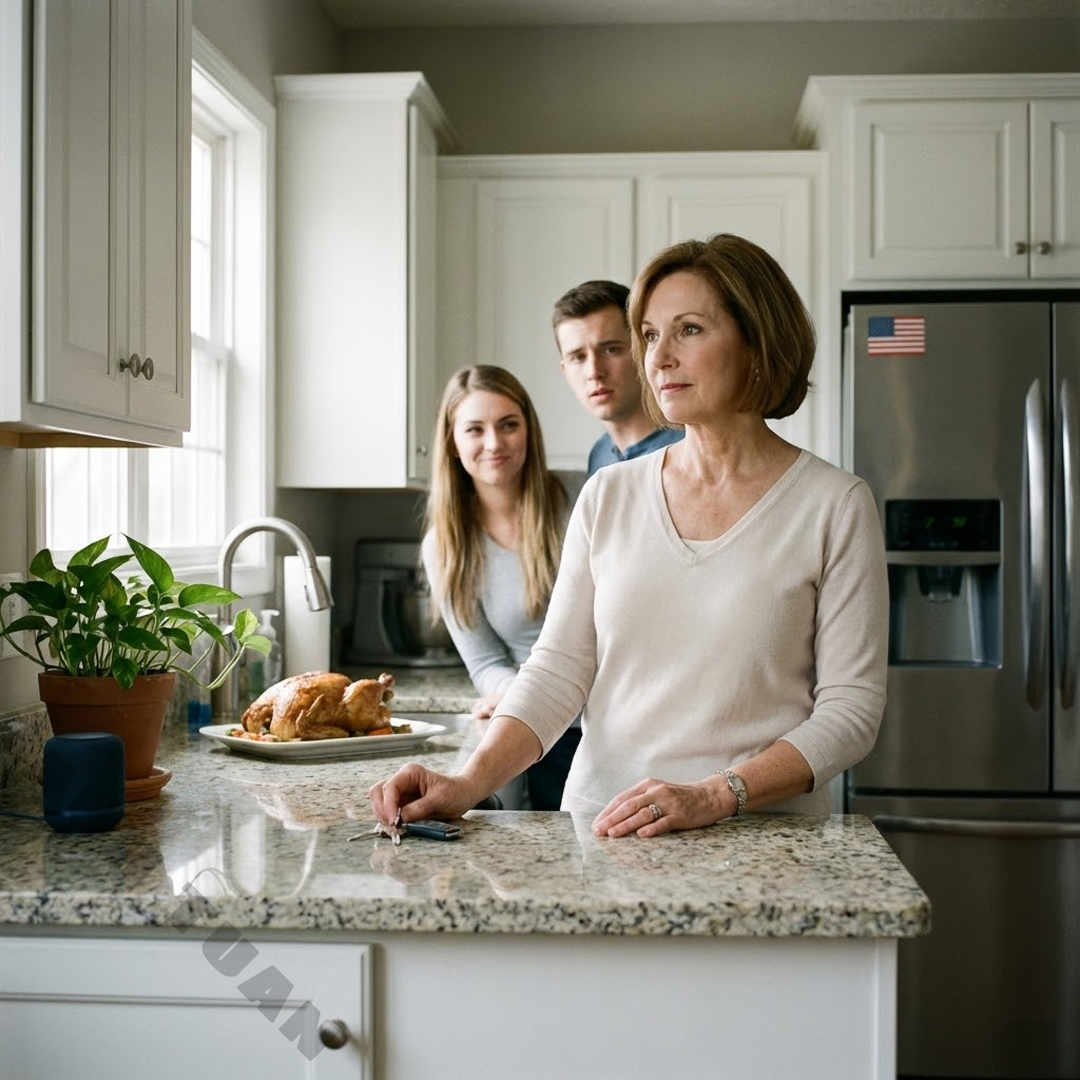
Tonight we’re starting with a dinner party but not the kind where people clink glasses and make toasts that warm your heart. No. This one begins with roast chicken, soft jazz humming from the Bluetooth speaker tucked behind the plant in the corner, and the distinct sound of my heart breaking.
You might not survive what you’re about to hear if you’ve ever felt invisible in your own home.
So before you get too comfortable, take a moment to like the video and subscribe but only if you really enjoy what I do here. Tell me in the comments where you’re watching from and what time it is there. I love knowing whose stories I’m keeping company with tonight.
Now, turn off the lights, maybe get a fan going for some soft noise, and let’s dive into tonight’s journey together.
The night it happened, I was still doing what I’d always done.
Giving.
I had spent the entire morning preparing that roast chicken the same way Aunt Helen taught me slow-roasted with rosemary, garlic stuffed beneath the skin. While it cooked, I ran errands. I vacuumed, polished the silverware, even cleaned the wine glasses with vinegar to make them sparkle, because Maddie liked things to look just so whenever her parents came over.
Not that she told me they were coming.
Again.
I should have known better than to stay.
They were already there when I got back her mother in her usual pastel sweater set, her dad telling some story with too many hand gestures. I came through the side door with a bottle of Merlot I’d brought up from the basement. Something nice. Something older than Maddie, if I’m being honest.
As I placed it on the counter, her mother looked at me not at me, through me like I was a smudge on the glass she hadn’t expected to see.
“And you are?”
I opened my mouth, but Maddie jumped in first, all laughter and high-pitched charm.
“Oh, that’s Caroline,” she said. “Our unofficial maid. Keeps the house running.”
They laughed.
All of them.
Even my son, Ben.
I stood there with the empty bottle still in my hand, trying to keep my smile from slipping. The room went soft around the edges.
You know that feeling when you step off a curb you didn’t see and your stomach drops?
That was my whole body in that moment.
I set the bottle down carefully so carefully, as if noise might break what little was left of my dignity.
Then I turned and walked slowly down the hallway to my bedroom.
Their laughter followed me like a stain.
Ben didn’t say a word.
Not, “That’s my mom.”
Not, “Actually, she owns this house.”
Nothing.
That night, I sat on the edge of my bed staring at the door I’d painted sky blue with my own two hands back when we moved in. I remembered that day: the smell of fresh paint, the excitement, the pride.
My name on the mortgage. My credit. My down payment.
Ben had just finished college. Maddie was new still polite back then.
They had nothing.
I gave them everything.
And now I was the help.
There’s an old saying: people will treat you how you teach them to treat you.
I’d taught them to expect everything from me quietly, gratefully and to give nothing back.
The next morning, I made coffee, fed the cat Maddie always pretended to like for Instagram. She came downstairs in her yoga pants, mid-scroll on her phone. Not even a good morning.
I waited.
Eventually, she looked up and blinked.
“What’s this?” she asked, as I held out the keys.
Every one of them front door, garage, mailbox, even the spare I kept in the planter.
I smiled.
“Good luck paying the mortgage now.”
Her brows pulled together.
“What?”
I didn’t answer.
I walked past her, down the hall I’d painted, past the photos I had framed Ben’s graduation, birthdays, the trip to Lake Erie. They blurred as I passed.
I didn’t take anything.
Not the throw blanket I crocheted. Not the dishes from my mother. Just my purse and the coat I wore when I brought Ben home from the hospital.
He must have heard the door.
He called after me.
“Mom!”
But I didn’t stop.
He followed me into the driveway barefoot, like a kid who just realized the house was on fire. But I kept walking calm, cold not angry, not even sad.
There’s something no one tells you about clarity.
It’s quiet.
It doesn’t make a scene.
It just knows.
And in that moment, I knew I was done.
I didn’t know where I was going.
But I knew where I wasn’t staying.
The last thing I saw in the rearview mirror was Ben standing in the driveway, stunned.
He had no idea what he just lost.
Neither did I.
Not yet.
They say you don’t realize you were drowning until you finally breathe.
That night in Aunt Helen’s tiny apartment on the edge of Dayton, it wasn’t freedom. Not exactly.
It was silence.
Thick, echoing silence the kind that fills your ears and your chest and leaves no room for anything else. The apartment smelled like time: old wood, mothballs, that faint scent of forgotten linen.
I dropped my purse on the chipped kitchen counter and just stood there.
I didn’t cry.
I didn’t smile.
I just stood.
That’s the thing about finally being alone after decades of being ignored. You expect it to hurt. You expect to miss the noise.
But the silence?
It’s a relief.
And that, I think, was the first real breath I’d taken in years.
The next morning, I woke up before the sun. Not because I had somewhere to be old habits die hard. I padded barefoot into the little kitchen with its crooked cabinet doors and mismatched drawer knobs. Everything in that apartment was just slightly off, like it had been rearranged by time.
I made a single cup of coffee black, bitter not because I liked it that way, but because there was no milk, and I couldn’t quite bring myself to go to the store yet.
The heater groaned like an old man with arthritis, spitting out warmth in wheezing bursts. I wrapped myself in the same cardigan I’d worn on nights Ben was sick with the flu, when I used to sit on the edge of his bed counting his breaths.
Now it just smelled like dust and the past.
For the first few days, I moved like a ghost. I slept on the couch because the bed frame in the back room was broken, and I didn’t have the heart to fix it yet. I lived on peanut butter sandwiches and microwaved soup.
I didn’t call anyone not because I had no one, but because no one had called me.
Ben didn’t text.
Didn’t email.
Not even a single, are you okay?
I told myself Maddie had probably told him not to.
Or maybe it was worse.
Maybe he just didn’t care.
I kept thinking about that night the way he laughed when she called me the maid. Not nervously. Not politely.
He’d laughed like it was true.
Like it was normal.
I used to cry in the garage when they’d go out to dinner and leave me home. I’d pretend to be asleep when they came back because it hurt too much to hear them mocking my TV shows the ones I paid for, in the house I bought, with the food I stocked.
All of it.
Mine.
There’s this quirky little fact I read once: when a hermit crab outgrows its shell, it has to leave it behind. Even if it has nowhere else to go, it risks everything because staying would mean being crushed by its own past.
That was me.
Shell-less.
Exposed.
But alive.
I started writing at night in an old spiral-bound notebook I found tucked in a drawer probably one of Aunt Helen’s, the kind I used to buy Ben when he was in middle school. Wide-ruled blue lines.
I wrote in pen because it felt more permanent. More real.
I didn’t write stories not yet.
I wrote truths.
About the night I held him for the first time, convinced the world had finally given me something good. About the time I fixed the water heater by myself and no one noticed. About how I waited every single birthday for him to say, “Thank you, Mom,” and how it never came.
I didn’t plan on telling anyone what I wrote.
It wasn’t for them.
It was for me.
My hands trembled the first time I wrote something honest:
I gave up everything to be his mother. And he gave me nothing back.
That’s not bitterness.
That’s math.
Then, on a Wednesday afternoon, while looking for light bulbs in the upstairs closet, I found it.
The old trunk.
Rusty. Heavy.
The one Aunt Helen used to keep under her sewing machine.
I remembered it from childhood always padlocked, always off limits.
But now the key was taped to the lid, yellowed and brittle.
Inside were papers dozens of envelopes, faded photographs, hospital forms, old handwritten notes and one envelope marked with my name.
Caroline, it read.
“If you’re reading this, it means you came back, and I’m so sorry you had to.”
My hands started shaking.
Inside the envelope was a letter from Aunt Helen, written nearly three decades ago. The pages were delicate, soft, like dried leaves. I unfolded them gently.
She had been a nurse. I knew that.
But what I didn’t know was that she had been working the night Ben was born.
There had been a room change.
Some tag confusion.
A baby switched.
She said she’d raised concerns at the time, but was told it was nothing that everything matched, that she was imagining things. She said she wanted to believe that.
For years, she did.
But then, years later, she found something.
A quiet settlement buried in the hospital’s old files.
A payment to a different family for emotional distress.
The wording was vague.
But Aunt Helen wasn’t.
That wasn’t your child, Carolyn, she wrote.
His name was Ryan Carter.
Your real son.
There was a photograph.
A baby in a blue blanket. No name, no label just a face.
But something about it felt like lightning in my chest.
Not pain.
Something else.
Recognition.
I read the letter three times.
My eyes burned, but no tears came.
I couldn’t process it.
Not yet.
Ben wasn’t mine.
But I’d raised him.
I held his hand at the dentist. I made his Halloween costumes. I scraped together change for his college textbooks. I sat through his piano recital even when he only hit three notes right.
But then maybe that coldness he always gave me wasn’t in my head.
Maybe it wasn’t personal.
Maybe just maybe he felt it, too.
That something was off.
That something never fit.
There’s an old saying Aunt Helen used to mutter when her knees acted up:
Your body knows the truth before your mind does.
I think hearts are the same way.
That night, I sat on the couch until sunrise with the photo in my hand and a thousand thoughts crashing like waves in my chest.
Not rage.
Not despair.
Freedom.
Not because I didn’t love Ben, but because maybe I finally understood why loving him always felt like trying to hold smoke.
And maybe I wasn’t broken after all.
The days after I found Aunt Helen’s letter passed like a dream I wasn’t sure I was supposed to wake up from. I walked around that little apartment like a sleepwalker, never turning on more than one light at a time. Everything felt suspended, like the air was thicker than usual, like I was moving underwater.
I didn’t tell anyone.
Not Ben.
Not Maddie.
And certainly not Ryan Carter the name I now whispered to myself like a secret spell I wasn’t sure I wanted to cast.
There’s a kind of silence that doesn’t feel peaceful.
It feels punishing.
That’s the kind of silence I lived in.
Each morning, I made exactly one cup of coffee. I’d sit at the chipped table near the window, watching the traffic roll by outside delivery vans, school buses, the occasional jogger braving the Dayton chill.
Each afternoon, I’d walk two blocks to the corner store just to feel like I existed. The clerk never asked my name, just nodded as I bought another can of soup or a loaf of bread I’d forget to eat.
In the evenings, I’d light the old candle from the back of the drawer lemon sage, barely any scent left and sit on the couch with the hospital files on my lap.
I read them again and again, looking for loopholes, errors, a missing line that might say: Just kidding. False alarm.
But it was all real.
Ryan Carter had been born the same night as Ben, in the same wing, during a temporary shuffle of rooms due to a pipe leak. His parents Janet and Thomas Carter had received a settlement from the hospital nearly a year later.
Confidential.
Buried.
Aunt Helen bless her soul had made copies of everything before she passed. She must have known I’d come back to Dayton one day. She must have felt something, too.
I grieved that night, but not for Ben.
I grieved for the birthday parties I never threw.
The scraped knees I never kissed.
The books I never read aloud.
The science fair volcano I never helped build.
All the firsts first steps, first crushes, first heartbreaks that belonged to someone else.
It hit me hardest when I imagined Ryan’s first day of kindergarten. I wondered if he cried, if he liked his teacher, if someone held his hand.
And I wondered:
Would I have done it better?
But oddly enough, I didn’t feel hatred toward Ben. I expected to. But no. I loved him not because of DNA or obligation, but because I chose to, even when he didn’t choose me back.
And that’s the worst kind of heartbreak.
The kind where you give everything.
Everything.
And they don’t even see the gift.
One Tuesday afternoon, I finally left the apartment and walked into town. I didn’t know exactly what I was doing until I found myself standing across from a little bookstore tucked between a bakery and a bike repair shop on Main Street.
Carter’s Books, the sign read painted deep green with gold hand-lettering that curled at the edges like ivy.
I knew.
I didn’t need to ask. Didn’t need to Google.
My bones just knew he was inside.
Through the glass, I saw him helping a young woman find a poetry collection. He wore glasses, a neat shirt, and he spoke with a soft voice. He tilted his head slightly when he talked, as if he was really listening.
I couldn’t move.
My knees buckled slightly, so I sat down on the bench across the street. I pulled my coat tighter even though it wasn’t that cold.
My heart was thudding not painfully, but insistently like it was trying to make me listen.
That.
That was him.
Ryan.
The man who should have been my son.
The one who never knew I existed.
I cried right there on the sidewalk. Not loud. Not gasping. Just soft tears that rolled down my cheeks and into the collar of my coat, like they’d been waiting years to be released.
I didn’t go in.
Not that day.
I sat, watched, then went home.
The next day I did it again.
And again.
And the day after.
It became a ritual: coffee in a paper cup, a seat on the bench, a book I never really read.
I watched his world from a safe distance.
I learned his rhythm when he opened the shop, when the deliveries came, the way he smiled at regular customers, the way he adjusted the displays when no one was looking.
I wasn’t stalking.
I was mourning.
Preparing.
Trying to understand who he was.
And somewhere along the way, I started watching Ben and Maddie again, too.
Old habits.
I didn’t reach out, not directly, but Maddie made it easy. She posted on Instagram like it was her job.
Scratch that.
It was her job.
Wellness coaching. Lifestyle branding. Empowered femininity nonsense. I say that with a pinch of salt and a whole spoonful of sarcasm.
Their lives looked perfect.
The house glowed. The wine flowed. The curated smiles. The faux-gratitude posts.
But I saw through it now, and what I saw was fake.
Maddie’s business was smoke and mirrors: rented spaces, fake reviews, borrowed clothes she never returned.
And Ben he’d quit his job six months ago.
“Manifesting his next path,” Maddie had posted.
Translation: unemployed.
They were building a sandcastle and pretending it was a fortress.
So I started a second notebook.
Not emotional. Not poetic.
Just facts.
Dates. Names. Business filings. Property records.
I pulled the deed for the house.
Still in my name.
Maddie had tried to refinance.
Denied.
Ben’s student loans still unpaid.
Credit cards maxed.
They were floating.
And I was the tide coming in.
But I didn’t say a word.
Not yet.
I wrote.
I watched.
I waited.
And I kept going back to the bookstore because Ryan he felt real, even from a distance. And one day I’d tell him.
But not yet.
First, I needed to understand the son I never got to raise before I introduced myself as the mother he never knew he lost.
It was a rainy Thursday when I finally saw him up close.
Closer than the glass window of Carter’s Books.
Closer than the polite bench across the street where I’d become a fixture in my own little ritual.
I hadn’t meant to linger. The rain had come on fast, slicking the sidewalk before I could open my umbrella. I stepped into the recessed entryway of the bookstore just to stay dry.
And then he turned.
Ryan.
He was restocking a shelf near the front biographies, I think and humming something under his breath. Something slow and familiar.
His eyes lifted, met mine through the glass, and he smiled.
Just a quick, casual smile. The kind you offer a stranger. The kind that says: You’re welcome here.
I nodded, trying to return the gesture, but my hands were trembling so badly I fumbled the umbrella and nearly dropped it on my foot. I turned too quickly, bumping my shoulder against the doorframe as I walked away.
I didn’t even make it to the car before the tears came.
I sat behind the wheel with the rain drumming against the windshield and my breath fogging up the glass. My hands gripped the steering wheel so tightly it hurt.
How do you tell someone they were stolen from you?
How do you sit across from a man with a life family, a mother and tell him his beginning was a mistake?
And worse:
How do you explain that he isn’t the one who needs to change anything?
But you do?
I went home and pulled out Aunt Helen’s letter again. Read it for the hundredth time. She had known had suspected from the start. She saw the switch but couldn’t prove it until years later. She’d buried the truth under layers of guilt and silence.
And when she couldn’t say it to my face, she left it for me to find.
The name wasn’t a guess.
Ryan Carter was confirmed.
She’d found the settlement. She’d done the research. She’d done everything except tell me.
And the hospital they never reached out, never informed me.
Because they weren’t supposed to.
A quiet payout to one family. A hope that the other would never ask questions.
But I wasn’t angry at them.
Not yet.
I didn’t even know if I had space left for anger.
I just wanted to know him.
I wanted to understand if the ache in my chest could be soothed by the sound of his voice. If the sharp edges inside me could soften when I heard him laugh.
So I did something that terrified me.
I went back.
This time, I walked in.
I waited until a quiet morning right after opening. The shop smelled like rain and old paper. Soft classical music played in the background. A bell above the door jingled as I stepped inside.
He looked up from behind the counter.
“Good morning.”
His voice was warm familiar in a way that made something inside me ache.
“Hi,” I said, trying to keep my voice steady. “I was hoping to find a copy of The Book Thief.”
“Lucky,” he said, flashing that easy smile. “We’ve got two copies. One’s a bit worn, the other’s a newer edition.”
“I’ll take the worn one,” I said without thinking. “I like books that have lived a little.”
He laughed, and I swear it was the sound I’d been waiting years to hear.
“You and me both,” he said. “There’s something comforting about broken spines.”
He rang it up, placed it in a small paper bag. His fingers brushed mine for a second as he handed it over.
“Enjoy,” he said. “That one’s special.”
I nodded.
“You own the place,” I said.
“Sort of,” he replied. “My parents helped me get it started after they retired. I do most of the day-to-day now.”
Of course they helped.
Of course he had parents who invested.
Not like Ben who let me bankroll his life and then handed me over to Maddie like I was part of the furniture.
Ben had me but never wanted what I gave.
Ryan had them and somehow still ended up kind.
I walked out holding that bag like it contained gold.
Back at the apartment, I opened the book and found a small note inside the front cover:
For the reader who still believes in redemption.
His handwriting.
I didn’t cry this time.
I smiled.
And I went back.
Not every day just enough that it became a rhythm. Sometimes I bought a book. Sometimes I just browsed.
Ryan began to recognize me.
“Back again,” he’d say with that half-curious, half-amused smile.
We made small talk about the weather, local events, coffee shops, the jazz trio playing downtown. He told me he hated wind chimes, but loved thunderstorms. Said he was working on a blog post about forgotten memoirs.
I said I liked books that felt like confessions.
“Me too,” he said. “You remind me of someone.”
I tilted my head.
“Who?”
He squinted, thought about it. “Maybe a librarian I had once. Or someone from my mom’s church group. I don’t know.”
I smiled.
“Maybe.”
But inside, I felt it the echo of something real. The beginning of a thread between us.
And in the shadows of that sweet, strange connection, the rest of my old life was beginning to fray.
Ben sent me a message.
After three weeks of silence, that’s what I got.
Mom, are you okay?
I didn’t reply. I wasn’t angry. I just didn’t have the energy to pretend I believed his concern.
Instead, I started digging deeper.
I looked into the house still legally mine.
Maddie had failed to refinance. She’d tried, but with no income of her own and a collapsing business, she didn’t have the credit or the cash flow.
They were struggling badly.
And I could have ended it all with a single phone call.
But I didn’t.
Not yet.
Because this wasn’t about revenge.
This was about reclamation.
Every night I wrote in my second notebook the one with tabs and Post-it flags and color-coded dates.
This wasn’t grief anymore.
It was a plan.
And while they lived their curated Instagram life on borrowed time, I was building something real.
Not just for me.
For him.
For Ryan the son I never knew.
The one who might never call me Mom, but who, without even knowing it, already saw me more clearly than Ben ever had.
There’s a strange thing that happens when you stop fighting to be seen.
You start noticing everything.
After that rainy Thursday, I walked into Carter’s Books like it was a church. Not for prayer exactly for reverence. For truth.
And slowly, without meaning to, I became part of the furniture. The kind people liked.
Ryan never questioned why I kept showing up. He just began greeting me with a familiarity that made my heart ache in all the best and worst ways.
“Morning,” he’d say, tapping the counter softly. “You’ve got good timing. We just got something I think you’ll love.”
Sometimes I did love it.
Sometimes I bought something I’d never read.
It didn’t matter, because I was watching him and learning him.
He had a calm about him that you can’t fake the way he listened when customers spoke, the way he offered suggestions that were never pushy, always thoughtful, the way he wore his quiet like a well-tailored coat.
The first time I saw him laugh really laugh it caught me off guard. An elderly man had asked for a mystery book without too much murder.
Ryan grinned and said, “Uh, so you’re looking for suspense with a soft touch.”
Cozy danger.
The man chuckled.
And Ryan did, too a warm, full laugh that made the backs of my eyes burn.
Ben never laughed like that.
Not with me.
Not unless Maddie was watching.
I remember once baking an entire strawberry tart for Ben’s birthday. He had one bite and said it was too sweet. Maddie laughed and called me cute for trying.
I laughed too, of course, because that’s what you do when you’re trying not to cry at your own table.
Ryan never made me feel like that even without knowing who I was.
One day, I finally sat down at the little café next door. Ryan came out for his lunch break and spotted me by the window.
“Mind if I join you?” he asked.
“Not at all,” I said, hoping my voice didn’t betray the thunder inside me.
He ordered peppermint tea and a turkey sandwich.
I ordered nothing.
I just wanted to sit near the warmth of something I hadn’t felt in years.
We talked about books mostly, then about life. He told me he almost became a teacher, but bookstores
“They feel more personal, I guess,” he said. “Less bureaucracy. More heart.”
I smiled. “You seem like the kind of person who’d be good at both.”
He looked at me for a second. Just looked.
“You remind me of someone,” he said again, more softly this time. “But I still can’t figure out who.”
“Maybe a librarian,” I offered again, keeping my voice light.
He chuckled. “Maybe.”
That moment stayed with me for days, because I didn’t just like him.
I recognized him.
Not just from the photo in Aunt Helen’s letter, not just from the DNA report tucked in my nightstand in the way he moved, the way he noticed small things, the way he held silence like it was sacred.
That was me.
That was us.
It was in the posture, in the pacing, in the way he sat slightly sideways when he was thinking, like his thoughts took up more room than his body.
I went home that night and dreamed of a different life.
One where he grew up in my house.
One where I packed his lunchboxes and sat in the bleachers at his soccer games.
One where I brushed the hair from his forehead after a fever broke and he called me Mom with sleepy eyes.
The ache in my chest felt less like a wound and more like a scar now still tender, but healing.
Meanwhile, back in the curated world of Maddie and Ben, things were cracking.
Ben sent another text.
Mom, Maddie’s stressed. Can we talk?
That was his idea of an apology.
A stress warning.
No I’m sorry.
No I miss you.
Just a request like I was a utility bill that needed resolving.
I didn’t answer, but I started looking deeper.
I pulled up the house deed again.
Still in my name.
Maddie had tried refinancing twice now both denied. Ben’s name wasn’t even on the loan.
They’d been living in a fantasy, and the lease on that fantasy was running out.
That’s when I met her my lawyer.
Her name was Maria.
Late fifties. Firm handshake. No nonsense.
She didn’t blink when I told her the story.
“Let’s file the motion this week,” she said after a long pause. “You’ve got every right legally, ethically.”
I signed the paperwork with a steady hand.
That night, I walked past the old house. Dayton was quiet in that early-evening kind of way just the sound of lawn sprinklers and cicadas.
Somewhere in the distance, the porch light was on. Maddie sat on the swing, scrolling her phone, a glass of wine in one hand like always. Through the window I could see Ben on the couch, controller in hand, some video game flickering across the screen.
They had no idea.
None.
And I didn’t feel vindictive.
I didn’t feel smug.
I felt still like the eye of a storm I had once been trapped in.
They didn’t know the ground was already shifting beneath them, that the woman they dismissed was the one holding the floor steady all this time.
I didn’t slam doors.
I didn’t shout.
I just kept walking.
There’s a debate I’ve seen tossed around in forums whether justice is best served cold or hot.
Me?
I think it’s best served silent.
And the first domino had already fallen.
The notice was sent at exactly 8:02 a.m. on a Tuesday. Maria had it delivered by courier a neat white envelope with my name, the legal name on the house deed, stamped clearly across the top.
Inside, the paperwork was precise. Bulletproof.
Thirty days to vacate.
The property was being listed for sale.
Ben called within the hour. I watched the screen light up his name still saved as Ben. Home made my heart twitch in a way I hated.
I let it ring once, twice, then flipped the phone over on the table and left it there, screen down.
He left a voicemail.
“Mom, what are you doing? Please call me. Maddie is freaking out.”
Of course she was.
The mortgage was still in my name. The refinances had failed. The coaching empire she built on borrowed quotes and stock photography had no real foundation.
I made tea just a little honey, just enough to dull the bitterness. I stirred it slowly and sat by the window watching the street outside, calm as a cat in the sun.
Later that day, another voicemail came this time from Maddie.
Her tone was clipped, trying to be professional, but cracking at the edges.
“Caroline, we need to talk. This is clearly a misunderstanding. Ben says you’re going through something and we’re trying to support you, but you’re jeopardizing our lives here. This isn’t fair.”
I listened to it twice.
She said our lives.
She didn’t say your house.
She didn’t say your sacrifice.
Fair.
That word rattled around in my brain like a loose screw. The woman who turned me into a servant in my own home was now pleading fairness.
That night, I sat on the couch with the apartment dark except for one lamp. I pulled out my second journal the one I used for evidence, for strategy and wrote the word FAIR in big letters across the top of the page.
Then I underlined it three times.
The next day, Ben showed up at the apartment.
I saw him through the peephole hair messy, dark circles under his eyes, jacket half-zipped like he hadn’t slept. He knocked gently at first.
Then again.
“Mom,” he called softly. “Please don’t do this.”
I didn’t answer.
I stood just behind the door, hand resting on the knob, but not turning it.
Let him sit in the silence.
Let him feel what it’s like to knock and not be heard.
Let him live what I had lived for years.
He left after ten minutes.
Maria called later that week.
“It’s official,” she said. “The house will be listed this weekend. Full profit to you.”
I could hear the satisfaction in her voice. She didn’t say it, but I could tell she was proud.
I was too.
Maddie tried to fight it. Claimed she had contributed. Claimed her brand had increased the home’s value.
Maria didn’t flinch.
“Let her try to prove it in court.”
She couldn’t.
Because Maddie had built everything with smoke and selfies, and now the world saw through it.
Word got out.
Dayton’s small enough that you don’t need a newspaper for news to travel.
Maddie’s Instagram went quiet. The story posts stopped. The morning matcha routines disappeared. Even her carefully filtered quotes about rising strong and energy alignment couldn’t save her.
Her last workshop canceled.
Her website under maintenance.
And then the cherry on top:
An old neighbor texted me out of nowhere.
Hey, saw Maddie’s mom storming out of your house yesterday. Red in the face, screaming into her phone. Everything okay?
Oh, I thought.
More than okay.
Whatever happened behind that door, it wasn’t rehearsed and it definitely wasn’t filtered.
Ben called again that night. I didn’t answer. He left another voicemail.
“Mom, did you send them something? Maddie’s parents? They think we lied about everything. They think we forged the business docs. I don’t know what’s happening. Just please call me.”
I didn’t reply.
Because what was there to say?
He had spent years defending a woman who humiliated me.
Now he was living in the fallout.
And me?
I was still visiting Carter’s Books.
Ryan had no idea what was unfolding on the other side of town. His world moved at a quieter pace, more grounded. He greeted me with the same warmth every time I came in.
No judgment.
No questions.
One afternoon, he let me help him catalog a new shipment.
“You should work here,” he joked. “You’re here more than I am.”
I smiled. “Maybe I will.”
We sat on the floor surrounded by books some dusty, some fresh. He read aloud back covers in dramatic voices, trying to make me laugh.
And he succeeded.
“Why do you come here so often?” he asked eventually, softly.
I froze for a moment, then said the truth.
“I like how it feels in here. Like nothing’s pretending to be something it’s not.”
He tilted his head, considering me.
“Me too.”
And just like that in the quiet of a bookstore in Dayton, Ohio, with the scent of paper and coffee in the air something clicked. A thread pulled tight.
Not a full connection yet.
But something close.
A whisper of familiarity neither of us could name.
I still hadn’t told him.
Not who I was.
Not why I was there.
But I would soon.
Because now the other part of my life the part with Maddie and Ben was burning itself down without my help.
And when the ashes cleared, I was going to rise out of it with something I never had before.
Not revenge.
Not rage.
Clarity.
And maybe just maybe a chance to begin again.
I’ve always believed that silence is more powerful than noise. You can scream your truth until your throat goes raw and no one will listen.
But silence?
Silence makes people nervous.
Silence is unsettling.
It’s the moment before the thunder the weight of something coming that you can’t stop.
That’s exactly what Ben and Maddie were sitting in now, and they had no idea just how loud my silence was about to become.
The official listing went live on a Friday morning. I didn’t check the real estate site myself. Maria sent me the link with a simple message:
It’s done.
Photos of the house flooded the page the kitchen I renovated, the living room where I once rocked Ben to sleep, the backyard where I planted those hydrangeas Maddie once ripped out because they weren’t “the aesthetic.”
I didn’t cry.
I didn’t save the photos.
I just closed the tab.
By noon, Maddie posted one of her last attempts at control: a perfectly filtered photo of herself in the doorway, mug in hand, barefoot on a white rug I had vacuumed a hundred times.
The caption read:
Sometimes the universe makes space for your next level by taking away what no longer aligns. Trust the shift.
Oh, Maddie.
It wasn’t the universe.
It was me.
And the shift was just beginning.
The next morning, my lawyer texted again.
Offer came in above asking.
That house the one they claimed as their own, the one they laughed in while mocking me at the dinner table was about to be someone else’s.
I didn’t feel triumphant.
I didn’t feel cruel.
I felt free.
Meanwhile, I kept showing up at the bookstore. Ryan and I had begun to form something that felt like the slow unfolding of spring after a long, punishing winter. Not obvious. Not dramatic.
Just real.
He’d wave when I walked in. Sometimes we’d chat. Sometimes we wouldn’t.
It didn’t matter.
The silence with him never felt like absence.
It felt like understanding.
One rainy afternoon, I was browsing the memoir section when he appeared beside me.
“You always go for the ones with the saddest spines,” he said.
I raised an eyebrow.
“Is that a diagnosis or an observation?”
He laughed.
“Both.”
We sat at the little café next door again. He talked about a book club he was hoping to start something small, local.
“I want it to feel like community,” he said, “not obligation. Like a room full of people who aren’t trying to outsmart each other.”
I said, “Exactly.”
There was a long pause.
Then he said, “You remind me of someone in my family. I still can’t place it, but there’s something in your voice.”
I didn’t know what to do with that, so I looked out the window. The rain slid down the glass like soft street tears.
“You ever feel like your life could have taken a completely different shape?” I asked.
Ryan nodded.
“All the time.”
We didn’t say much after that, but something settled between us. Not truth not yet but closeness.
A thread connecting two people who didn’t know why they felt familiar.
Only that they did.
At night, I boxed up old photos.
Ben as a baby.
His first lost tooth.
A Halloween costume I stayed up all night sewing because he wanted to be a velociraptor and Target didn’t sell one in his size.
I didn’t throw them out.
But I did put them away.
Because the woman who clung to those memories the one who baked the birthday cakes, who never sat down during dinner, who accepted silence as gratitude
She wasn’t here anymore.
In her place stood someone they never expected.
Someone they never should have underestimated.
And while I packed up memories, Maddie’s world began to crumble.
Her website quietly disappeared.
Her last retreat was canceled due to “scheduling conflicts.”
Followers noticed.
Comments started piling up.
Are you okay?
Why are sponsors pulling out?
I signed up for your January package and haven’t heard back.
Then someone dug deeper.
The local blogger who covers Dayton’s lifestyle scene posted a quiet, vague article about influencer fraud and questionable brand practices. She didn’t name names, but Maddie was no longer safe behind filters.
Her parents stopped commenting on her posts.
And Ben?
He faded into the background exactly the way I used to.
The last voicemail I got from Maddie was clipped and cold.
“You’re really going to throw away your family for what? A house? Money? You’ll regret this. People like you always do.”
But she was wrong.
I hadn’t thrown away my family.
They had let go of me a long time ago.
I just stopped holding on.
The day the for-sale sign went up, I didn’t drive by. I didn’t need to.
A friend texted me a photo anyway.
The sign stood bright and new in front of the house, the hydrangeas blooming defiantly on either side. Beneath it, in Maddie’s signature cursive, a cardboard sign read:
Manifesting a new beginning.
Sure, Maddie.
Whatever helps you sleep.
That night, Ryan and I talked about grief. Not directly not like, Hey, what are you grieving today? but the kind of conversation that knows it’s about loss without saying the word.
He recommended a memoir.
“It’s about grief,” he said, “but also forgiveness. The kind that takes years.”
I swallowed the lump in my throat.
“You think I’d like it?”
He looked at me more serious than usual.
“I think you’d understand it.”
I took the book home and set it on the nightstand.
Didn’t read it.
Not yet.
Because I wasn’t done grieving.
And I definitely wasn’t ready to forgive.
At least not Maddie.
Not Ben.
But Ryan?
Ryan didn’t need forgiveness because he hadn’t taken anything from me. He’d just been lost, same as I had.
And now maybe we were both beginning to find each other in the shelves of a bookstore in Dayton, Ohio not because we were owed anything, but because we chose to look.
The weather was shifting again that in-between time in Dayton when fall starts to tug on summer’s sleeve. The kind of days where the air smells like wood and wind, and the sun feels like it’s holding back just a little.
I kept visiting Carter’s Books. Not every day now, but often enough that I didn’t need to say anything when I walked in. Ryan would nod, maybe hold up a book, maybe just offer a smile.
There was something in the air between us that didn’t need naming.
One afternoon, I arrived just as he was restocking the local authors’ shelf.
“Back again,” he said without looking up. “You really should let me set up a tab.”
I laughed. “You’d regret it. I’m a dangerous kind of reader.”
He smiled.
“The best kind.”
We spent an hour reorganizing the display. I didn’t offer. He didn’t ask.
We just did it.
At one point, he handed me a hardcover and our fingers brushed again just like that first time. I caught his eyes flicking to mine for a moment longer than usual.
There was a rhythm to our conversations now banter and silence, familiarity and restraint. He’d mentioned his parents in little stories: his mom’s addiction to crossword puzzles, his dad’s love of terrible puns. I’d nod and listen, biting back the words I wanted to say.
That should have been me.
But I never said it.
Not yet.
Because I didn’t want to steal something that belonged to him. I didn’t want to crash into his life with revelations and wreckage.
I just wanted to know him.
And if that meant helping alphabetize short stories while sipping peppermint tea, then that’s what I’d do.
Meanwhile, across town, Ben and Maddie were falling apart.
I didn’t need to be there to see it. I had my sources old neighbors, mutual friends, even the town Facebook group Maddie used to dominate with her curated event invites and sponsored product shout-outs.
Now?
Radio silence.
One neighbor posted a cryptic message:
Crazy how fast people can go from influencers to invisible. Watch who you build your house of cards with.
Another commented:
Reckon the mortgage fairy stopped showing up.
I didn’t smile.
Not really.
But I did feel something small and sharp loosen in my chest like a thread had finally snapped, one that had been tugging at me for too long.
And that’s when I called Maria again.
“I’m ready,” I told her. “List the house. No extensions. No renegotiations.”
She didn’t hesitate.
“I’ll draft the final documents today.”
That evening, I walked through my old neighborhood not as a ghost, not to haunt it. Just to say goodbye.
I passed the park where I used to push Ben on the swing, his little legs kicking the air like he could fly. The grocery store where I’d count coupons at checkout just to afford his favorite cereal. The elementary school that still had the same mural I painted for the winter carnival fundraiser.
None of it hurt the way I thought it would.
Because grief is funny that way.
It softens when you’re not looking.
Back at the apartment, I pulled out my old notebook the one with the hard truths. I opened to a fresh page and wrote:
I gave everything I had to a family that never looked back. But now I’m choosing something else.
Not payback.
Not punishment.
Peace.
And for the first time, I believed it.
A few days later, Ryan and I had coffee again. He was in a good mood. He’d just gotten approval for a small grant to host a series of author talks in the store.
“You should come,” he said, stirring sugar into his tea. “It’s nothing fancy, but I think you’d like it. First is a local woman who wrote about starting over after a divorce.”
“I’m familiar with that theme,” I said.
He grinned. “Most of Dayton is.”
We laughed, and it was easy softer now.
Then he said, “You ever write?”
I blinked.
“A little,” I admitted. “Mostly just for me.”
“You should publish something,” he said. “Stories like yours matter.”
I looked down at my cup.
“Maybe one day.”
The truth was, I had written more in the last three months than I had in the last thirty years pages and pages of grief, clarity, and everything in between. It wasn’t just about Ben and Maddie. It was about being erased slowly, quietly, and what it meant to take the pen back and start over this time on your own terms.
Ryan reached into his satchel and handed me a folded flyer.
“Here,” he said. “In case you change your mind.”
I slipped it into my bag without reading it, because just sitting with him like this two people building something without a name was enough.
Meanwhile, back at the house, the clock was ticking. The closing date had been set. Ben and Maddie had exactly nineteen days left to pretend the walls weren’t caving in.
A friend told me they’d stopped answering the door. That Maddie’s parents had pulled their financial support. That Ben had been spotted applying for jobs at a local tech store, looking lost.
I didn’t check.
I didn’t follow up.
I just added a note to my journal:
Collapse confirmed.
There’s a kind of pride that grows slowly when you finally learn to love yourself more than you loved their approval.
And I was growing into it.
One afternoon, as I left the bookstore, Ryan called out to me.
“Hey,” he said, wiping his hands on a cloth. “You ever think about working here, even part-time?”
I stared at him.
“Are you serious?”
He shrugged. “I could use the help. You already know the inventory better than I do.”
I smiled.
“Maybe. I’ll think about it.”
He looked at me then not just a passing glance, but like he saw something there.
Something solid.
And for once, I didn’t feel like a ghost drifting through someone else’s life.
I felt seen.
The woman who once stood invisible in her own kitchen was gone.
And in her place stood someone with her name back, her voice back, her story back and a new chapter waiting just behind the shelves.
I never thought reclaiming a house would feel like reclaiming a life.
But the day the final documents came in sealed, signed, and satisfying I stood in the middle of the apartment holding a manila envelope like it was a golden ticket.
Maria had included a sticky note in her no-nonsense scrawl:
Sale finalized. Funds released. You did it.
I stared at the check for a long time.
It wasn’t just money.
It was every unpaid hour, every ignored sacrifice, every thankless chore, every forgotten birthday, every time I smiled through an insult to keep the peace.
It was the physical proof that my labor had always had value whether they acknowledged it or not.
That night, I lit the good candle. The one I’d been saving for no reason. I made dinner that wasn’t from a can. And I played jazz, soft and steady, like background music for a movie where the main character finally realizes she doesn’t have to earn her own worth.
Ben didn’t call that day.
Maddie didn’t email.
But I knew they knew.
The house had officially changed hands. The new owners would move in next week. And Maddie’s entire online presence went silent, as if the Wi-Fi had gone out on her perfectly filtered life.
My phone buzzed once.
An old neighbor texted:
They’re moving out. Box by box. Looks like the end of a very curated chapter.
I didn’t respond.
I just closed my phone and returned to my tea.
I’d already said my goodbyes.
The day the moving truck pulled up, I didn’t go by the house. I thought about it, but something in me resisted.
I didn’t need to see the fall.
I’d lived the slow collapse long enough.
Instead, I walked to the bookstore.
Ryan was at the counter, fiddling with a small wooden sign.
“Hey,” he said without looking up. “I was hoping you’d come in today.”
“Why is that?” I asked, stepping closer.
He turned the sign toward me.
It read:
AUTHOR SPOTLIGHT CAROLYN WALKER
I blinked.
“What is that?”
“You left your notebook here the other day,” he said casually. “I read a few pages. You’ve got a voice.”
My stomach dropped.
“You read it?”
He raised both hands. “Only the first few entries. I wasn’t snooping just curious. You left it under the register.”
I felt my face flush.
“It’s… it’s not finished.”
“Then finish it,” he said. “You’ve got something important to say.”
I didn’t know what to say back. I had written those words in the quiet, in grief. They weren’t meant for the world. They were meant to keep me standing when I had nothing else.
But maybe maybe that was exactly why they mattered.
That afternoon, we sat in the back corner of the store with cups of coffee. The rain came down in soft waves, blurring the windows like watercolor.
“I’ve been thinking about how we met,” Ryan said.
“Yeah,” I said. “Feels like one of those quiet accidents that ends up meaning something.”
I smiled. “I like quiet accidents.”
He looked at me, really looked.
“You’ve got a strength I don’t see very often. The kind that doesn’t need to announce itself.”
“Comes from years of not being heard,” I said softly.
“I hear you,” he replied.
I had to swallow hard to keep from crying.
The house was gone.
Ben and Maddie were officially out of my life. The past packed up in boxes I no longer carried.
And here I was sipping coffee with the son who didn’t know he was mine offering me kindness without even realizing what it meant.
Some people talk about destiny like it’s dramatic thunder, lightning, fireworks.
But I think it’s more like this:
A bookstore.
A storm.
A cup of coffee between two people who never meant to find each other.
But did.
That night, I pulled out my laptop the new one I bought with a sliver of the sale. Nothing fancy. Just sturdy. Reliable.
And I began typing.
Not just entries.
Chapters.
The story of a woman who gave until she vanished.
Then slowly quietly took it all back.
Not with rage.
With truth.
With silence.
With the kind of strength no one sees coming.
Meanwhile, Maddie’s downfall continued. An anonymous email had gone out to her former sponsors a neat PDF file filled with business inconsistencies, fake invoices, and screenshots of rented spaces she claimed were owned.
I hadn’t sent it.
But I had mailed something.
A slim packet to her parents’ address. No return name, just a sticky note on top:
Everything you think you know is performance.
Two days later, Maddie’s mother was seen leaving the apartment complex they’d landed in, shouting into her phone face red, purse swinging like a wrecking ball.
What happened inside those walls wasn’t my business.
I’d already reclaimed what mattered.
And more importantly, I’d let go of what didn’t.
Later that week, Ryan invited me to a poetry night he was hosting.
“I’m terrible at poetry,” I said.
He smiled. “Then you’re probably the best kind of audience.”
The shop was lit with candles and old floor lamps. A local college student read a piece about surviving the first year after her mom died. An older man recited something about peeling oranges and regret.
I sat in the corner taking it all in.
Ryan stood up at the end to read something of his own, but before he did, he looked at me just for a second and I felt it again.
That thread.
That not-quite-yet, but maybe soon feeling.
Back at the apartment that night, I wrote until dawn about Ben, about Maddie, about Ryan, and about the woman I used to be. The one who set tables. No one thanked her for. Who bit her tongue until it bled.
She wasn’t a ghost anymore.
She was an author.
I always thought heartbreak would come like a sudden blow some spectacular, unmistakable crash. A door slammed. A betrayal shouted. A cut you could point to.
But I was wrong.
Heartbreak, it turns out, can arrive quietly drip by drip like water through a cracked ceiling. You don’t notice it until the damage is already done, until the wallpaper peels, until the floorboards swell, until the ceiling caves in, and suddenly you’re standing in the wreckage wondering how you didn’t hear it coming.
That’s what it felt like when Ben finally showed up.
It was late afternoon, the kind of soft overcast day where the clouds hang low and even the birds seem hesitant to make noise. I had just poured a second cup of tea and was halfway through typing a new chapter when I heard it.
A knock.
Three soft wraps on the door.
Hesitant.
Careful.
I stood up, walked slowly to the door, and checked the peephole.
Ben.
He looked like a man unraveling his hair unkempt, his face hollow. His shirt looked like it had been pulled from the bottom of a laundry pile. He stood there with his hands in his pockets, rocking slightly on his heels.
I hesitated.
Then I opened the door.
“Mom,” he said, his voice catching. “Can I come in?”
I didn’t answer.
I just stepped aside.
He walked in like someone unsure if he was still welcome. He looked around the small apartment the worn armchair, the tea-stained mug, the stack of books on the side table, the scent of lemon balm from the candle.
He didn’t say anything for a long moment.
Then, finally, he asked, “Why are you doing this to us?”
I sat down, folding my hands in my lap.
“To you,” I repeated slowly. “Ben, I’m not doing anything to you. I’m doing something for me.”
He exhaled harshly.
Ben exhaled hard, running a hand through his hair.
“You’re selling the house,” he said, voice rough. “The only place I’ve ever lived. You just… gave it away.”
I stared at him.
“No,” I said. “I took it back.”
His eyes dropped to the floor. “I thought it was ours.”
My voice went steady not cold, just firm.
“You let your wife turn me into your maid. You watched it happen. You laughed when she mocked me in front of her parents. You stood there while I was erased from the life I built.”
He opened his mouth, then shut it again.
“I thought you were just being dramatic,” he mumbled. “I didn’t know it hurt you like that.”
I shook my head.
“That’s the problem, Ben. You didn’t know. You didn’t ask. You just assumed I’d keep being the quiet background to your curated life.”
He looked like he wanted to argue, to explain, but all he did was pace the room, tension rolling off him in waves.
“Olivia,” he started then stopped himself, correcting. “Maddie… isn’t who I thought she was.”
“That’s not news to me,” I said, folding my arms.
He finally met my eyes. There was something there I hadn’t seen in years.
Vulnerability.
“I lost everything,” he said.
I shook my head.
“No, Ben. You gave it away.”
He sat down heavily across from me, suddenly small like the little boy who once clung to my leg on the first day of preschool.
Except now, I didn’t feel the need to comfort him.
I watched as he tried to find his words.
Then I stood and walked to the kitchen drawer. I pulled out the envelope the one with Aunt Helen’s letter, the DNA results, the hospital files. I held it in my hand and felt the weight of it: years, truths, consequences.
“I’m going to tell you something now,” I said quietly. “And I need you to listen.”
He nodded, unsure.
I handed him the envelope.
“These are your birth records. Read them.”
He opened it slowly. His brows furrowed, confusion blooming across his face, and then he read and read and read.
The color drained from his cheeks.
He looked up at me, eyes wide.
“This… this isn’t real.”
“It is.”
He swallowed. “You’re saying I’m not your son.”
“I’m saying I didn’t give birth to you,” I said. “But I raised you. I loved you, even when you didn’t love me back.”
He sat frozen. Then, in a whisper:
“So… who is your real son?”
I didn’t answer.
His eyes scanned the papers again, fingers trembling.
“I don’t know who I am anymore,” he whispered.
I stood straighter.
“Now you know how I felt for years.”
He didn’t cry. Not really. But something in him broke. I saw it the collapse behind his eyes, the moment the ceiling gave out and the water rushed in.
I didn’t feel victorious.
I didn’t feel cruel.
I felt done.
I walked him to the door.
He turned back, eyes glossy. “Can we fix this?”
I met his gaze, steady.
“I don’t know,” I said. “But it’s not my job to try anymore.”
Then I closed the door.
Not hard. Not soft. Just enough.
For the first time in my life, I wasn’t the one holding it open.
That night, I sat at my desk and stared at the cursor blinking on the screen. I typed:
Some truths don’t shatter the world. They uncover it.
Then I closed the laptop and poured myself a glass of wine not to numb anything, just to mark something.
The end of pretending.
The beginning of whatever came next.
Outside, the wind picked up. The trees rustled like a whisper through the dark. And inside, I sat still in the silence no longer afraid of it.
Because silence doesn’t scare me anymore.
Not when I know what it cost me to earn it.
It took me three days to decide how I was going to do it.
I practiced the words in the mirror, whispering them like spells I couldn’t quite finish. In the car, at the grocery store, even in the shower, I spoke fragments of truth to myself.
I’m your mother.
There was a mistake.
You’ve lived a life that wasn’t meant for you, and so have I.
But every time I got close to the whole truth, my throat closed.
How do you say something that could shatter someone’s foundation?
How do you give someone the kind of truth they never asked for?
Still, I had to try.
Ryan was in the bookstore like always. The same soft music played in the background classical piano today. The windows let in golden September light that stretched in long beams across the hardwood floor. Dust floated in the glow like little echoes of stillness.
When he saw me, he smiled.
“You came at the right time. We just got a new batch of rare poetry editions.”
I swallowed.
“Actually… I came to talk.”
Something in my voice made him pause. His expression softened.
“Sure,” he said. “Come on back.”
He led me through a side door to a tiny break room microwave, old kettle, secondhand couch that sagged in the middle. The scent of peppermint tea and paper, comforting and unassuming.
We sat.
I took a deep breath. My hands were shaking, so I laced them together to still them.
“I’ve been coming here for a reason,” I said.
“I figured,” he said gently. “You’re not exactly here for the books.”
I laughed a short, sad sound.
“No,” I admitted. “I’m not.”
I reached into my bag and pulled out the envelope. The same one Ben had read, but this time I’d added a note in my own handwriting.
This changes everything, but it doesn’t have to ruin anything.
Ryan’s eyes flicked to it. His voice went cautious, but not unkind.
“What’s this?”
I placed it on the table between us.
“Something that’s going to change your life,” I said.
He didn’t reach for it immediately. He looked at me, searching my face like there was an answer he didn’t have the question for yet.
I began slowly.
“Some years ago, I gave birth to a baby. But I didn’t take him home.”
His brows knit together.
“There was a mistake at the hospital. Two babies switched. Mine was given to another family, and I raised a child that wasn’t mine.”
I paused, the words tasting like metal.
“I loved him with everything I had,” I said. “But he never really saw me.”
Ryan was perfectly still.
“I’m not telling you this to take anything from you,” I said. “I don’t want your life. I just… I needed you to know the truth.”
He reached for the envelope, opened it, pulled out the pages. His fingers were careful respectful. He read Aunt Helen’s letter first, then the hospital report, the DNA result, the timeline I’d pieced together with shaking hands and sleepless nights.
When he finished, he set the papers down.
But he didn’t speak.
I watched his chest rise and fall. His hands trembled slightly where they rested on his knees.
“This is a lot,” he said finally.
“I know.”
“And you’re… Carolyn,” he said, eyes lifting. “Carolyn Walker.”
I nodded. “I raised a son named Ben. But you’re the one I gave birth to.”
He looked down at the table, then back at me.
“I don’t feel anything,” he said. “Not yet.”
“You don’t have to,” I told him. “There’s no right way to feel this.”
He nodded slowly.
“I have parents,” he said. “They raised me well.”
“I’m not here to ask you to replace them,” I said. “I’m not trying to claim something that’s already yours.”
He studied me for a long moment.
Then he asked softly, “Why now?”
“Because I couldn’t live with the silence anymore,” I said. “Because the truth deserves to breathe.”
He leaned back on the couch, exhaling hard.
“I don’t know what to do with this.”
“I don’t either.”
We sat like that two people with a thread now visible between them, no longer hidden in the knots of circumstance.
After a long pause, he said, “I don’t hate you.”
Tears welled up in my eyes.
“That’s more than I expected,” I whispered.
He stood and paced slowly. His movements were tight, contained, like a man trying to find the edge of a new map.
“You didn’t have to come,” he said.
“But you did.”
“I didn’t know how not to.”
He looked at me again, something shifting in his expression less confusion, more clarity.
“Can we take it slow?” he asked. “I don’t want to make this something it’s not.”
“I wouldn’t ask for anything else,” I said.
He nodded, then managed a small, fragile smile.
“You want to stay for tea?”
I let out a breath I hadn’t realized I was holding.
“I’d love to.”
We didn’t talk about the envelope again that day. We talked about books, about the fall weather, about how he hated the sound of wind chimes but loved the feel of rain hitting the roof.
And though the truth still sat between us raw, trembling, unopened in all the ways that mattered, something else had started.
Not a relationship. Not yet.
But maybe the faintest flicker of something new.
A beginning not born from biology, but from bravery.
By the time I left, the light had changed. The air was cooler. And for the first time since I read Aunt Helen’s letter, I didn’t feel like I was carrying the whole weight alone.
Because now we carried it.
And somehow, that was enough.
By the time autumn rolled in for real, the trees in Dayton had turned to fire reds and golds painted the sidewalks, and the air smelled like woodsmoke and apples. Change was everywhere outside, inside, around me.
But for once, I wasn’t resisting it.
I was walking with it.
The house sold faster than I expected. Full asking price, all in my name. Every cent came to me.
Ben and Maddie were given thirty days to vacate. No extensions, no renegotiations just the cold, clean finality of a legal truth they never imagined I had the strength to claim.
I didn’t evict them out of anger.
I evicted them out of necessity.
That house wasn’t a home to me anymore. It was a mausoleum of everything I gave and everything I lost. And watching them box it up piece by piece pillow by pillow, throw pillow by throw pillow, curated photo frame by curated lie felt like watching a stage set being torn down after the play’s final act.
There was no standing ovation.
Just silence.
A friend from the neighborhood texted me the day the movers arrived.
They look like ghosts.
I didn’t go by. I didn’t need to.
Instead, I went to the farmers market with Ryan.
It was casual. He’d mentioned it in passing said he was going to grab apple butter for his mom. I said I’d never had real apple butter.
He looked at me like I’d confessed to never having seen snow.
So we walked together two people among the stalls.
He picked up a jar and held it up like a prize.
“My mom used to make this every fall,” he said. “It’s basically cinnamon and nostalgia in a jar.”
Something about the way he said my mom didn’t hurt.
It felt okay. Natural.
Because she had been his mom.
And I had been someone else’s.
Ben never called me Mom in a way that sounded like belonging. Not for years.
But Ryan just being near him felt like recognition, even if the name wasn’t there.
We didn’t talk about the envelope.
We didn’t talk about what he knew now.
Not that day.
That day was for trees and cider and the sound of laughter from children running between booths.
That night, I sat alone with my tea looking at the last few photos of Ben. I had decided to keep one of him as a toddler in overalls, muddy from the backyard. One from his high school graduation with his arm draped lazily around my shoulders like I was a coat rack.
I’d done everything for him kept the lights on, made his meals, supported his dreams.
And in the end, he treated me like a footnote.
I didn’t miss him.
I missed the idea of what we were supposed to be.
That’s the kind of grief people don’t talk about the grief for what never was. A version of your life that only existed in your own effort and imagination.
But grief is a shadow.
It stretches, then shrinks.
It doesn’t stay forever.
Pride, though that grows, especially when you learn to love yourself more than you love being tolerated.
A few days later, I took one final walk through the old neighborhood. Not to relive anything just to say goodbye.
I passed the school where Ben learned to read, where I used to pack him lunches with little notes. He stopped reading by fourth grade. I passed the grocery store where I once begged the manager for extra shifts to pay the water bill. I even passed the old movie theater where Maddie had once laughed at me for liking romantic comedies.
I let it all go.
Because that chapter was over.
And I was writing the next one.
Back at the apartment, I drafted a letter to the foundation. I’d chosen a nonprofit that helped women start over after abuse, abandonment, or long years of being unseen. I donated a portion of the house sale to them.
They called to thank me.
I told them it wasn’t generosity.
It was justice.
Meanwhile, Ryan and I kept talking.
Not about the hospital, not about the years lost.
We weren’t there yet.
Maybe we never would be.
But he invited me to lunch. We talked about music, about his plans for the bookstore. He wanted to add a small room in the back a quiet reading lounge, a place for people to come and breathe.
“You should help me design it,” he said.
“You sure?” I asked, half teasing.
“I’m very opinionated about furniture,” he grinned.
“Good,” I said. “I hate flimsy chairs.”
There it was again that thread, that small pull in the chest that said, This is yours too.
He still hadn’t called me Mom.
And I still hadn’t asked him to.
Because the relationship we were building wasn’t built on blood.
It was built on attention and patience and a quiet kind of kindness that takes root only in still soil.
Meanwhile, Maddie and Ben had vanished from public view. Her Instagram was inactive. Her website domain was listed for sale.
The last time her name appeared in local chatter, it was in hushed tones and half-truths. The email I sent to her parents that anonymous dossier of screenshots, tax evasion, and fake partnerships worked its way through the pipeline like slow-dripping poison.
Not fatal.
Just revealing.
They stopped speaking to her. The financial support dried up. Her curated life collapsed inward one unpaid invoice at a time.
Ben tried to get a job, but he had nothing recent on his resume. No credentials. No references. A man who had lived on autopilot now had to face the wheel.
Last I heard, he was renting a small apartment on the far edge of Dayton, near the train tracks.
I didn’t celebrate.
Because it wasn’t a victory.
It was a release.
One morning, Ryan and I sat on the wide windowsill of the new reading room, drinking tea from chipped mugs.
“You’ve really made this place your own,” he said, looking around.
I smiled. “Feels like it’s mine in a way nothing else ever was.”
He nodded. “Funny how it happens. The things that aren’t meant for you end up slipping through your fingers. But what is for you… stays.”
I glanced at him.
“You’re a lot wiser than most people your age.”
He shrugged. “Too many books.”
We both laughed.
Later that week, I got one last letter in the mail from the title company the official statement. Proceeds. Deed. Closed. All documents sealed and recorded.
I held it for a moment, then tucked it into the back of my journal not as proof, but as punctuation.
That chapter was closed.
Ben didn’t reach out again.
Maddie never tried.
And I didn’t seek them out.
Because some ghosts need to stay where they belong in the corners of memory, not at your table.
That weekend, Ryan hosted the bookstore’s first official event in the new space: a reading night. Free tea and cookies. People brought folding chairs and wore sweaters. Someone played a cello softly in the corner.
And as I looked around that warm room surrounded by strangers and familiarity I realized something.
I belonged here.
Not because anyone had invited me.
Because I had chosen it.
After the crowd cleared out, Ryan and I stayed behind to tidy up. He handed me a dish towel and smiled.
“You know,” he said, “I used to feel like I had two lives. One that belonged to me and one that didn’t.”
I nodded. “I think I understand.”
He looked at me for a long moment.
“Somewhere in between,” he said, “I think I found you.”
The lump in my throat swelled, but I just smiled.
“I’m glad,” I said, because somewhere in between, I found me too.
We didn’t say anything else. We just stood in the quiet hum of the bookstore, side by side, folding napkins and brushing crumbs into our palms.
It was the most peace I’d ever known.
And not once not once did I think about the kitchen where I used to stand invisible.
Because that woman?
She was gone.
The one who replaced her was whole.
And no one no one was ever going to overlook her again.
It was quiet the morning I opened the shop alone for the first time. Ryan had a dentist appointment nothing major, but he texted me early:
Keys under the mat as always. It’s yours today.
I slid the key into the lock and stepped inside.
The smell hit me first old books, wood polish, and something faintly sweet from the tea we’d brewed the day before. It felt like a heartbeat, this place, like something living had found its rhythm here.
I turned on the lights one by one. Not all at once. Softly. Respectfully the way you might wake a child who’s sleeping peacefully.
By nine, the first customer wandered in an older woman in a cardigan that looked hand-knit, her gray curls pinned back with a pencil.
“Is the new reading room open yet?” she asked.
I smiled.
“Right this way.”
She stayed for almost an hour, reading in the big armchair by the window, her cup of tea steaming gently on the side table. When she left, she nodded and said, “Feels like this place has good bones.”
It does, I thought.
And for once, I didn’t just mean the building.
Later that day, I restocked the memoirs-and-second-chances shelf. A woman browsing nearby asked if I had any recommendations. I handed her a copy of a memoir I’d written down in my own journal for inspiration.
“I’ve lived something like this,” she said, glancing at the back cover.
I nodded.
“Me too.”
She didn’t ask for details. She didn’t need to.
Sometimes shared silence is enough to build trust.
That night, Ryan stopped by just before closing. He leaned against the doorway to the reading room, watching me adjust a crooked bookend.
“You changed the vibe in here,” he said.
I smiled. “Hope that’s a good thing.”
He smiled back. “It’s the best thing.”
We sat in the window for a while, sipping tea, letting the shop quiet itself for the evening.
Then he said gently, “I told my parents.”
I looked at him, unsure.
“About me?” I asked.
He nodded. “Took me a few days, but… yeah. I showed them the letter, the records, all of it.”
“What did they say?”
“They cried,” he said softly. “They said it doesn’t change anything. That they love me the same. But they understood why I needed to know.”
I felt a tear slip down my cheek before I could catch it. He noticed, but he didn’t mention it.
“They asked if I wanted to meet you,” he added.
My heart skipped.
“And what did you say?”
He turned to me, serious.
“I said I already had.”
I looked down at my hands. They were shaking not from fear, from fullness.
“I’m not trying to take their place,” I whispered.
“I know,” he said. “But you never had to try. You were already something. Something real.”
We sat like that until the sky darkened outside.
Before he left, he handed me a small envelope.
“You should read this tonight,” he said. “Not now.”
He walked out with a wave and a quiet smile. I locked up behind him and turned off the lights one by one.
At home, I opened the envelope.
Inside was a card.
On the front, a photo of a stack of books slightly messy, slightly beautiful.
Inside, in his handwriting:
You gave me life.
Then you gave me truth.
Now you’ve given me space.
Thank you.
Ryan.
I didn’t cry.
I sobbed.
Not out of grief.
Not out of regret.
Out of something else entirely.
Release.
Peace.
The next morning, I stepped into the bookstore with that card tucked into the pocket of my coat. I opened the shop, brewed the tea, and unlocked The Next Chapter.
It didn’t feel like just a room anymore.
It felt like a promise.
And for the first time in my life, I felt like I belonged to something because of who I was not in spite of it.
Not Carolyn the giver.
Not Carolyn the helper.
Not Carolyn the forgotten.
Just Carolyn.
A woman who had given everything, then walked away, then built something new quietly, fiercely, fully her own.
There were still quiet moments of sadness echoes of memories that lingered in the corners of my heart.
But now I let them pass.
Because not all losses are tragedies.
Some of them are beginnings in disguise.
And this this was mine.
And so here we are.
The lights are low now. The room’s gone still. You might hear the hum of your fan, or the weight of your own breathing, and maybe just maybe the echoes of the life we’ve just wandered through together.
A story of one woman’s quiet unraveling and her even quieter rebuilding.
I want you to remember something:
Not all strength looks like shouting.
Sometimes it’s the way you pick up your keys and walk out of the house you paid for without slamming the door. Sometimes it’s in the way you fold a memory, place it gently in a drawer, and move forward.
Anyway, Carolyn didn’t need revenge. She didn’t need applause. She needed space. She needed stillness. She needed to stop being invisible in her own story.
And she did.
She gave herself the ending they never saw coming not with fire or fury, but with silence, truth, and the kind of peace that can’t be faked.
Maybe you see a little of yourself in her. Maybe you’ve given too much, been overlooked too long, or been made to feel like you had to earn your place at a table you built yourself.
News

“I Still Miss Him”: Dolly Parton Breaks Down Mid Song as Reba McEntire Joins Her for Heart Shattering Tribute to Late Husband Carl Dean.
“I Still Miss Him”: Dolly Parton Breaks Down Mid Song as Reba McEntire Joins Her for Heart Shattering Tribute to…

This guitar carried my soul on its strings when no one knew my name…
In the electric silence that follows a singer’s last note, when the world holds its breath in anticipation of what’s…

The Voice reveals 4 returning coaches for season 28 including Niall Horan and Reba McEntire
The duo will be joined by fellow show alums Michael Bublé and Snoop Dogg. Nial Horan and Reba McEntire on…

Reba McEntire: “Drag Queens Don’t Belong Around Our Kids”
Reba McEntire Sparks Controversy with Statement on Drag Queens and Children. Country music legend Reba McEntire has found herself at…

Reba, Miranda Lambert, & Lainey Wilson Debut Powerful New Song, “Trailblazer,” At The ACM Awards
“Trailblazer” Is A New Song That Celebrates The Influential Women Of Country Music’s Past And Present Reba McEntire, Miranda Lambert, and Lainey…
Jennifer Aniston made a surprise appearance with a dazed expression and an unresolved…
Jennifer Aniston is no stranger to the public eye. For decades, she’s been one of the most beloved faces in…
End of content
No more pages to load