
I had been retired for exactly forty-eight hours when the phone rang and reminded me that some people only notice your time when they want to spend it for you.
The house was quiet in that sweet, unfamiliar way that still felt like a luxury. The morning sunlight slanted across my living room carpet, catching dust motes I normally never saw because I was usually rushing out the door with a tote bag full of graded papers and a travel mug of coffee. Now there was nowhere to rush, and the stillness felt like a warm blanket draped over my shoulders.
My coffee table was covered in brochures like a teenager’s messy dream board. Yellowstone. The Grand Canyon. A road trip down the Pacific Coast Highway, with pictures of cliffs and blue water and sunsets that looked too perfect to be real. I’d spent my adult life planning lessons and grocery lists and ways to stretch a paycheck. It felt almost sinful to be planning myself.
I glanced at the clock. Four o’clock on a Tuesday. Two days into retirement, and my body was still braced for the end-of-school-day chaos that no longer belonged to me.
The phone rang again.
When I saw the name on the screen, my chest tightened before I could stop it. Brooke Miller. Not my son’s name. Not my grandchildren’s. Hers.
I held the phone in my palm for a beat, like I could weigh the cost of answering. Brooke never called to chat. Brooke never called because she missed me. Brooke called the way a person taps a vending machine, impatient for something to drop.
I answered anyway, because old habits die hard, and because I still believed that family deserved my best effort even when it didn’t deserve my kindness.
“Hello?”
She didn’t bother with a greeting.
“Helen,” she said, sharp and brisk, as if my name was a task on her checklist. “I’m dropping off the kids with you.”
The sentence hit my ears and landed somewhere behind my ribs.
“I’m sorry?” I said, because sometimes repeating a thing forces the speaker to hear how insane it sounds.
“I have an incredible opportunity in Miami,” she continued, voice already speeding ahead. “It’s a conference, and it’s going to change our lives. Two weeks. The kids can’t miss school, obviously, so I’m bringing them to you. You’re retired now. You have more time.”
More time.
As if time was a basket on my arm and she was casually reaching in.
“Brooke,” I said carefully, “I have plans.”
There was a small pause, and then she laughed. Not a warm laugh. Not the kind that connects people. The kind that cuts.
“What plans can a retired old woman have?” she said. “Please. Knitting? Daytime TV? You’ll be fine. I’m dropping them off tomorrow at seven. And don’t feed them junk like last time.”
The last time.
The last time I saw my grandchildren had been Christmas, six months ago, for two hours. Two polite hours in their living room while Brooke hovered like a security guard, redirecting the children whenever they drifted toward me. Then she’d bundled them up and announced they had to leave for her parents’ house, the “important” grandparents. The ones with money. The ones with the kind of social life Brooke wanted to borrow.
“I’m not watching them,” I said, and my voice came out smaller than I intended.
Brooke’s tone hardened instantly.
“What do you mean you’re not? You’re their grandmother. It’s your obligation. Besides, Michael agrees.”
My son didn’t know. I could feel it in my bones. Michael worked fourteen-hour shifts at the manufacturing plant on the south side of Columbus. He came home exhausted, showered, collapsed. Brooke handled everything that looked like “family life,” which mostly meant she controlled it.
“If you ever want to see your grandchildren again,” Brooke said, lowering her voice into something meant to sound like a warning, “you’d better cooperate. Because I decide if they have a grandmother or not.”
Something inside me went still.
It wasn’t rage at first. It was clarity. A clean, cold line drawn across a decade of swallowed humiliation. I heard her threat and, instead of shrinking like I had so many times, I felt the strangest thing.
I felt awake.
“All right,” I said, and I softened my voice until it sounded almost sweet. “Bring them tomorrow.”
Brooke exhaled like she’d won.
“That’s more like it,” she said. “And listen. Aiden is allergic to dust. Chloe is picky. Leo needs his iPad at night. Their medicines are in the blue suitcase. Don’t try to fill their heads with your… old-fashioned ideas.”
“I understand,” I said, and I meant it in a way she couldn’t.
She hung up without saying goodbye, as if the conversation was finished because she’d gotten what she wanted.
I stared at my retirement certificate on the wall. Thirty-five years at Lincoln Elementary, shaping other people’s children, teaching them to read and write and think and treat each other decently. I’d handled tantrums, lies, bullying, tears, anxiety, and every version of modern parenting that parents swore was necessary. I’d sat through conferences where mothers cried and fathers glared and grandparents sighed in the corner.
But nothing, absolutely nothing, had prepared me for what it felt like to be dismissed by my own family like a piece of furniture. Useful only when someone needed somewhere to set their problems.
I set my phone down and walked to the kitchen. My kettle sat on the stove like it had always sat there, dependable and simple.
I filled it with water and turned the burner on.
Then I picked up my phone again and dialed a number I hadn’t called in years.
Carol answered on the second ring.
“Helen?” Her voice lifted in surprise and something like relief. “Oh my God. Are you okay?”
“Carol,” I said quietly, “I need your help.”
There was a beat, and then her tone shifted into the one she used when she meant business. Carol had been through a divorce that nearly broke her, and the version of her that survived it had learned to recognize the sound of a woman finally reaching her limit.
“Tell me what’s going on,” she said.
I told her, and as the words poured out, I realized how long I’d been holding them in. Not just this phone call. Not just Brooke’s entitlement. The whole ten years of subtle cruelty that had been delivered with smiles and plausible deniability.
Carol listened without interrupting. When I finished, she didn’t say, “Maybe she didn’t mean it.” She didn’t say, “Try to keep the peace.” She didn’t say, “You know how she is.”
She said, “Okay. Here’s what we’re going to do.”
My throat tightened.
“You remember those recorders I told you about back during my divorce?” Carol asked.
“The little ones?” I said.
“The little ones,” she confirmed. “Buttons. Chargers. Smoke detector camera. Whatever you need.”
I exhaled slowly.
“And your sister?” I asked. “Is she still at child protective services?”
Carol’s sigh turned heavier.
“She is,” she said. “Helen, you’re serious.”
“I’m done being treated like a free service,” I said. “And those kids… Carol, something isn’t right. I can feel it. I’ve taught thousands of children. When a child is disrespectful, it’s usually a symptom, not a personality.”
Carol was quiet for a second.
“I’ll bring what I have tomorrow morning,” she said. “And I’ll talk to my sister. But Helen, you need to be smart. Evidence. Documentation. No drama.”
I smiled, and it wasn’t a gentle smile.
“I spent thirty-five years running a classroom,” I said. “I know how to stay calm while someone tries to test me.”
That night I barely slept. Not because I was scared of watching the kids. I loved my grandchildren, even from a distance. I could still picture Aiden’s baby cheeks, Chloe’s toddler curls, Leo’s tiny fist wrapped around my finger.
I couldn’t sleep because I kept replaying Brooke’s words.
You don’t do anything anymore.
It was such a small sentence, and yet it carried the weight of how she saw me. Not as a woman who had worked herself into the ground. Not as a mother who had raised a son alone after losing her husband. Not as a teacher who had spent decades holding other people’s children steady when their lives were wobbling.
Just an old woman, sitting in a house, waiting to be used.
In the darkness, I stared at the ceiling and let myself remember the life I rarely talked about anymore.
My husband, Richard, had died on a rainy October morning when Michael was three. A pileup on I-80 in a sudden blizzard, fifty cars, sirens, chaos. Twenty-three people died on the highway. Richard lasted three days in the hospital, long enough for me to burn through every dollar we’d saved trying to keep him alive.
“Take care of our son,” he whispered, and his voice sounded like gravel and love. “Make him a good man.”
I promised him I would, and I did. I did it with exhaustion and sacrifice and a stubbornness that sometimes felt like the only thing holding me upright. I taught during the day, tutored after school, baked pies on weekends, sold them at church fundraisers, clipped coupons, wore the same winter coat for ten years, and told my son we were fine even when my bank account said otherwise.
Michael ate before I did. Michael got new shoes while mine split at the seams. Michael went to Ohio State University because I refused to let widowhood become his ceiling.
I was proud of him. I still was.
That pride was part of what made Brooke’s cruelty sting. Not because I needed her approval, but because I couldn’t understand how someone could look at my son, at the life he’d been given, and treat the people who loved him like obstacles.
At seven o’clock the next morning, my doorbell rang.
Not seven-oh-five. Not seven-ten. Brooke was always punctual when it suited her.
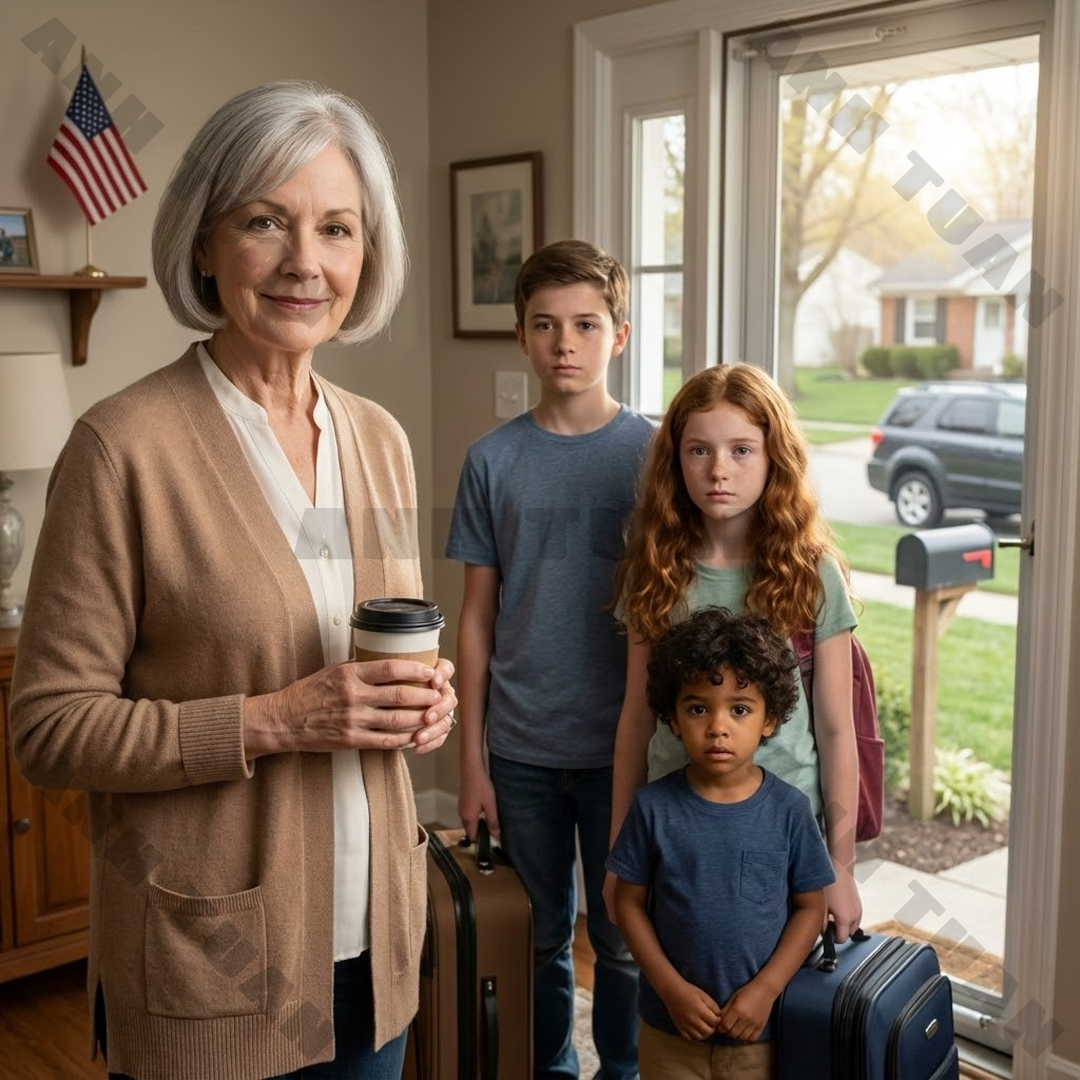
I opened the door, and there they were.
Three children stood on my porch with suitcases bigger than their torsos. Aiden, twelve, tall for his age, phone already in his hand like it was fused to his skin. Chloe, ten, arms crossed, eyes narrowed in permanent offense. Leo, seven, small and restless, already craning his neck to look past me into my house as if he expected to be disappointed.
Behind them, Brooke stood with a polished smile, hair curled, makeup flawless, wearing sunglasses even though the morning was cloudy. She looked like a woman stepping into an airport lounge, not a mother leaving her children.
“I don’t have time to chat,” she said immediately.
She didn’t step inside. She didn’t kiss the children. She didn’t kneel down to hug them. She rattled off instructions like I was an employee.
“Aiden is allergic to dust,” she said. “Chloe won’t eat anything green. Leo needs his iPad to fall asleep. Their medicines are in the blue suitcase. I’ll be back in two weeks. Michael is working. Someone has to support this family.”
She looked me up and down, the way she always did, like she was mentally appraising my worth and finding it lacking.
“Not all of us get to retire with a pension,” she added, voice sharp with envy disguised as commentary.
My pension was fifteen hundred dollars a month after thirty-five years of service. Brooke spent that on nails, lashes, clothes she wore once for photos, and whatever new identity she was trying on that week.
The children dragged their suitcases into my foyer without looking at me. Aiden’s eyes flicked around my house like he was cataloging flaws. Chloe’s lips twisted. Leo’s gaze landed on my living room, on the bookshelf, on the framed photos of Michael as a boy.
Brooke leaned in close enough for me to smell her perfume and the faint bitterness underneath it.
“And don’t you dare fill their heads,” she whispered. “Remember. I decide if you ever see them again.”
Then she straightened and walked away on clicking heels, the sound sharp against my porch boards. Her SUV started with a confident purr, and within seconds she was gone, leaving a cold, empty silence behind.
I stood in my doorway with my grandchildren and realized how little they looked like they belonged anywhere. They carried the tense posture of children who didn’t trust adults.
“Grandma,” Aiden said, not as a greeting but as a complaint, “what’s the Wi-Fi password?”
I had unplugged the router before they arrived. Not as punishment. As a reset. A classroom doesn’t start with recess. It starts with attention.
“It’s down,” I said calmly.
Aiden’s face twisted in shock.
“What do you mean it’s down?”
“It means there’s no internet right now,” I replied.
He stared at me as if I’d announced the end of the world.
“No way,” he snapped, then turned and began shouting, “Mom! Mom!”
Chloe rolled her eyes.
“She’s gone,” I said. “And yelling isn’t going to fix the internet.”
“You’re the worst grandmother,” Aiden barked. “That’s why nobody comes here.”
The words were too sharp for a twelve-year-old to have invented. They carried Brooke’s voice inside them like poison.
Chloe stepped forward, chin lifted. “I’m hungry,” she said. “But I’m not eating anything you cook. Mom says you’re a terrible cook and Dad is skinny because you feed him junk.”
Leo bounced on his toes. “Can I watch YouTube?” he asked. “At home I watch it all day.”
I looked at them, all three of them, and I saw what Brooke had been doing.
Not just to me.
To them.
Children don’t come out of the womb contemptuous. They learn contempt. They learn it as a defense, as a weapon, as a way to match the emotional climate they live in.
“Listen,” I said, and my voice stayed steady. “Your mother asked me to take care of you. She didn’t ask me to entertain you. There is food in this house, water in the sink, beds to sleep in. Everything else is earned.”
Chloe’s eyes widened like I’d slapped her.
“Earned?” she repeated. “We’re kids.”
“In this house,” I said calmly, “everyone contributes.”
Aiden scoffed. “Mom says I don’t have to do anything at Grandma’s. She said you’ll just complain but you’ll do it anyway.”
I walked to the kitchen and opened the fridge.
“Breakfast first,” I said. “Then rules.”
I cooked pancakes. Not the rushed kind. The kind I used to make for Michael on Saturdays when money was tight but I wanted him to feel rich in some other way. I cut strawberries into stars, poured chocolate milk into cups, set the table like it mattered.
When Aiden walked in and saw the spread, he stopped short.
“What is this?” he asked suspiciously.
“Breakfast,” I said. “Sit.”
He sat like it was a trap. He took a bite, and for a second his face softened before he caught himself and hardened again.
“It’s okay,” he muttered. “I’ve had better.”
Chloe and Leo followed, drawn by the smell. Leo grabbed a pancake like he’d been starving for years.
“This is good,” Leo said with his mouth full.
“Shut up,” Chloe hissed, elbowing him. “We’re not supposed to—”
“Not supposed to what?” I asked gently.
Chloe froze, and for the first time I saw uncertainty flicker behind her hostility.
After breakfast, I laid out my rules the way I used to lay out classroom expectations on the first day of school.
“No Wi-Fi,” I said. “No screens until chores are done. Chores are simple. Aiden washes dishes. Chloe makes beds and helps with laundry. Leo picks up toys and helps with small things.”
Aiden’s face flushed.
“That’s child labor,” he snapped.
“It’s family,” I corrected. “And the sooner you learn the difference, the easier your life will be.”
He pushed back from the table hard enough to scrape the chair.
“I’m telling my mom,” he said.
“You can,” I replied. “When she answers.”
Chloe’s mouth tightened. Leo looked between us, confused, like he wasn’t used to adults being calm when children pushed.
That first day was chaos wrapped in entitlement.
Aiden stomped down the hallway and slammed doors. Chloe complained about everything. Leo whined and demanded and tried to sneak into my bedroom like he was looking for an iPad hidden in drawers. They weren’t evil children. They were children with no boundaries, raised in a house where attention came through drama and power was gained through noise.
By the evening, Aiden’s anger spilled into destruction. He knocked over a lamp, not an accident but a challenge. Chloe threw a glass into the sink too hard, shattering it. Leo ripped pages out of one of my photo albums, laughing because he thought the reaction was the fun part.
I didn’t yell. I didn’t cry. I didn’t beg.
I stood and watched, calm, letting my hidden camera record everything Carol had helped install that morning.
Because I knew exactly what Brooke would do when she returned.
She would claim I mistreated them.
She would paint herself as the victim.
She would weaponize their behavior and call it proof.
So I gave her something else.
I gave her reality.
That night, after I sent them to bed, I heard soft crying from Chloe’s room.
Not the loud, performative kind. The kind that comes from a child who has stopped acting and started hurting.
I knocked once, then opened the door.
Chloe lay curled on her bed, hugging something against her chest. When she saw me, she startled and tried to hide it.
“What do you have there?” I asked softly.
“Nothing,” she snapped, but her voice shook.
I moved closer and saw the edge of a photo.
It was an old picture of me holding her when she was a baby, her tiny fingers curled around mine, her cheeks pressed against my shoulder. One of the few times I’d been allowed to hold her before Brooke’s campaign to push me out.
Chloe’s eyes filled.
“Do you miss your mom?” I asked gently, sitting on the edge of her bed.
“No,” she said too fast. Then she swallowed. “I mean… she’s always gone. I’m used to it.”
There it was. The crack.
“How often does she travel?” I asked.
Chloe stared at the wall.
“I don’t know,” she whispered. “A lot. She says it’s work. She says if we tell Dad anything he’ll get sad and… and he’ll die.”
My stomach turned.
Adults don’t usually need children to keep secrets unless the adults are doing something shameful.
I stood up slowly.
“Chloe,” I said, “tomorrow I’m making pecan cookies. The ones you used to like when you were little.”
Her eyes lifted for a split second, hope flashing, then dimming.
“Mom says your kitchen is dirty,” she mumbled.
“Your mom says a lot of things,” I replied. “Tomorrow you can see for yourself.”
I closed her door quietly and walked down the hallway with a heavy heart.
In my room, I sat on the edge of my bed and let myself breathe through the rage.
I didn’t hate Brooke because she was rude to me. I hated what she had done to these children. She had taught them to treat love like weakness and boundaries like cruelty. She had trained them to believe they had power only when they were taking it.
That was not parenting.
That was damage.
At six o’clock the next morning, Carol arrived with a shoebox.
She didn’t hug me. She didn’t chat. She handed me the box like a soldier handing over equipment.
“Three recorders,” she whispered. “A smoke detector camera. And these.”
She slid a manila envelope across my counter.
Credit reports.
I flipped through them, my hands steady but my chest tightening with each line.
“Brooke has thirty thousand dollars of debt,” Carol said quietly. “In Michael’s name.”
My vision blurred for a second. Not because I couldn’t process the number, but because my son had been carrying a marriage like a man carrying a sinking boat, convinced that if he worked harder it would float.
“Carol,” I whispered.
“I know,” she said. “And my sister. Lauren. She can come by tomorrow afternoon. Not officially, not yet. A routine check. But Helen, you need proof of neglect, not just bad behavior.”
“I’m getting proof,” I said, and my voice sounded like someone I didn’t recognize. Someone older than fear.
That morning, I made breakfast again. Not because I wanted to bribe them. Because I wanted to show them something consistent.
Aiden came down first, hair messy, eyes tired. He stopped short when he saw the table.
“You’re doing this again?” he asked, suspicious.
“I eat breakfast every day,” I replied. “It’s normal.”
He sat, more cautious than hostile. Chloe and Leo joined, and Leo, bless his little heart, smiled as if he couldn’t help it.
“Grandma’s food isn’t bad,” he said.
Chloe glared at him, but she took a bite too, and I watched her face change against her will.
After breakfast, I set my rules again, calm and unmovable.
Aiden crossed his arms. Chloe huffed. Leo bounced, impatient.
Then Aiden said the thing that finally pushed me into the next stage.
“My mom said if we don’t listen to you,” he muttered, “you’ll get mad and then you’ll cry and then you’ll give up.”
I looked at him for a long moment.
“That might have worked before,” I said softly. “It won’t work now.”
Aiden’s eyes narrowed.
“Why?” he asked.
Because I’ve finally stopped being afraid of losing you, I thought. Because love that requires me to accept abuse isn’t love, it’s captivity.
But I didn’t say that. Not yet.
Instead, I said, “Because I love you too much to let you grow up thinking this is how the world works.”
That afternoon, while they did chores with loud complaints, I noticed Aiden’s phone on the counter.
It wasn’t locked. He had tried to log into something earlier and left it open. Kids these days live in clouds of information, and they forget that clouds can rain.
I hesitated, because privacy matters. Even with children. Even with anger.
Then I remembered Brooke’s threat.
I decide if they have a grandmother or not.
I remembered Chloe’s whisper about secrets.
I remembered the way Leo said his mother was always on a trip.
I picked up the phone and opened the messages.
What I found turned my stomach into ice.
Brooke. Dominic.
Not just flirting. Not just an affair. A plan.
“I have almost everything ready,” Brooke had written. “Michael signed the papers without reading. As always. The house is already in my name.”
Dominic replied, “And the brats?”
Brooke’s answer made my fingers go cold.
“I’ll dump them with the old woman until he gives me the divorce,” she wrote. “Michael works so much he barely sees them. He won’t fight for custody. We need money to move to Miami for good. The old woman has a house. It’s worth at least two hundred thousand. When she dies, Michael inherits. As his wife, half is mine.”
Dominic replied, “We can speed that up.”
I stared at the screen, my breath shallow.
Brooke had taken out credit cards in Michael’s name. She’d sold a car that belonged to him and told him it was stolen. She’d tried to take out a loan against my home and needed my signature, which explained her sudden interest in bringing the kids here, in softening me up, in placing me under pressure and obligation.
And the trips.
Miami wasn’t a conference.
It was an escape route.
I took pictures of everything. Every message. Every plan. Every piece of proof. I sent copies to Carol and printed them on my old printer until the ink nearly ran out.
Then I sat at my kitchen table and let myself feel the rage properly.
Not loud rage.
Focused rage.
The kind that makes you dangerous in a calm way.
That night, during dinner, I tested the children gently.
“What do you want to do tomorrow?” I asked, casual.
“Go home,” Aiden said automatically.
“To which home?” I asked. “Your dad’s home, or… Dominic’s home?”
Chloe’s fork clattered against her plate.
“I don’t know what you’re talking about,” she whispered.
Aiden’s face tightened instantly. Leo giggled nervously, the way younger children do when they sense grown-up tension but don’t understand it.
“Does Dominic stay at your house?” I asked softly.
Chloe stared at her plate, silent.
Leo’s eyes widened.
“Sometimes,” he said, then clapped a hand over his mouth like he’d said a bad word.
Aiden shot him a furious look.
“Leo,” he hissed.
“It’s okay,” I said quickly, keeping my voice warm. “You’re not in trouble.”
Leo’s shoulders sagged, and he blurted the truth the way only a seven-year-old can.
“He sleeps in Mom and Dad’s room,” he said. “And we’re not allowed in. And they make weird noises.”
Aiden stood up so fast his chair tipped backward.
“Shut up,” he snapped. “Mom said if we tell anyone, Dad will get sad and die.”
My chest tightened with fury.
“Your dad is not going to die,” I said firmly. “Adults don’t die because someone tells the truth. Adults get hurt. But hurt is not death.”
Chloe’s eyes filled, and suddenly she broke. Not into tantrums. Into real tears.
“She said Dad is boring,” Chloe whispered. “She said Dominic is fun. She said we’re going to have a new house with a pool. She said we won’t be poor anymore. She said we won’t end up like you.”
The words came out like bile, like she’d been forced to hold them until they burned.
I reached across the table and took Chloe’s hand. To my surprise, she didn’t pull away.
Aiden’s face crumpled, not into softness but into conflict. He looked like a boy trying desperately to keep his loyalty to his mother intact because the alternative was unbearable.
“Dad doesn’t know,” he whispered.
“No,” I said. “He doesn’t.”
“Are you going to tell him?” Leo asked, voice shaking.
I looked at my grandchildren, these three children caught in the middle of adult selfishness, and I made a decision that felt like a door closing behind me.
“I’m going to protect you,” I said. “And I’m going to protect your father. And your mother… your mother is going to face consequences.”
That night, after they went to bed, I called Michael.
He answered on the third ring, breathless, as if he’d been running.
“Mom?” he said. “Everything okay? Brooke said you offered to watch the kids.”
Offered.
The word tasted bitter.
“They’re fine,” I said gently. “But I need you to come over tomorrow after work. There’s something we need to talk about.”
Michael hesitated. “Is it urgent? Brooke asked me not to bother her while she’s on her trip.”
“It’s about the house,” I said, choosing my words. “There’s a leak. It could affect the structure.”
It wasn’t a lie. My roof did leak. But the real leak was in his life.
“I’ll be there around seven,” Michael said.
When I hung up, I looked at the calendar.
Twelve days until Brooke returned.
Twelve days to dismantle ten years of manipulation.
And now I had something I hadn’t had before.
Evidence.
The next day, Lauren from child protective services came at three o’clock. She arrived in jeans and a simple blouse, hair pulled back, expression professional but not cold.
She walked through my house quietly, eyes scanning details the way people in her line of work do.
She listened to me explain what had happened, then asked to speak with the children individually.
Aiden tried to posture. Chloe tried to hide. Leo tried to charm.
Lauren saw through all of it. She asked calm questions and waited through silence without filling it. She listened the way I used to listen in parent conferences, not to words but to what lived underneath them.
When she finished, she pulled me aside in my kitchen.
“Mrs. Miller,” she said quietly, “these children are dealing with emotional neglect and manipulation. The oldest is carrying anger that isn’t his. The girl is anxious. The youngest is copying behavior because it’s how he survives.”
My throat tightened.
“What happens now?” I asked.
“Document everything,” she said. “When the father comes, I want to speak with him. When the mother returns, if what you’ve shown me is real, there will be an investigation.”
“It’s real,” I said, voice hard.
Lauren nodded. “Then we handle it carefully.”
At seven-fifteen, Michael arrived.
He came straight from work in his uniform, eyes sunken with exhaustion, shoulders slumped like he was carrying the entire world and still apologizing for its weight.
When he stepped into my kitchen, for a moment I saw him as a boy again. Eight years old, patched-up shoes, trying not to cry when other kids teased him.
“Hi, Mom,” he said softly. “How are the kids?”
“They’re upstairs,” I said. “Michael, sit down.”
He frowned. “Is it about the roof?”
“It’s not the roof,” I said. “It’s your marriage.”
Michael froze.
“What are you talking about?” he asked, and his voice carried the tired defensiveness of a man who had been trained to doubt his own instincts.
I placed a folder on the table.
Inside were the screenshots. The bank statements. The credit card debts. The photos Brooke had posted, smiling on beaches while claiming she was working.
Michael picked up the papers with trembling hands.
As he read, color drained from his face.
“This…” His voice cracked. “This can’t be”
“It’s Brooke,” I said softly. “And Dominic. Your children know. They’ve known for months.”
Michael’s eyes snapped up.
“The kids?” he whispered, and that one word carried so much grief it nearly broke me.
“They’ve been told to keep secrets,” I said. “They’ve been told you’ll die if you find out.”
Michael’s mouth opened, closed. His eyes filled, but he didn’t cry. He went still in a way that scared me more than any shout could have.
“I’m an idiot,” he whispered.
“No,” I said firmly. “You’re a man who trusted someone who didn’t deserve it.”
From upstairs, footsteps sounded. Aiden appeared in the doorway, face pale. Chloe hovered behind him, Leo clutching Chloe’s sleeve.
They had heard us.
Michael looked at them, and for the first time in a long time, he truly looked. Not past them. Not through them. At them.
“Aiden,” he whispered.
Aiden’s jaw trembled.
“Dad,” he said, voice small. “We already knew.”
Michael’s face crumpled, and then he did cry. Quietly. Like a man who had been holding everything in because he believed his tears would make him weak.
He opened his arms.
“Come here,” he said.
For a second, the children hesitated, as if they didn’t trust tenderness.
Then Leo moved first, running into his father’s chest. Chloe followed, then Aiden, stiff at first, then melting as Michael held them like he was trying to make up for years of absence with one embrace.
I turned away and made coffee because I needed my hands to do something practical while my heart tried not to shatter.
That night, Michael stayed. Not just a visit. He moved into my house with the children, at least for now. He took vacation days, the first time in three years he’d allowed himself to stop working long enough to breathe.
And together, we built a new routine.
Not perfect. Not instantly. But real.
Wake up at seven. Breakfast at eight. Schoolwork. Chores. Outdoor time. Earned screen time, not as a right but as a privilege. Family dinner at six. Bed by nine.
At first, the kids resisted. Aiden complained loudly. Chloe rolled her eyes. Leo tested every boundary.
But Michael held firm, and so did I.
In the mornings, I cooked with Chloe. At first she stood with arms crossed, suspicious. Then she started asking questions. How much cinnamon? Why do you cream butter first? What happens if you add eggs too fast?
One afternoon, as we rolled dough for pecan cookies, Chloe asked quietly, “Grandma… why does Mom hate you?”
I paused, my hands dusty with flour.
“She doesn’t hate me,” I said carefully. “She fears me.”
Chloe blinked. “Fears you?”
I nodded. “Because I stayed. I worked. I built a life with my hands. And when someone like that exists, it reminds a person like your mother that there were choices. She doesn’t like being reminded.”
Chloe stared at the dough as if it held secrets.
“Is Mom a bad person?” she asked.
I didn’t want to turn her into a child who had to decide whether her mother deserved love. That burden belongs to adults, not ten-year-olds.
“Your mom is lost,” I said. “She made selfish choices. That doesn’t mean you have to let those choices hurt you.”
Chloe swallowed. “She hurt us,” she whispered.
“I know,” I said softly. “And we’re going to heal.”
Aiden changed slower. Anger had become his armor. Without it, he didn’t know who he was.
Dr. Wallace came three times a week. She sat with the kids in my living room, her voice calm, her questions gentle but unflinching.
One day, after a session, she pulled me aside.
“Aiden is terrified,” she said. “Not of Brooke. Of his own feelings. He thinks if he stops being angry, he’ll fall apart.”
I nodded. “He’s been the man of the house emotionally,” I said. “He’s been carrying what his father didn’t know he needed to carry.”
Dr. Wallace’s eyes softened. “He needs consistent safety,” she said. “Not speeches. Not punishments. Consistency.”
I had built my life on consistency. I could do that.
Leo surprised all of us. Without constant screens, he began noticing everything. He’d sit on my porch steps and watch squirrels. He’d ask questions about the moon. He’d hum to himself while coloring, a soft sound that made my house feel alive.
One night, as I tucked him into bed, he looked up at me and whispered, “Grandma, I think Mom doesn’t love me.”
The words were so quiet they almost disappeared.
My throat tightened.
“Why do you think that?” I asked gently.
Leo’s eyes filled.
“I heard her tell Dominic I was a mistake,” he whispered. “She said if I wasn’t here she would already be free.”
My chest broke in a clean, sharp way.
I cupped his face with both hands.
“You are not a mistake,” I said firmly. “You are a gift. And if your mom can’t see that, it is her loss. Not yours.”
Leo’s lip trembled. “Then why did she have me?” he asked.
Before I could answer, Aiden’s voice came from the doorway.
“To trap Dad,” Aiden said bitterly. “She got pregnant when Dad wanted a divorce the first time.”
Chloe’s eyes widened.
“Dad wanted a divorce before?” she whispered.
Aiden nodded, jaw tight. “Three years ago. I heard them fighting. Dad found out Mom spent Grandpa Richard’s insurance money on a trip with her friends. Then she said she was pregnant. Dad stayed.”
Richard’s insurance money.
I felt dizzy. Michael had once told me he was saving that money for the kids’ education. Now I understood where it had gone, and why my roof still leaked while Brooke’s Instagram showed beaches and cocktails.
The next morning, Chloe came to my room before dawn, eyes red.
“Grandma,” she whispered, “I need to tell you something.”
I sat up and pulled her into a hug.
Chloe took a deep breath and handed me a USB drive.
“Mom has another phone,” she whispered. “One Dad doesn’t know about. She hides it in her makeup bag. I saw emails and documents. There’s a house in Miami. And… and there was something about custody. She was planning to take us.”
My heart stopped.
Chloe’s hands trembled. “I copied it,” she whispered. “I don’t know why I did it. I just… I felt like someone needed to know.”
I hugged her harder, my ten-year-old granddaughter carrying secrets no child should have to carry.
We plugged the USB into my old laptop.
What we found was worse than I expected.
Not just proof of the house in Miami purchased in Dominic’s name with money siphoned from their accounts. Not just emails with a lawyer. A detailed plan.
Phase one: convince Michael she needed a training trip.
Phase two: Dominic would empty the house of valuables.
Phase three: provoke an incident with me and make it look like I mistreated the children.
Phase four: use it to justify leaving with the kids “for safety.”
Phase five: once in Miami, disappear.
And there was an audio file.
Brooke’s voice, cold and casual.
“I don’t care if the brats cry,” she said. “They’ll forget in two months. Michael is pathetic. If he fights, I have edited videos that make it look like he hit Aiden. Technology works miracles.”
Chloe started sobbing.
“Was she going to say Dad hit us?” she whispered.
Michael arrived home later that morning with a look that told me something else had happened.
He walked into my kitchen, face pale.
“Mom,” he said, voice shaking, “I went to the bank. Brooke emptied our savings account yesterday. Thirty-eight thousand dollars.”
Everything they had saved in ten years.
I didn’t let him sit in that shock alone. I showed him everything. The USB. The plan. The audio.
With each piece of evidence, Michael seemed to age.
“How could I be so blind?” he whispered.
Aiden sat beside him, anger softened into grief.
“It’s not your fault,” Aiden said quietly. “Mom is a very good liar.”
Michael’s eyes filled.
“But I’m their father,” he whispered. “I should have protected them.”
“You’re protecting us now,” Chloe said softly.
That mattered. Not because it erased the past. Because it built a future.
Martinez came that afternoon with paperwork and the kind of calm confidence that comes from knowing the law is on your side if you have proof.
“With this,” he said, tapping the folder, “we can file for emergency custody. We can also request a restraining order. Attempted parental kidnapping is serious. And the financial fraud…”
Michael swallowed hard.
“I don’t want her to go to jail,” he said. “I just want my kids safe.”
Martinez nodded. “Then we negotiate. She gives up custody, returns the money, and we don’t pursue criminal charges. But we need to be ready. When she comes back, she will not be calm.”
We prepared carefully.
The children wrote letters in therapy, not to send, but to release what lived inside them. Aiden filled three pages with rage. Chloe wrote questions and heartbreak. Leo drew his mother as a figure with suitcases instead of hands.
We burned the letters in a clay pot in my backyard, under a gray Ohio sky, and as the paper curled into ash, Leo asked, “Are we free now?”
Dr. Wallace knelt beside him and said, “Now we begin to be free.”
Three days before Brooke’s return, we took the kids to the park where I used to take Michael when he was little. The same old swings, the same basketball courts, the same smell of cut grass and distant traffic.
Leo climbed a tree, laughing. Chloe sat beside me on the bench and ate corn on the cob like she was trying to taste childhood. Aiden wandered a little farther, pretending he didn’t want to be near us, then returning every few minutes as if he needed to check that we were still there.
On the ride home, the kids fell asleep in the back seat, heads leaning against each other in a way they never would have allowed two weeks earlier.
Michael drove with both hands tight on the steering wheel.
“Mom,” he whispered, “I’m scared.”
“I know,” I said.
“What if she comes back and tries to take them by force?” he asked.
“Then she meets the law,” I replied. “And she meets us.”
The morning Brooke was due to arrive, Carol took the kids to her house as planned. They protested at first because they wanted to see Brooke’s face, but I held firm.
“This isn’t revenge,” I told them. “This is protection.”
At eleven o’clock, Martinez arrived with documents. A patrol car parked down the street, discreet but ready. Lauren stayed nearby, prepared to step in if Brooke tried to twist the narrative.
At twelve-oh-three, I heard Brooke’s SUV pull into my driveway.
My heart pounded harder than I wanted it to, not from fear of her but from the weight of what was about to change.
The front door opened without a knock.
Brooke walked in like she owned the house, tan, wearing a new dress that probably cost more than my monthly pension, dragging a Louis Vuitton suitcase.
“Ugh, it’s so hot,” she announced, as if talking to the air. “Michael? What are you doing here? You should be at work.”
Then her eyes landed on Martinez.
Her smile faltered.
“Who is that?” she snapped.
Michael stood. His voice was steady, not the exhausted voice I was used to.
“We need to talk,” he said.
Brooke laughed, brittle. “Talk about what? I’m tired. Where are the kids? I hope your mother didn’t spoil them.”
“The kids aren’t here,” I said calmly.
Brooke’s eyes narrowed. “Excuse me?”
Martinez cleared his throat.
“Mrs. Miller,” he said, “I’m attorney Martinez. I represent Mr. Miller in divorce and emergency custody proceedings.”
Brooke’s face changed instantly. The mask cracked, then snapped back on with desperate speed.
“Divorce?” she laughed too loudly. “Michael, honey, what did your mother do to you now? You know she’s old. She makes things up.”
Michael’s jaw tightened. He pulled out his phone and played the audio file.
Brooke’s voice filled my living room, cold and undeniable.
“I don’t care if the brats cry… Michael is pathetic…”
Brooke turned pale.
“That’s edited,” she snapped. “That’s illegal.”
“It’s also illegal,” Martinez said, calm as a stone, “to open credit cards in your husband’s name without his consent. Thirty thousand dollars of debt.”
Brooke’s mouth opened, closed.
“I don’t know what you’re talking about,” she said, and her eyes shot to me with pure hatred. “You did this. You meddling old woman.”
“No,” Michael said, voice like steel. “You did this. We just found out.”
Martinez slid the documents across the coffee table.
“You have two options,” he said. “You can agree to the divorce, waive custody, return the money, and leave quietly. In exchange, we do not pursue criminal charges. Or we go to court. With this evidence, you will lose custody. And you will face charges for fraud and attempted parental kidnapping.”
Brooke’s hands trembled.
“You can’t do this,” she whispered. “I have rights. I’m their mother.”
“Children are not property,” I said quietly. “And being a mother is not a title you wear. It’s something you do.”
Brooke’s face twisted.
“I want to see my children,” she snapped.
“Not until you sign,” Michael said.
Brooke grabbed her phone and started dialing.
“I’m calling Dominic,” she said. “He’s a lawyer. He’ll—”
She dialed and dialed and no one answered.
Dominic, the man she thought was her escape, had already started protecting himself.
Brooke’s eyes filled with rage and humiliation.
“He abandoned me,” she whispered.
“The way you abandoned your family,” I said, and my voice stayed calm because I refused to give her the satisfaction of my emotion.
At that moment, the front door opened again.
Chloe stood there, breathless. She had slipped away from Carol’s house, defiant.
Brooke’s face lit up like she’d found oxygen.
“Chloe,” she cried, rushing forward.
Chloe stepped back.
“Don’t touch me,” Chloe said, voice shaking but steady.
Brooke froze.
“What did they do to you?” she snapped. “What did that woman tell you?”
Chloe’s eyes filled.
“Grandma didn’t tell me,” she said. “You did. In your messages. In your lies. Every time you left.”
Aiden and Leo appeared behind her, faces serious in a way no child should have to be.
Brooke tried to reach for Aiden.
“Son,” she said, voice syrupy. “Your sister is confused.”
Aiden’s jaw tightened.
“No,” he said. “You’re confused if you think we’re going back with you.”
Brooke’s face twisted. “I am your mother.”
Leo’s voice came out small but sharp.
“A mother doesn’t call her kid a mistake,” he said.
Brooke turned white.
“I never—” she began.
“A mother doesn’t steal money for trips,” Aiden added.
“A mother doesn’t use her kids like excuses,” Chloe said, and her voice cracked on the last word.
The three of them stood close together, holding hands.
“A mother protects us,” they said, and the words landed in my living room like a verdict.
Silence filled the space. The kind that makes you hear the refrigerator hum and the clock tick and someone’s breathing.
Brooke’s eyes turned to me, hatred burning.
“You’re going to pay for this,” she hissed.
I held her gaze.
“I already paid,” I said quietly. “For years. Now it’s your turn.”
Brooke snatched the papers off the table and signed them with furious strokes, like she could tear the truth by pressing hard enough.
Then she threw the pen down, grabbed her suitcase, and stormed out.
Her SUV roared away, and the sound faded into the neighborhood like a storm moving on.
Michael sank onto the couch and pulled the children into his arms.
They cried, not because they missed Brooke in that moment, but because something heavy had finally been lifted and they didn’t yet know how to stand without it.
I made chamomile tea, because some parts of me would always be a teacher and a mother, and tea was my way of telling people they were safe.
In the weeks that followed, Brooke tried to claw her way back into control.
She posted vague quotes online about betrayal and toxic families. She told mutual friends I had manipulated Michael. She filed a complaint with social services accusing me of abuse, because of course she did. She tried to paint Michael as violent, because she couldn’t imagine losing without rewriting the story.
But we were ready.
When a social worker showed up at my house with Brooke and Dominic, I didn’t panic. I didn’t beg. I didn’t shout.
I invited them in.
Then I showed them footage from the day the children destroyed my living room, footage that showed me calm, steady, not abusive. I showed them therapy reports. I showed them financial records. I showed them Brooke’s messages.
And then, in the middle of it all, Dominic slipped.
He had started recording Brooke’s conversations to protect himself, and in his fear, he gave us the final piece of proof we needed.
On a recording, Brooke’s voice said, “It doesn’t matter if it’s true. I just need CPS to believe me so I can get the kids back. With them, Michael will give me whatever I want.”
The social worker’s face changed in real time.
Filing false reports is not a game. It’s a crime.
Brooke lost more ground that day, not because we attacked her, but because she couldn’t stop revealing herself.
Dominic left her right there in my yard, disgusted and terrified of consequences.
Brooke stood alone, defeated, and for the first time I saw her without the mask.
Not powerful.
Not glamorous.
Just empty.
Months passed.
The children began to look like children again.
Aiden got on the honor roll, not because he suddenly became perfect, but because his anger stopped swallowing his focus. He started therapy with real effort. He learned to put his rage somewhere safe instead of throwing it at people smaller than him.
Chloe joined the volleyball team. She made friends. She laughed more. She stopped flinching when adults raised their voices, because she was finally in a home where raised voices weren’t the main language.
Leo discovered music. My old piano, the one that had sat untouched for years, finally had someone to play it. His fingers stumbled at first, then steadied, and one night he played a simple melody so sweet I had to step into the kitchen so he wouldn’t see my tears.
Michael changed too. The defeated man who had arrived at my door with grease on his uniform and exhaustion in his eyes slowly became someone else. Someone with color in his face. Someone who laughed. Someone who cooked dinner sometimes and didn’t apologize for taking up space in his own life.
He got promoted to production manager. With the raise, he started paying down the debts Brooke had left, one ugly bill at a time, and each payment felt like another chain falling off.
And I, Helen Miller, the retired teacher who supposedly did nothing anymore, found myself busy in a way I’d never expected.
The neighborhood moms heard what happened, not through gossip, but through the quiet shifts they saw in the kids. They saw Aiden holding the door for elderly neighbors. They saw Chloe walking to school with a lighter step. They saw Leo smiling at strangers instead of staring at a screen.
They asked me if I’d tutor their kids.
Then they asked if I’d teach art.
Then cooking.
Then simple life skills, the things schools don’t have time for anymore and families forget until they need them.
So I created something small and real.
A little workshop in my living room at first, then, with Michael’s help, a proper room built in my backyard with big windows and a fan and shelves for paints and paper. The kids called it Helen’s Art House, and the name stuck.
I charged twenty dollars a class, fair but modest. The real payment was watching children create something with their hands and feel proud, watching them learn to clean up their mess without being shamed, watching them learn that structure is not cruelty.
One Saturday morning, six neighborhood kids sat around my table painting, and my grandchildren moved among them like little helpers, confident in a way they’d never been before.
“Grandma Helen,” a five-year-old girl said, holding up her painting, “look!”
It was a smiling sun over a house with smoke coming from the chimney.
I smiled. “That’s beautiful,” I told her. “Tell me about it.”
“It’s my house,” she said, “because my mom said home is where you feel safe.”
My throat tightened, because I understood that sentence in my bones now.
One evening, after the neighborhood kids left, my family sat down for dinner. It had become a tradition, not forced, not staged, just something we did because we wanted to.
Michael looked around the table and cleared his throat.
“I have news,” he said.
Chloe bounced. “Did you get another promotion?”
Michael smiled. “Not yet. But I was thinking… Mom, what if we expand your workshop? Build a real classroom space. Make it official.”
I waved my hand like it was too much.
“Michael, that’s not necessary,” I said.
“Yes, it is,” he replied quietly. “You saved me. You saved my kids. Let me give you something back.”
Aiden stood up suddenly, awkward in the way teenagers are when they care too much.
“I have something too,” he said.
He pulled out a piece of paper, his hands trembling.
“I wrote an essay for the school contest,” he said. “It’s about you.”
He cleared his throat and read, his voice shaky at first, then stronger.
“My hero doesn’t wear a cape. My hero is sixty-seven and has wrinkled hands from working hard. My hero is my grandmother. She taught me that love isn’t bought with gifts or trips. Love is built with patience and boundaries. My grandmother saved me from becoming someone I don’t want to be. She taught me family isn’t just blood. It’s a choice. And I choose her.”
Chloe wiped her eyes quickly, pretending she wasn’t crying.
Leo climbed onto his chair and held up a drawing.
It was all of us holding hands in front of my house, with the American flag across the street drawn in the corner because he noticed it now, because he noticed everything now.
Above us, in his messy handwriting, he had written: MY REAL FAMILY.
I pressed a hand to my mouth to keep myself from sobbing.
That night, after the kids went to bed, I went out into my backyard. The moonlight spilled over my tomato plants, over the little classroom Michael had built, over the quiet neighborhood streets where porch lights glowed like small promises.
I thought of Richard, my husband.
“I did it,” I whispered into the night. “I raised our son. And now I’m helping raise our grandchildren. Not the way we imagined. But I did it.”
I thought of Brooke too, alone somewhere, chasing whatever life she thought she deserved. I didn’t wish her harm. I didn’t wish her pain.
I wished her clarity, because clarity is the beginning of consequence.
In the spring, I received an unexpected call from Lincoln Elementary.
The principal’s voice sounded excited.
“Mrs. Miller,” she said, “we’ve heard about your workshops. Would you be interested in giving a few paid sessions at the school?”
I closed my eyes and smiled.
Life has a strange way of giving back what you sowed, sometimes years later, sometimes in forms you never expected.
Then Mother’s Day arrived.
I didn’t expect much. Mother’s Day had always been complicated after Richard died, always carrying grief in its shadow. And in recent years, Brooke had made sure it passed with minimal attention, as if acknowledging me too much would strengthen my place in the family.
That morning, I woke to footsteps and whispers.
Then my bedroom door opened and three children burst in like sunlight.
“Happy Mother’s Day!” they shouted.
Leo climbed onto my bed first, grinning. Chloe followed, holding a tray. Aiden hovered awkwardly behind them, trying to look cool and failing.
On the tray was breakfast. Slightly crooked pancakes. Strawberries cut unevenly. A glass of orange juice that sloshed dangerously.
Michael stood in the doorway with soft eyes.
“They wanted to do it,” he said.
Leo looked at me seriously.
“Happy Mother’s Day, Mama Helen,” he said.
My throat tightened. “But I’m your grandmother,” I whispered.
“You’re more than that,” Michael said quietly. “You’re the mother we all needed.”
Chloe handed me an envelope.
Inside were legal papers.
“What is this?” I asked, confused.
Michael sat on the edge of my bed.
“The kids asked for it,” he said gently. “They want you listed as a legal guardian too, as a backup. In case anything ever happens, they want to make sure they stay with you. Not with Brooke.”
I stared at the papers until the words blurred.
Aiden swallowed hard.
“It was our idea,” he said, proud and nervous. “Because… because you’re the only adult who didn’t give up on us.”
I cried then. Not quiet tears. Not polite tears.
The kind of tears that come when something broken finally becomes whole.
Leo crawled closer and patted my arm like he was comforting me the way I used to comfort him.
“Grandma,” he asked softly, “are you happy?”
I looked at my room full of people who loved me. My son steady again. My grandchildren healing. My house filled with purpose and laughter and paint jars and cookie dough and homework.
I took a breath that felt like my lungs were finally allowed to fill all the way.
“I’m more than happy,” I said. “I’m whole.”
And I meant it.
Because in the end, Brooke didn’t win by leaving. She lost by never learning how to stay.
We won freedom. We won peace. We won the kind of love that doesn’t need to threaten anyone to exist.
I had been retired for forty-eight hours when Brooke called and told me I did nothing anymore.
Now, as I held my family close, I understood the truth with a quiet, fierce joy.
I had never done so much.
I had never mattered more.
News

“I Still Miss Him”: Dolly Parton Breaks Down Mid Song as Reba McEntire Joins Her for Heart Shattering Tribute to Late Husband Carl Dean.
“I Still Miss Him”: Dolly Parton Breaks Down Mid Song as Reba McEntire Joins Her for Heart Shattering Tribute to…

This guitar carried my soul on its strings when no one knew my name…
In the electric silence that follows a singer’s last note, when the world holds its breath in anticipation of what’s…

The Voice reveals 4 returning coaches for season 28 including Niall Horan and Reba McEntire
The duo will be joined by fellow show alums Michael Bublé and Snoop Dogg. Nial Horan and Reba McEntire on…

Reba McEntire: “Drag Queens Don’t Belong Around Our Kids”
Reba McEntire Sparks Controversy with Statement on Drag Queens and Children. Country music legend Reba McEntire has found herself at…

Reba, Miranda Lambert, & Lainey Wilson Debut Powerful New Song, “Trailblazer,” At The ACM Awards
“Trailblazer” Is A New Song That Celebrates The Influential Women Of Country Music’s Past And Present Reba McEntire, Miranda Lambert, and Lainey…

Jennifer Aniston made a surprise appearance with a dazed expression and an unresolved…
Jennifer Aniston is no stranger to the public eye. For decades, she’s been one of the most beloved faces in…
End of content
No more pages to load