
The first thing I noticed was how they stood too close, like they were trying to shrink the air around me.
Randall planted himself at the edge of the conference table, shoulders squared, arms folded, the same posture he used at open houses when he wanted buyers to feel like there was nothing left to negotiate. Trevor hovered beside him, half a step back, wearing his suit like it didn’t quite belong to him. He kept rubbing his thumb along the seam of his sleeve, a nervous habit he must have picked up somewhere along the way, because the boy who used to tear through my kitchen barefoot never once worried about seams.
“You’re not mentioned in the will,” Randall said, voice flat, as if he were announcing the weather. “So that’s that.”
Trevor added, softer but not kinder, “It’s just for immediate family.”
Immediate family.
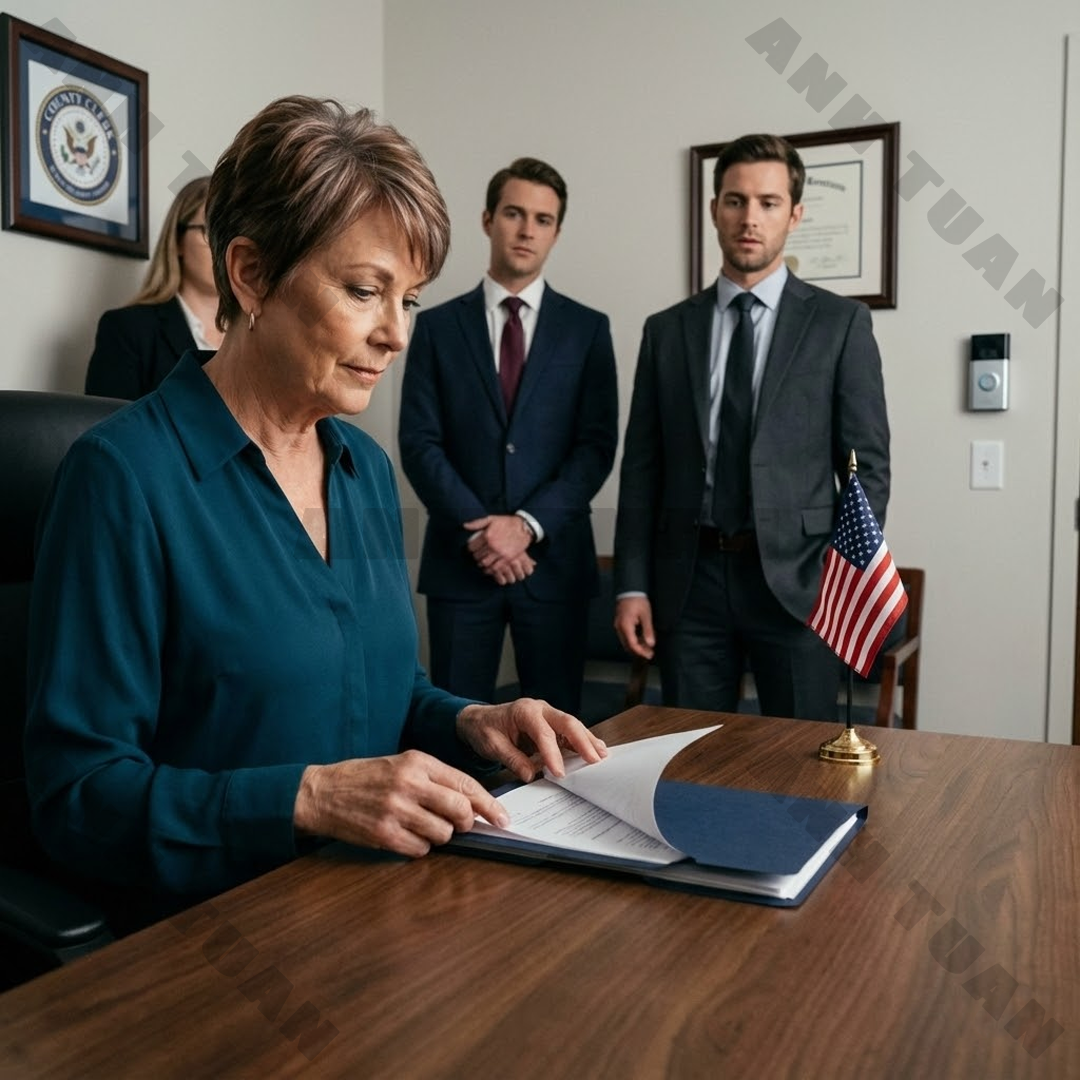
For a moment, my lungs refused to take a full breath. The phrase didn’t just sting, it rewrote the room. I stared at my sons, two grown men in tailored suits, hair trimmed clean, shoes polished like they’d never walked through mud, and I felt something inside me tilt. I gave them life. I gave them a home. I gave them their first bank accounts, their first cars, their first second chances. If that didn’t count as immediate, then what did.
The office itself was designed to make people behave. Polished oak table, elegant curtains, framed degrees along the walls, the faint scent of lemon oil and paper. A small American flag stood in a brass base near the receptionist’s desk, stiff and spotless, like it had never been taken outside to feel the wind. Everything looked official, clean, final. Even grief looked tidy in here.
I stood at the entrance holding my navy folder like a shield. Not because I planned to, but because my hand knew what my heart was still catching up to. Inside the folder were originals, not copies. The kind of documents you keep wrapped in plastic sleeves, the kind you don’t tell people you have, because people change when they know.
No one seemed to care what I held. Not the attorney at the head of the table. Not the paralegal with her fingers hovering over the keyboard. Not the two distant cousins on the far side of the room, who barely looked up, as if this was just another family argument dressed in paperwork.
“I received a letter,” I said quietly, the words steady even when my chest felt tight. “From Winslow and Chambers. It had this address. This date.”
Randall scoffed.
“They must have made a mistake,” he said. “We’re handling the estate now. Aunt Marlene appointed us last fall.”
“She didn’t have children,” I replied. “I’m her sister.”
Trevor smiled in that familiar way he used to smile when he wanted to sound patient, like he was explaining something obvious to someone slow.
“Mom,” he said, “you’re not in this version. We can explain it later. For now, just please don’t make a scene.”
A scene.
It wasn’t a big word, but it was heavy with history. It carried every time I’d swallowed my discomfort so the room could stay pleasant. It carried every holiday dinner where I laughed at a joke that made me small, every family photo where I stood slightly off to the side because no one thought to pull me in.
I looked down at the carpet, beige velvet with flecks of green, worn where people walked most. There was a stain near the sideboard, a dull shadow of old coffee, the kind that becomes invisible once everyone decides it’s not worth dealing with. I let the silence hang, not as a weapon, but as a mirror. I wanted them to hear what the room sounded like without my constant softening.
“I’m not here to make a scene,” I said. “I’m here because Marlene wanted me to be.”
The receptionist cleared her throat. She was young, the kind of young that still believes rules are clean and fair. Her nameplate read K. Mendes, the letters too sharp for such an uncomfortable moment.
“You’re not on the list,” she said, voice careful.
I didn’t blame her. She was doing what she’d been trained to do.
“She would have wanted me here,” I said again, but this time I wasn’t speaking to Randall or Trevor. I was speaking to the room itself, to the degrees on the wall, to the polished table, to whatever part of the world still believed in doing things properly. “She wanted this handled the right way.”
Randall shifted, irritated. Trevor glanced at the attorney like he expected someone to shut me down.
Instead, I stepped forward, opened my folder, and slid out the top document. My hands didn’t shake. That surprised me. For days I’d imagined this moment with trembling fingers and a voice that cracked. But I wasn’t cracking. I was clarifying.
I walked to Ms. Mendes’ desk and held the paper out.
“Please give this to Mr. Harold,” I said. “I believe it supersedes any amendments made last fall.”
Ms. Mendes blinked, then took it with both hands like it weighed more than paper. She stood, walked toward the door at the end of the room, and slipped out.
Randall started to speak, but Trevor tugged his arm.
“Let’s just wait,” Trevor muttered, low enough that only I could hear it.
I turned and sat in the chair they’d blocked.
Neither of them stopped me.
That was the first crack. They had planned for me to hover. To stand uncertainly until someone guided me into the position they’d assigned. They hadn’t planned for me to sit down like I belonged at the table.
My folder rested on my lap now, no longer a shield. It was proof. Proof doesn’t argue. It doesn’t beg. It simply exists and waits for the room to catch up.
Across the table, a cousin I hadn’t seen in twenty years gave me the faintest nod. Not loyalty, not affection. Just recognition, the way you acknowledge a fact you can’t deny.
The door opened.
Mr. Harold stepped in, tall and gray-bearded, suit jacket carrying the faint dust of old files. He held my document in one hand and flipped through it slowly, deliberately, like each page was a step across thin ice.
Then he looked up.
“Mrs. Deloqua,” he said. “May I speak with you privately for a moment?”
Randall bristled.
“We were told this was a closed session,” he snapped. “Immediate family only.”
Mr. Harold didn’t glance at him.
“This concerns joint filings from 2008,” he said, still speaking to me. “If you’ll follow me.”
I stood and followed him into the hallway. The carpet muffled our steps, but my heartbeat still felt loud. Not from fear. From the strange sensation of watching a story you thought you knew suddenly change shape.
His office smelled like cedar and paper. Not fancy, not showy. Steady. The kind of office that exists to turn messy human lives into clean legal endings. He laid my document flat on the counter, then took a breath like he was about to say something that would rearrange a family.
“This is unexpected,” he said.
“It shouldn’t be,” I replied. “It was done properly.”
He nodded once.
“You and Marlene executed a mutual will in 2008,” he said. “Witnessed, notarized, filed with the county. It predates the revision your sons submitted.”
“She insisted,” I said. “She didn’t trust anyone but me.”
Mr. Harold’s eyes softened just slightly.
“Legally, it overrides later changes unless it was revoked in your presence,” he said. “Was it?”
“No.”
He exhaled slowly.
“Then you are the sole beneficiary,” he said. “Entire estate. House, land, accounts.”
The words landed with a clean, metallic finality. Not triumph. Not joy. Just truth taking its place.
“The boys don’t know,” I said.
“They suspect,” he replied. “But they don’t know.”
He closed the file carefully.
“Would you like me to inform them now?” he asked.
“No,” I said, and surprised myself with how quickly the answer came. “Let them hear it during the reading. With everyone else.”
He studied me, as if deciding whether I was vindictive or simply tired.
Then he nodded.
“All right,” he said. “We’ll proceed.”
When I returned to the conference room, neither of my sons looked at me directly, but I saw it anyway. Their posture had changed. The air around them had shifted. They could feel the ground moving under the certainty they’d been standing on.
Mr. Harold took his seat, opened his folder, and began in the calm voice people use when they’re trying to make grief sound orderly. Formalities first, the phrasing that turns a life into assets and distribution. Then he cleared his throat.
“An earlier mutual will filed in 2008 has been located and verified,” he said. “This will supersedes later amendments submitted without proper revocation of the mutual agreement.”
Randall’s head snapped up. Trevor blinked like he’d misheard.
Mr. Harold continued, voice even.
“Under the terms of the mutual will, the sole beneficiary of the estate is Mrs. May Deloqua.”
For a moment, no one spoke.
Not a sigh. Not a whisper. The room went quiet in a way that felt like gravity.
Randall’s certainty didn’t collapse all at once. It cracked. Slowly, then sharply, like ice carrying too much weight.
“This can’t be right,” he said, but his voice didn’t have the authority it had when he blocked my chair.
Mr. Harold didn’t flinch.
“The filing is valid,” he said. “Notarized. Witnessed. Recorded. It has not been revoked.”
Trevor’s jaw tightened. Randall looked at me then, not with love, not with recognition, but with calculation. With the quick internal math of a man reworking a plan in real time.
I didn’t smile. I didn’t gloat. I simply sat there with my hands folded and let the truth stand without decoration.
When the meeting ended, the parking lot outside the building was bright with late-morning sun. A line of leafless trees edged the sidewalk, winter holding on in thin, stubborn ways. I walked to my car slowly, keys cool in my palm, feeling the strange calm that comes after you do something you should have done years ago.
At home, the house was quiet, but not the comforting kind. The kind that makes you feel like even the walls are listening.
I hung up my coat, kicked off my shoes, and went straight to the kitchen. The light over the sink flickered, as if it had been trying to get my attention for months. I put the kettle on anyway. Habit. Even when my stomach was too tight to drink anything.
There was a time this kitchen was loud. Randall arguing with Trevor over cereal, voices bouncing off cabinets. Marlene laughing from the doorway, perfume trailing behind her like a joke. Derek clinking his mug against mine just to make me smile before work.
That was another life.
Derek died twenty-two years ago, just after New Year’s. Heart failure. He was gone before I could get the ambulance to the house. I remember sitting on the porch in my robe, snow falling into my slippers, phone dangling from my hand like it weighed more than my body could hold.
Randall was twenty-three. Trevor was barely twenty.
They were devastated for a week. Then grief turned practical.
Who gets the car. Who pays the mortgage. Who handles insurance. Who makes the calls. They stepped into adulthood like some people step onto a moving train, fast and loud and careless. At first, I told myself it was strength. I told myself it meant I’d raised capable sons.
Randall got into real estate, always charming, always able to sell confidence even when the foundation wasn’t solid. Trevor stayed local, got into mechanics, opened a garage with a friend from high school, said he liked engines because engines didn’t lie.
I helped them both. I always helped.
When Randall’s first deal fell through and he needed to bridge the gap before the next one, I wrote him a check. When Trevor’s business partner skipped town with their funds, I dipped into my pension. No questions. Just love. That’s what I believed motherhood was, love poured out until the cup looked empty, then poured again.
When Marlene started getting sick, when her letters stopped being funny and started repeating, when she couldn’t remember what she’d said five minutes earlier, I was the one who found her a doctor. I drove her to every appointment, sat in waiting rooms under posters about caregiver fatigue, listened to doctors say phrases like mild cognitive decline as if soft words could soften hard truths.
She hated the idea of assisted living. She said she’d rather die in her own perfume than live in someone else’s hallway. So I turned my guest room into her space. I put a quilt on the bed, hung her favorite framed prints, set a small radio by the window because she liked jazz in the mornings. I built her a life inside my life and told myself it would be enough.
“She’s not our responsibility,” Trevor said one day when I asked him to pick up her prescriptions.
“You’re her sister,” he added, like that ended the discussion.
I didn’t answer. There was nothing to say that would change him.
Marlene was witty and sharp even as her memory softened around the edges. She wore perfume even when she didn’t leave the house, dabbed it behind her ears like a ritual. One night, maybe a year after she moved in, she asked if we could write our wills together.
“People change when there’s money on the table,” she said. “Let’s not give them the chance.”
We met with a lawyer, Mr. Harold’s predecessor, and had everything done properly. Two signatures. Two witnesses. Each of us naming the other sole beneficiary. I remember thinking it was more ceremony than necessity, but I went along with it because Marlene looked relieved afterward, like she’d finally locked a door she didn’t trust anyone else to close.
Years passed. Her mind faded, but her instincts stayed sharp.
She still smiled when I read her poetry. Still called me baby sister even when she couldn’t recall what day it was. She died on a Thursday morning in her sleep, peaceful. I sat with her for two hours before calling anyone, not out of denial, but respect. Some people deserve a soft goodbye.
The funeral was small. Family, a few neighbors, a couple of women from her church who brought casseroles and said things like she’s in a better place with practiced gentleness. Randall gave a speech that sounded rehearsed. Trevor stood stiffly, hands in pockets. Neither of them had visited her more than twice in the last year.
But after the service, something changed. They started asking about the estate.
Randall called more often. Trevor came by unannounced. They offered to help.
“You shouldn’t handle this alone, Mom,” Randall said, voice smooth, eyes bright with something he tried to dress as concern.
I let them. I watched. I waited.
When the letter from Winslow and Chambers came, I didn’t tell them. It was addressed to me. Full name. Correct address. No mistake. Then last week, I overheard Randall on the phone while he thought I was outside.
“She doesn’t need to be there,” he said. “We’ve got the final draft. It’s all lined up.”
I went upstairs, opened my safe, and took out the navy folder. Everything they thought was lined up had been signed away years ago.
Still, part of me hoped I was wrong. Hoped they were careless, not cruel. But the day they blocked my chair proved otherwise.
The kettle whistled. I turned it off, poured water into a mug Marlene brought back from Dublin, painted with tiny green clovers. She used to laugh at how cliché it was, how perfect for an Irish bar, not a quiet kitchen in the Midwest. I watched the steam rise and felt the house holding its breath.
Not the silence of peace.
The silence of anticipation, like the second before a doorbell rings.
I stared out the window at the dogwood tree Marlene planted in 1995. Pale blossoms stretched into the air like hands. She once said dogwood was delicate but defiant, a tree that refused to look tough while still surviving harsh seasons.
That day, I understood the house was too quiet because it was waiting.
They would come.
Not today, but soon.
They would come with apologies and explanations dressed as concern. They would come with flowers they didn’t choose and smiles that didn’t reach their eyes. They would say things like, “We were confused,” and “It’s not what you think,” and “We’re family.”
And I would nod because I’d learned that nodding often tells more truth than words.
That’s when I made my decision, not revenge.
Clarity.
This wasn’t about making them suffer. It was about making sure they never again mistook my silence for weakness.
The next morning, I sat at the kitchen table with a cup of tea gone cold and the envelope still sealed in front of me. It held a certified copy of the original will, the one Marlene and I signed together, notarized, witnessed, stored in my fireproof box for years. I hadn’t opened it since the day we filed it. I didn’t need to. I knew every line, the way you know the words to a prayer you’ve recited for decades.
A dull ache sat behind my eyes. Not a headache, just a weight. The kind you carry when you know something irreversible has begun.
Randall hadn’t called. Not even a text. Trevor either. The silence wasn’t accidental. It was strategic. They needed time to regroup, to find a way to spin what happened in that office. Or maybe they were waiting for me to fold from embarrassment the way they expected me to fold from everything else.
That had happened once before, in a different form.
When Derek died, I made the mistake of trusting Randall with paperwork. He was the older one. The responsible one. That’s what I told myself. Within two weeks, he’d convinced me to sign over the deed to our family home.
“Just until probate clears,” he said. “It’s simpler for taxes.”
I signed because I was exhausted and grieving and still believed my son wouldn’t use my trust as a tool.
Two years later, I had to beg him not to refinance under his name. He told me I was being dramatic. That I didn’t understand how the world worked.
That was the first time I felt the shift, the tilt from mother to obstacle.
Trevor was subtler. He didn’t ask for control. He asked for sympathy. When he needed a transmission, it was just a short loan. When his girlfriend left him, I was the one who cleaned his apartment while he sat on the couch staring at the wall. He never yelled. He just forgot to say thank you. He made it easy to keep giving because his need looked softer, more human. But soft need can drain you just as quickly as sharp demand.
I broke the envelope seal and slid the papers out. My handwriting was there beside Marlene’s on the last page. Firm, clean, no trembling. I could still remember the day we signed. County office, fluorescent lights, a bored clerk stamping paperwork with the indifference of someone who’s watched a thousand families pretend they won’t fight later.
This document is irrevocable unless jointly dissolved with written consent of both parties.
Marlene never revoked it. I never wanted to. Even as her mind unraveled in places, she trusted me to remember for both of us. Now the trust was written in legal ink.
I dialed Winslow and Chambers.
“Winslow and Chambers, this is Dana,” a voice answered.
“Hello, dear,” I said. “Could I speak with Mr. Harold, please? It’s May Deloqua.”
He picked up on the third ring.
“May,” he said. “I was just about to call you.”
“Is that so,” I replied, letting the edge show.
“I’ve reviewed the documentation,” he said. “It’s solid. Your claim is not only legitimate, it takes precedence. The estate is being transferred to your name. House, land, accounts, everything listed in the 2008 will.”
“It’s done?” I asked.
“It’s in motion,” he corrected. “You should have formal confirmation by the end of next week. The later will your sons submitted should not have been processed without consulting the earlier agreement.”
I thanked him and hung up, then stared out the window again.
The dogwood blossoms looked pale pink in the morning light. I thought about Marlene planting that tree and telling me it would outlive both of us. At the time, it sounded like her usual drama. Now it felt like a lesson. Something delicate can still refuse to be uprooted.
That day, the house wasn’t quiet in a peaceful way. It was quiet like the second before a doorbell rings. Quiet like anticipation.
And I knew they would come.
Not because they missed me. Not because they wanted to check on me. But because something they thought was theirs had slipped out of their hands, and people hate the feeling of losing what they already spent in their minds.
I didn’t tell anyone I was going to see Mr. Harold in person. Let them think I was still sitting in my kitchen stunned, wounded, waiting. Let them believe I was curled up in an armchair whispering their names through tears.
That version of me was the one they were most comfortable with.
But I wasn’t walking into Harold’s office for pity. I had a folder in my handbag and a list of names on my notepad, and I had one very clear goal.
His office sat on the second floor of a brick building downtown, across from the courthouse square. The sidewalks were cracked, the benches occupied by men with paper cups of coffee, the kind of town center where everyone pretends not to watch each other while watching everything. An American flag hung near the courthouse steps, lifting and falling in the wind with stubborn steadiness.
Mr. Harold looked up when I entered.
“May,” he said, standing. “You didn’t need an appointment, but I’m glad you came.”
“I want to formalize the transfer,” I said, sitting without waiting to be invited. “All of it. Titles, accounts, documents. And I want protections in place.”
“Protections?” he asked.
“Yes,” I said. “Legal locks. I don’t want either of my sons accessing a cent of this estate. Not through proxy, not through power of attorney, not through charm.”
He cleared his throat and reached for his pen.
“We can draft restrictions,” he said. “You’re within your rights. Title updates will take a few weeks.”
“I want the accounts moved immediately,” I said. “There’s too much cash sitting vulnerable.”
He nodded. “Understood.”
As he filled out forms, I looked around his office. Paper. Lemon oil. The soft creak of a building that had stood through decades of human mess. It reminded me of Derek’s workbench, steady, full of tools that did what they promised.
“I also want to open a trust,” I said. “A living trust for someone who still treats me like a human being.”
His pen paused.
“Do you have a beneficiary in mind?” he asked.
I nodded. “Claire Whitlow.”
He looked up. “Your cousin’s granddaughter.”
“She’s twenty-six,” I said. “Works nights at the city library. Visits every two weeks like clockwork. Never asked me for a dime.”
“And you want to make her the successor to Marlene’s estate?” he asked.
“Not all of it,” I said. “But a portion. Enough to set her free from struggle. Enough to let her breathe.”
“That’s generous,” he said.
“It’s appropriate,” I corrected.
We worked in silence. I signed where needed, read every clause, asked questions. Mr. Harold didn’t rush me. That mattered more than I expected. For most of my life, people rushed me through decisions like my caution was an inconvenience.
When we finished, I sat back.
“One more thing,” I said.
His brows lifted.
“I want a clause in my own will,” I said, “that if either of my sons contests any part of these arrangements after my passing, they are to be disinherited completely.”
He didn’t flinch.
“A no-contest clause,” he said.
“Yes.”
He wrote it down without comment. People who’ve never been used by their own family call that harsh. People who have understand it’s not harsh, it’s hygiene.
I left his office with paperwork under my arm and a calm that felt unfamiliar. Not joy. Not victory. The quiet after a storm, when the sky is still charged but open.
I drove home past the elementary school where I taught for nearly thirty years. The playground was empty, swings swaying in the wind. I used to walk that way with Randall in one hand and Trevor in the other, their jackets half zipped, cheeks red, arguing over who got to push the doorbell when we got home.
Now they wouldn’t even push open a door for me.
At home, the answering machine was blinking.
Two messages.
Trevor first. “Hey, Mom. Just checking in. Hope you’re okay. Randall and I think maybe we should sit down soon. Clear the air. Get things straight.”
Randall second. “Mother. There may have been confusion regarding the will. Possibly a clerical issue. We’d appreciate you forwarding any documents you brought to the meeting for transparency.”
Transparency.
I almost laughed. That word isn’t always about truth. Sometimes it’s about access. Sometimes it’s about making sure someone can see the thing you’re trying to keep safe.
I deleted both messages.
Then I wrote two letters. One to Randall, one to Trevor. Short, calm, clear.
I received your messages. I am not interested in discussing the estate at this time. All matters are being handled through my attorney. Please direct any further questions to him.
No warmth. No apologies. No openings.
They would understand. Or they would pretend not to, which would tell me everything anyway.
The next morning, the doorbell rang at 9:07.
I was still in my robe, coffee in hand. Through the window, I saw a silver car parked crooked at the curb.
Randall’s.
He hadn’t parked in front of my house in years.
I didn’t answer right away. I let him wait, because waiting is a lesson people like Randall rarely get. The second ring came sharper, impatient. He had always been impatient when the world didn’t move on his schedule.
When I opened the door, he smiled. It was the Christmas smile, the one he used after Derek died, the one that didn’t touch his eyes.
“Hi, Mom,” he said like nothing had happened. “I was in the area.”
“At nine in the morning,” I said, eyebrow raised. “On a Saturday.”
He laughed like I was joking. “May I come in?”
I hesitated, then stepped aside. Not because I wanted him inside, but because I wanted to see how far he’d go.
He walked in like he remembered the layout, looked around like he expected the house to reflect his authority. Something had shifted, though, and he could feel it. Not the furniture. The air.
I didn’t offer coffee.
He sat on the edge of the armchair, suit jacket too formal for a drop-in, fingers laced like he was in a negotiation meeting.
“I wanted to talk,” he began. “There seems to have been some miscommunication with Marlene’s documents. Trevor and I were blindsided.”
“Were you,” I asked softly, “or did you assume I’d sit quietly?”
He paused. “Well… we were surprised. No one told us there was a prior will.”
“Because you didn’t ask,” I said.
He blinked, not liking the feeling of being spoken to as an equal.
“You assumed,” I continued. “You assumed she left it to you. That I’d nod along the way I always did.”
“I wouldn’t put it that way,” he said.
“No,” I said. “You wouldn’t.”
He leaned forward, voice softening into persuasion, the same tone he used when he wanted someone to sign something.
“Mom, we’re family. We should be on the same page. We can fix this. Find a solution.”
“You’re very good at what you do, Randall,” I said. “Selling people things.”
“I’m not trying to sell you,” he snapped.
“You sold me the first time,” I said, cutting in, “when you told me I needed to sign over the house for taxes after your father died.”
His mouth opened, then closed. His eyes dropped for a second, and in that second the mask slipped.
“I’m not angry,” I said, and it was true. Not in the way he meant. “This isn’t anger. This is the end of a pattern. Everything is being handled legally. If you challenge it, you will be disinherited from anything I still control.”
He sat back, stunned.
“You’re really going to cut us out?” he asked.
“I’m going to stop rewarding neglect,” I said.
For the first time in years, he had nothing to say.
Two days later, Trevor showed up. Not in a suit, but in jeans and an oil-stained jacket, boots scuffed, hair still carrying the smell of a garage. He stood on the porch shifting his weight like a boy waiting to be called inside.
I watched him through the curtain for a full minute before opening the door.
“Hey, Ma,” he said, sheepish.
It had been years since he called me that.
“You here for a chat,” I asked, “or do you need something fixed?”
He scratched his neck. “Maybe both.”
I stepped aside. He walked in and took off his boots without me asking. A small detail Randall would never notice, and yet it mattered to me more than I wanted to admit.
Trevor sat at the kitchen table like he used to when he was broke and trying to avoid admitting it. I made tea. Old habits have long roots.
We sat in silence while it steeped.
“I didn’t know about the old will,” he said finally. “Randall handled everything with the lawyers. I just trusted him.”
“You always did,” I said, stirring my tea.
He pulled an envelope from his jacket and slid it across the table.
“I don’t want money,” he said quickly. “That’s not why I’m here. This is… everything you loaned me. I wrote it down. All the numbers.”
When I opened it, every number was right. Down to the fifty dollars I slipped him for a tow truck years ago. Down to the grocery run I paid for when he was too proud to admit his card declined. That detail hit me harder than I expected, because it meant he had been aware. He had known I was giving more than I could afford, and he had let me anyway.
“You kept track,” I said.
He nodded. “Always meant to make it right. I just didn’t know how to say it.”
“And now you do,” I said.
He stared at his hands.
“I was angry at the reading,” he admitted. “At you. At Marlene. At everything. But I wasn’t surprised.”
“Why not?” I asked.
“Because you’re not stupid, Ma,” he said, and the honesty in it was ugly. “You were never stupid. I think we just counted on you acting like you were.”
The steam rose between us like a thin curtain.
It wasn’t that they thought I didn’t know better.
It was that they thought I would never speak up even if I did.
“I want to earn back your trust,” Trevor said quietly.
“Then don’t fight the will,” I said. “Don’t hire lawyers. Don’t let Randall talk you into anything. Just leave it.”
He nodded slowly. “I can do that.”
I didn’t smile. I didn’t soften. I just looked at him.
“Good,” I said.
And for once, that was enough.
The letter from Randall’s attorney arrived three days later in a heavy white envelope with a downtown return address I recognized by reputation. Expensive. Aggressive. Always dressed in courtesy. The kind of firm that sends polite threats the way other people send holiday cards.
The letter was polite. Words like unfortunate discrepancy and amicable resolution. It requested a brief consultation to align understanding. It didn’t mention money, but it didn’t have to. It ended with the soft promise of all legal remedies.
I read it once, then again, then set it down.
Somewhere deep in my chest, something old stirred. Not fear. Memory.
A memory of myself in my twenties, sitting in an office with Derek signing our first mortgage papers while a broker talked over me like I wasn’t there. I hadn’t spoken up then. I nodded. I signed. I smiled when it was done.
I made tea, sat at the kitchen table, and called Mr. Harold.
He picked up on the second ring.
“I received it,” I said.
“So did I,” he replied. “I’ve already drafted a response.”
“Will it hold?” I asked.
“It won’t need to,” he said. “The law holds. This is posturing. They may try to file something to rattle you, but the will is strong. The mutual agreement is recorded. It predates their revision. Marlene’s capacity at the time of signing is well documented.”
That night I didn’t sleep. I lay awake thinking not of paperwork, but of Randall at seven years old standing at the edge of the pool afraid to jump. How I stood in the water with my arms open, promising I’d catch him.
And I did.
Every single time.
There’s no word for the ache of knowing someone you once caught without fail would now rather see you drown.
The next morning, I wrote Randall a letter. Not through lawyers. Not for court.
For him.
One page typed, clean and spare.
Randall, I received your attorney’s letter. You’ve made your position clear. Here is mine. I will not rescind the will. I will not entertain compromise. I will not sit across from men who see me only as a delay in their plans. You have already taken enough from me. I am choosing, for the first time, not to give you more. Mother.
I folded it, placed it in an envelope with no return address, and drove to the post office myself. The clerk behind the counter knew my face from years of buying stamps for school newsletters and birthday cards. She asked how I was doing in the same careful tone people use when they know something is happening but don’t want to pry.
“I’m fine,” I said. Not because everything was fine, but because I was no longer pretending to be fragile.
When I got home, the answering machine was blinking.
Claire’s voice.
“Hi, Aunt May. I hope this week hasn’t been too heavy. I baked lemon squares, the kind you like, with extra zest. I’ll bring them by tomorrow. Okay. I miss you.”
For the first time in days, I smiled. Not because the situation was lighter, but because someone still knew how to show up.
Claire arrived the next afternoon with a tin held in both hands like it mattered. She always knocked softly, like she wasn’t sure she was welcome even after years of being welcome. I opened the door before she could knock twice.
“Still fast on your feet,” she said, smiling.
“Still sweeter than you need to be,” I replied, stepping aside.
We sat at the kitchen table. I poured tea from the good pot, the one with the tiny crack under the handle. Claire never mentioned the crack. She held her cup with both hands and listened like listening was something you could do with your whole body.
“Have they called again?” she asked after a while, not naming who.
“Randall sent a lawyer,” I said. “Trevor came by.”
Claire’s eyes lowered. She picked at the parchment around the lemon squares.
“I’m proud of you,” she said.
The words caught me off guard because I couldn’t remember the last time someone said that without wanting something afterward. I looked at her freckles, her hair half tied, her careful kindness.
“You remind me of her sometimes,” I said.
“Marlene?” Claire’s voice softened.
“Not the face,” I said. “The way you carry yourself.”
Claire’s eyes shone, not dramatic, not performative, just real.
“She was good to me,” she said. “Even when she forgot my name, she still held my hand like she knew me.”
“She did know you,” I said. “Her heart never forgot.”
We sat in silence for a while, drinking tea, letting the house breathe. I told Claire enough. Not everything. That the estate was secure. That transfers were in motion. That a trust was being prepared in her name, modest but stable, enough to give her options.
She went still.
“You don’t have to do that,” she whispered. “Why me?”
“Because you come,” I said. “Because you stay. Because you never once asked for anything, and you always brought something anyway. Your time. Your presence. Your lemon squares.”
Claire looked down, eyes wet.
“I don’t deserve that kind of trust,” she said.
“No one does,” I said gently. “That’s the point. Trust isn’t earned like a paycheck. Sometimes it’s given like a light in a dark room.”
Before she left, she paused at the doorway.
“If they ever try to make you feel small again,” she said, “call me. I’ll remind you who you are.”
I didn’t cry until the door closed. Not because I was sad, but because someone promised to stand by me, and I believed her.
The call came late that night. I didn’t recognize the number, but I answered anyway. At a certain age, you answer because you never know what might not wait until morning.
“Mom,” Trevor said, voice low and strained. “Randall filed a motion. He’s contesting the will.”
I closed my eyes. Not from shock. Exhaustion.
“He says it’s fraudulent,” Trevor continued. “That Marlene was incompetent. That she was pressured.”
“She wasn’t,” I said.
“I know,” he whispered. “But he’s threatening to sue me if I don’t support him. Says I’m betraying family.”
The word family sounded like a joke in Randall’s mouth, like a tool he picked up when he needed leverage.
“Do what you need to protect yourself,” I said calmly. “But don’t protect him at the cost of your spine.”
“I’m not as strong as you think I am,” Trevor said.
“You don’t have to be strong,” I replied. “You have to be clear.”
He went quiet.
“You’re not a boy anymore,” I said. “You don’t need your brother’s permission to be decent.”
He sighed. “I wish Dad was here.”
“I do too,” I said. “Your father would tell you to stop asking what Randall wants and ask yourself what’s right.”
“I know,” Trevor said, softer.
“That’s enough,” I told him. “Let it be enough to act.”
After we hung up, I stayed awake staring at the ceiling. Randall wanted a war. Fine. But not with yelling. Not with scenes. With boundaries. With records. With the kind of dignity that doesn’t bend when pushed.
The next morning, the mail arrived in a thick envelope stamped with the courthouse seal. Randall had followed through. I opened it at the kitchen table with my old brass letter opener, the one I’d had since the seventies, a retirement gift from my first principal.
Inside were accusations dressed as legal language. Allegations of undue influence. Claims of mental incompetence. A request to freeze asset transfer until a judge could review the will.
There it was in black ink.
A son suing his mother.
I set the papers down. Not slowly. Not dramatically. Just down.
Then I called Mr. Harold.
“I received it,” I said when he answered.
“So did I,” he replied. “I’m already responding.”
“What happens now?” I asked.
“We respond,” he said. “Then we wait. They may try to rattle you, but the law is not easily rattled.”
After the call, I made a sandwich and ate it standing up because sitting felt like surrender. Then I pulled Marlene’s photo album from the shelf, the thick leather one worn at the corners. I opened to pages filled with her face in years most people forget. Marlene on a boat in 1986, denim jacket too big, laughing into the wind. Marlene in 1992 at a Fourth of July barbecue, face smudged with charcoal, paper plate in hand. Marlene in 2003 standing beside me outside the library, holding my hand like it was the most natural thing in the world.
She didn’t look incompetent.
She looked alive.
And now she was being turned into an argument. That was the cruelty of it. Randall wasn’t just challenging me. He was erasing her, painting her choices as tainted, her judgment as invalid, as if love made her less capable.
Anger didn’t arrive like an explosion. It came like a tide. Slow. Inevitable. Reaching for my ankles, then my knees, then my chest.
When it reached my chest, I stood.
I went to the hallway closet and pulled down the fireproof box again. Inside were documents, yes, but also Marlene’s journals. Not all of them, but enough. Pages from her final years, entries about her illness, about what she wanted, about her decision to keep the mutual will intact.
Her handwriting was strong. Her sentences were clear.
I copied the relevant pages and drove to a print shop. A young man in a hoodie asked what I needed. I told him to bind the pages neatly. I watched the machine punch holes through paper like it was punching holes through Randall’s story.
When I mailed the packet to Mr. Harold, I included a note.
If they want proof of her mind, give them her words.
At the bank, they offered me coffee. That was new. The woman behind the desk, Dana, called me Mrs. Deloqua with careful respect. Not because I demanded it, but because Mr. Harold had called ahead.
She slid a folder across the desk.
“I have the paperwork here,” she said. “It authorizes transfer of all account holdings into your name. And the trust is being set up as we speak.”
I signed one page, then another, my hand steady. I used to be afraid of banks, of lawyers, of words like irrevocable and power of attorney. I used to smile and nod while men explained things I already understood, just to keep peace.
Now I asked questions.
Now I signed without apology.
Dana handed me another folder.
“If anyone attempts to access the accounts,” she said, “you’ll be notified immediately.”
“They won’t,” I said. “But thank you.”
She smiled, genuine. “If more clients were like you, my job would be easy.”
Outside, the sun was sharp. The sidewalk was warm under my shoes. I walked past the courthouse square, past the diner where Derek and I used to get coffee on Sundays, past the bus stop where I used to stand waiting for Randall and Trevor when they were still small enough to wave at me like I was the whole world.
The town looked the same and yet it didn’t. The same brick storefronts, the same flags on porches, the same parked pickup trucks and minivans. But I felt different moving through it. I wasn’t trying to be agreeable anymore. I wasn’t trying to be easy. I was just being clear.
When I got home, the mail was already in the box. One envelope, handwritten.
Trevor.
Inside was a note, brief and sincere.
Ma, I told Randall I’m not joining the lawsuit. He didn’t take it well. Said things I won’t repeat. But I’m not backing down. I’ll pay back what I owe you even if it takes ten years. I hope one day you’ll believe I mean it. T.
I sat at the kitchen table with the letter in my lap, breathing in its weight. It wasn’t redemption. It wasn’t a full repair. But it was a choice. A real one.
That night, I pulled down a different box from my closet, the one holding the beginnings of my own affairs. Bank documents. Insurance forms. A draft of my will, still incomplete. I sat on the floor, papers spread around me like a map.
For once, I didn’t feel overwhelmed.
I felt steady.
I started writing, not just legal language, but a letter to be opened after I’m gone. To Claire, to explain what was hers and why. To tell her I chose her not because she was perfect, but because she was present, because she reminded me what family could feel like without demand.
I wrote the final line just before midnight.
You gave me back something I didn’t know I’d lost, the right to decide how my life ends, not in silence, but in peace.
I sealed it, filed it, and went to bed with no noise in my chest, no ache in my bones, just quiet.
The kind that doesn’t ask for anything.
The kind that stays.
I heard the knock before I saw the car. Three short wraps, not urgent, but certain. When I opened the door, Randall stood there again. No suit this time, no briefcase, just a windbreaker and jeans, and a look I hadn’t seen on his face since he was a teenager caught in a lie.
He didn’t ask to come in.
Good.
“I figured I’d try one last time,” he said.
I said nothing. Let him fill the silence, because men like Randall cannot stand silence. They interpret it as weakness, but it isn’t. It’s space. It’s a boundary.
“I know you’re angry,” he said.
“Do you,” I asked.
He looked down, then up again.
“I’ve been thinking,” he said. “About what Trevor said. About what you said about Marlene. I know I handled things badly.”
Badly. Such a careful word, as if this was a spilled drink, not betrayal.
“I was trying to protect the estate,” he continued.
“You thought she didn’t know her own mind,” I said.
His jaw clenched. “She was slipping. You know she was.”
“She was,” I said. “And she still had more clarity than you did.”
He opened his mouth, then closed it. The wind lifted a few dogwood petals and scattered them across the steps like confetti. Marlene would have laughed at the timing, the way beauty shows up right when you’re trying to be hard.
I stepped onto the porch and pulled the door mostly shut behind me, leaving it latched. I didn’t want him inside my walls. I wanted him out in the open air with the truth.
“I have nothing left to give you,” I said.
His eyes flashed. “You think I’m some kind of monster.”
“No,” I replied. “I think you’re a man who never learned how to lose.”
That landed. He stared past me into the yard.
“I used to admire you,” I said, voice quieter now. “Not because you were successful. Because you made things happen. You had drive. Focus. Charm.”
He nodded once, still not looking at me.
“But somewhere along the way,” I continued, “you started believing you were owed. That success meant you couldn’t be challenged. That anything outside your plan was a mistake to be corrected.”
He swallowed hard.
“I was scared,” he said. “After Dad died. We were scared.”
“So was I,” I said. “And I still didn’t turn grief into entitlement.”
He finally looked at me. “So what now?”
Now was the moment he wanted mercy. He wanted softness. He wanted the old me to come out and smooth everything over because that was the role I always played. The fixer. The forgiver. The one who apologized even when I was the one being hurt.
“I’m speaking now,” I said, “but I’m not going to reward your behavior with comfort. You don’t get to hurt people and then demand a warm ending because you’re tired.”
He rubbed his hands together as if cold had suddenly found him.
“You’re really leaving it to Claire,” he said, and I heard the bitterness he tried to hide.
“Some of it,” I said. “The rest will go to causes Marlene cared about. The library. A children’s shelter. Places that give more than they take.”
He looked stunned, like he couldn’t imagine money leaving the family orbit.
Then he exhaled.
“I guess this is it,” he said.
“Yes,” I replied. “It is.”
He turned and walked down the steps. No yelling. No slamming. Just a slow pull away from the curb. I stayed on the porch after he was gone, listening to the wind move through bare branches, watching a squirrel dart across the lawn, unaware of the decades of human drama echoing around it.
I didn’t feel triumphant.
I felt clean.
There’s a kind of grief that comes after clarity. Not grief for what you lost, but grief for what you thought you had. The illusion of unconditional loyalty. The fantasy that blood automatically means love. The roles you played so long you forgot they weren’t laws of nature.
I wasn’t just their mother. I was a woman. A sister. A teacher. A keeper of promises.
And I had one more promise to keep, this time to myself.
No more shrinking.
No more smoothing over.
Not even for blood.
The courtroom was smaller than I expected. I’d only been inside that courthouse once before, years ago for jury duty, when it felt grand and intimidating, all wood paneling and polished railings designed to make ordinary people feel small.
But that day, it didn’t feel that way.
Not to me.
Mr. Harold sat beside me, calm and composed. He brought copies of everything, stacked neatly like a spine. The 2008 will. The notarized statements. Marlene’s journal pages. A photograph of Marlene and me signing the document at the county office, both of us smiling like women who knew exactly what we were doing.
Randall sat at the other table alone. His lawyer wasn’t there. The clerk whispered something about illness. I didn’t believe it. I believed the lawyer saw what was coming and chose not to stain his name chasing a claim with no foundation.
The judge was a woman, middle-aged, sharp-eyed, with no patience for performance. She read through the file, asked Mr. Harold two questions, then turned to Randall.
“You have submitted a claim contesting the validity of a 2008 will,” she said. “Correct?”
Randall stood. “Yes, Your Honor.”
“On what grounds?” the judge asked.
Randall swallowed. “I believe my aunt was no longer of sound mind when she signed the document.”
Mr. Harold didn’t flinch. He handed the judge a folder.
“In that folder,” he said, “you will find documentation confirming the decedent’s mental capacity at the time of signing, including witness statements and contemporaneous writing.”
The judge flipped through it silently. Then she looked up at Randall.
“Do you have documentation to the contrary?” she asked.
Randall shifted. “No, Your Honor, but I believe—”
“We do not run courtrooms on belief,” the judge cut in. “We run them on evidence.”
She tapped the file once, decisive.
“I have seen enough,” she said. “There is no merit to this contest. The will stands. Motion dismissed.”
The gavel struck once, short and final.
Mr. Harold leaned toward me and whispered, “It’s over.”
I nodded, not because I needed reassurance, but because I’d already known. Randall walked out without looking at me. I watched him go without hate, just distance, like watching a stranger leave a room I no longer had to sit in.
Outside, the sun was sharp on the courthouse steps. Mr. Harold offered to drive me home. I declined. I wanted to walk.
I walked through the square, past the café where Derek proposed over burnt pie and strong coffee, past the bus stop where Trevor used to wait with his lunchbox swinging, past the bookstore where Marlene once bought me a secondhand cookbook I never used. Everything looked the same, and nothing did.
At home, I changed into my softest sweater, put the kettle on, and sat by the window. Claire would be coming soon. She always came on Fridays, like clockwork, like habit, like love that didn’t need explaining.
On the mantel sat one final envelope, not money, not property, but understanding. Inside were three pages in my handwriting.
This is not a reward. This is recognition. You showed up. You stayed. You asked nothing and gave much. Even in a room full of people I raised, you made me feel seen. One day you may be standing where I am now, looking back instead of forward. If that day comes, remember this. You owe no one your silence, not for peace, not for family, not for love.
I sealed it and let it wait.
Claire arrived just before sunset with a plain tin in her hands.
She set it down without ceremony, as if showing up was nothing special.
It was everything.
We talked about ordinary things, the new librarian at work who whispered instead of speaking, the neighbor’s dog digging up my tulips again. Small things. Good things. Then I handed her the envelope.
She blinked. “What’s this?”
“Just words,” I said, “but ones I want you to have.”
She didn’t open it right away. She held it like it mattered. That was enough.
After a while, I heard myself speak.
“I think I’m done,” I said softly.
“With what?” she asked.
“With waiting for something that was never coming,” I said.
Claire looked at me with that gaze of hers, the kind that sees more than it should.
“You’re not angry anymore,” she said.
“No,” I replied. “I’m something better.”
She smiled, and for a moment I saw Marlene in her again, not the face, but the feeling, the way her eyes creased when she felt understood.
When Claire left, she hugged me longer than usual. Then I was alone, but not lonely. The house held a different quiet now, not the silence of absence, but the hush of completion. Papers filed. Words said. Boundaries drawn. The real love left standing, clear and upright.
I think a lot these days about what we leave behind.
Not just money. Not just things.
Truth. Memory. Choice.
There was a time I believed my silence was kindness. That not rocking the boat was my role. That being good meant being agreeable, pleasant, invisible.
I don’t believe that anymore.
I believe in decency, yes, but not at the cost of self. I believe in family too, but not the kind that only remembers you when there’s something to inherit. I believe in love deeply, but I no longer mistake it for obligation.
If you’ve read this far, maybe you understand.
Maybe you’ve sat across from people who used to make you feel safe and realized they no longer see you as whole. Maybe you’ve been the giver too long, the forgiver, the one who stepped back so others could step forward.
If you have, I hope you know you can stop.
You can say no.
You can say enough.
You can protect the parts of yourself you used to hand out freely.
And you don’t have to apologize for doing it late, only for never doing it at all.
So if this story meant something to you, if you saw yourself in these pages, share it with someone who needs to remember they’re not alone.
You’re not.
Not now.
Not anymore.
News

“I Still Miss Him”: Dolly Parton Breaks Down Mid Song as Reba McEntire Joins Her for Heart Shattering Tribute to Late Husband Carl Dean.
“I Still Miss Him”: Dolly Parton Breaks Down Mid Song as Reba McEntire Joins Her for Heart Shattering Tribute to…

This guitar carried my soul on its strings when no one knew my name…
In the electric silence that follows a singer’s last note, when the world holds its breath in anticipation of what’s…

The Voice reveals 4 returning coaches for season 28 including Niall Horan and Reba McEntire
The duo will be joined by fellow show alums Michael Bublé and Snoop Dogg. Nial Horan and Reba McEntire on…

Reba McEntire: “Drag Queens Don’t Belong Around Our Kids”
Reba McEntire Sparks Controversy with Statement on Drag Queens and Children. Country music legend Reba McEntire has found herself at…

Reba, Miranda Lambert, & Lainey Wilson Debut Powerful New Song, “Trailblazer,” At The ACM Awards
“Trailblazer” Is A New Song That Celebrates The Influential Women Of Country Music’s Past And Present Reba McEntire, Miranda Lambert, and Lainey…
Jennifer Aniston made a surprise appearance with a dazed expression and an unresolved…
Jennifer Aniston is no stranger to the public eye. For decades, she’s been one of the most beloved faces in…
End of content
No more pages to load