
At my graduation dinner, my parents said they were ending their financial support, calling it a life lesson and a “gift” for me. They expected me to lose it or beg for another chance. But I didn’t. I stayed calm, thanked them for the meal, and opened the folder I’d brought to the restaurant. What they didn’t realize was that my next step was already confirmed in writing, starting Monday, and I didn’t need their approval to move forward.
The hostess stand at Maison Lumière had a tiny flag magnet clipped to a stack of reservation cards, the colors crisp under the warm chandelier glow. It was a small thing, almost nothing, but it caught my eye the way tiny truths do when you are walking into a room that has always belonged to someone else. A server drifted past with tumblers of iced tea beading in the soft light, a Stars and Stripes pin on his lapel like a polite reminder that this was America, where reinvention was supposed to be possible, even for the daughter who never fit her family’s mold. The string quartet in the corner eased from Sinatra to something slower, something that sounded like a memory trying to behave.
I paused at the threshold and took one clean breath. The night smelled like truffle butter, expensive perfume, and the subtle metallic edge of ambition. My mother would love that the air itself felt curated. My father would love that the lighting made everyone look like an investment worth displaying. My sister would love that there were enough reflective surfaces to catch the perfect angle.
I walked in anyway, on time, steady, refusing to arrive like an apology.
Through the beveled glass, I could already see my mother’s silhouette, posture polished, smile preloaded like she’d practiced it in the car. I could see my father’s shoulders squared, his hands folded in that patient way he used when he wanted to look generous. I could see Avery tilting her phone toward the chandelier to test the exposure, as if the night didn’t count unless it was captured.
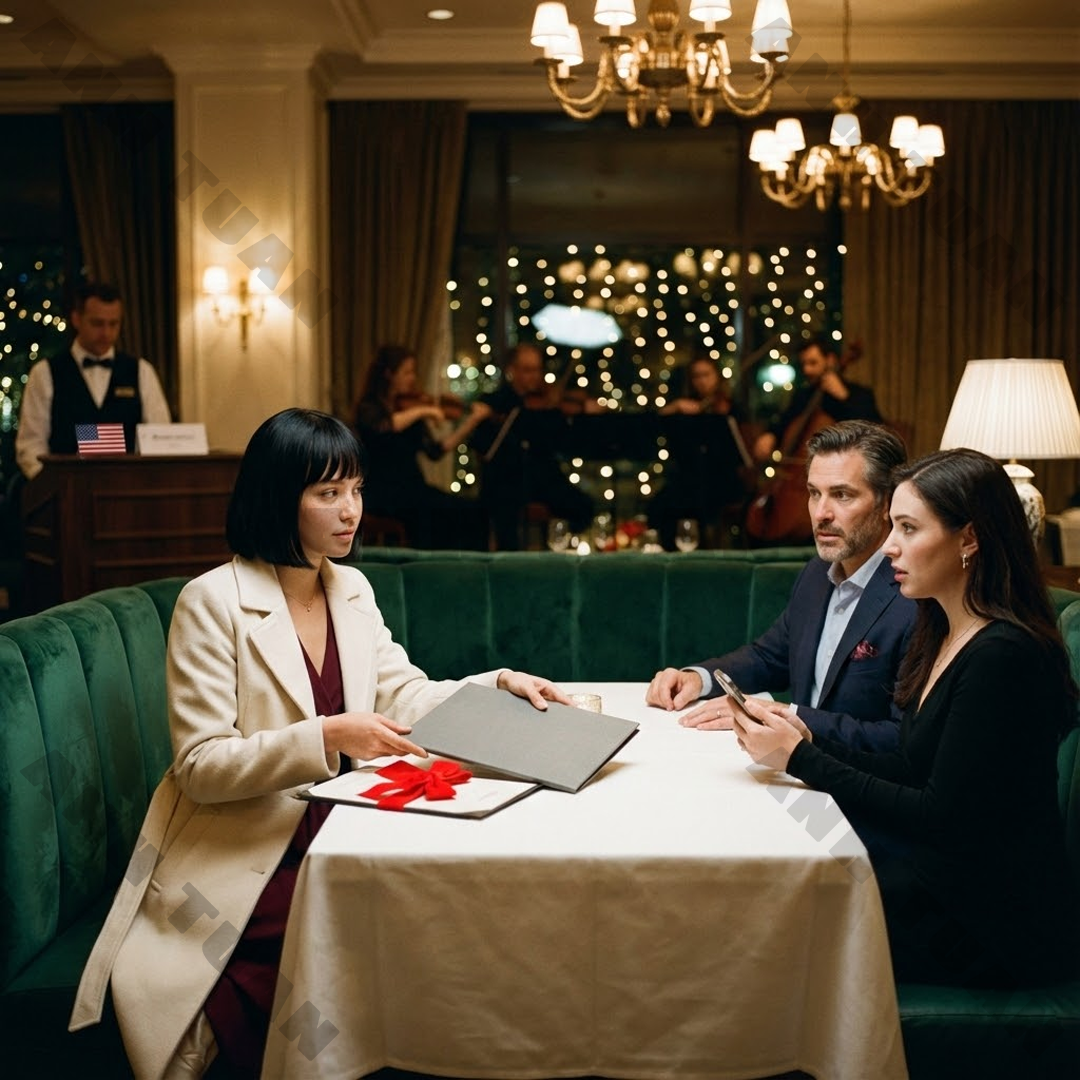
In my bag, the folder I’d brought felt heavier than paper should. That was fine. I’d learned to carry weight without announcing it.
The hostess glanced down at the reservation cards, then back up at me with a flicker of surprise she tried to smooth away. “Bennett party?” she asked.
“Yes,” I said. “They’re expecting me.”
Her eyes dropped again, scanning. I saw the pause, the soft hesitation when she realized my name wasn’t there, and I felt an old familiar heat rise in my chest. It wasn’t new. It wasn’t dramatic. It was the same small sting I’d felt at school awards, family parties, charity dinners, anywhere my parents were in charge of the list.
The hostess recovered quickly, professional, kind. “Right this way,” she said, and picked up a set of menus like she was carrying something delicate.
As we walked between tables, I caught glances from strangers who saw my posture and my blazer and assumed I belonged to someone important. They had no idea how long it had taken me to stop flinching under that kind of assumption. My family sat in the corner under a halo of chandelier light, a table positioned so it could be seen without being interrupted. My mother always chose corners like that. Corners were control. Corners were safety.
She stood the moment she saw me, her face opening like she’d been waiting for this exact second.
“Taylor, darling,” she said, and reached out as if she wanted to hug me. The gesture stopped just short of contact, hovering in the air, because she could never quite commit to affection if it might wrinkle her outfit or smear her lipstick. “Look at you.”
“You look nice,” I said, because politeness was a language I spoke fluently even when my throat wanted to close.
My father rose more slowly, just enough to be respectable. “There she is,” he said, and smiled in that calm, corporate way that always made me feel like I was at a meeting I hadn’t scheduled.
Avery lifted her phone slightly, framing me as I arrived. I saw the tiny red light at the corner of the screen and felt my stomach tighten with a complicated kind of resignation. Of course she was filming. Avery filmed everything that might later be useful.
I slid into my chair, smoothed my napkin across my lap, and kept my hands still. The linen was white, the crystal exact, the silverware heavy enough to feel serious. The waiter offered water, then iced tea, then wine. My mother chose wine. My father chose sparkling water, like he wanted to look disciplined. Avery chose whatever would photograph best.
I chose iced tea because I wanted to stay clear.
My mother rested her hand on the edge of the table, her diamond ring catching the light. “We have something special for you,” she said, voice dipped in sugar.
The waiter approached with a pristine white envelope and placed it by my plate like it was a dessert.
Avery leaned in, phone steady, eyes bright with anticipation.
My father cleared his throat. “It’s time we all move forward,” he said.
My mother smiled wider. “From all of us,” she added, like she was presenting a gift at a baby shower.
I looked at the envelope, then at their faces. For a moment, I saw them as I’d seen them my whole life, a family obsessed with performance, convinced they were the audience and I was the understudy. They were waiting for a reaction they could interpret. Tears would make them powerful. Anger would make them right. Begging would make them generous.
I opened the envelope slowly.
Inside was a letter on heavy, embossed paper. The language was legal, stiff, final. We, the undersigned, hereby release and relinquish all familial obligations and ties with Taylor Bennett. It was signed by each of them. My father’s signature was sharp and confident. My mother’s was elegant, looping like she was signing a thank you card. Avery’s was neat, practiced, perfect.
My graduation present.
The table went quiet in the way rooms do when people are waiting to see if someone will break.
I folded the paper once, then again, careful, precise. I set it beside my spoon as if it were nothing more than a receipt.
“Thank you,” I said.
Avery blinked. “You’re thanking us?”
My father’s eyebrows lifted a fraction, his expression tightening like a man who had just watched a deal go sideways. My mother’s smile faltered, then returned, thinner, trying to hold.
“Taylor,” my mother said softly, “you don’t have to make this harder.”
I met her gaze and felt something inside me settle into place, a quiet click like a lock turning.
“I’m not making it harder,” I said. “I’m making it clear.”
Then I reached into my bag and pulled out my folder.
It was the same neutral gray as the suit Nathan Cole had worn the day he slid a contract across a table and told me I’d built something scalable. I placed it on the linen and opened it toward them.
The Northbridge letterhead gleamed under the chandelier. The acquisition announcement sat on top, the ink clean and final. Beneath it was my offer letter. Director of Data Operations. Root Flow Integration Lead. Start date: Monday.
For a moment, nobody moved. Even Avery’s phone dipped slightly as her brain tried to catch up to what her camera was capturing.
My father leaned forward, reading. His mouth tightened. “This is yours?”
“Yes,” I said.
My mother’s hand hovered over her wine glass, then fell to the table. “We didn’t know,” she whispered.
“I know,” I said.
Avery’s eyes flicked between the letters and my face, her expression cracking in a way I’d never seen before. “You sold it,” she said, voice too sharp to be neutral.
“I built it,” I replied. “Then I sold it. The deal closed last week.”
My father’s jaw flexed as if he wanted to bite down on a word he couldn’t control. “How much?” he asked, because of course that was his first question. Money was the only language he trusted.
“Enough,” I said. “And that’s not the point.”
My mother tried to regain her composure, smoothing her napkin like she could smooth the moment. “Taylor, sweetheart, we were only trying to teach you to stand on your own.”
“I already am,” I said. “That’s why your lesson arrived late.”
Avery’s phone was still in her hand, but the red light was off now. She didn’t know what she was filming anymore. For the first time, she looked like a person without a script.
I stood, not rushed, not dramatic. I slid the disownment letter back toward them, the paper whispering softly on linen.
“You can keep the letter,” I said. “I already have my own.”
I didn’t raise my voice. I didn’t smile. I didn’t ask for anything. I simply turned and walked out.
Behind me, the quartet shifted songs without knowing they were scoring a funeral.
Outside, the air off Lake Michigan hit my face like truth. It smelled like rain, car exhaust, and the faint mineral edge of water. The city pulsed beyond the restaurant doors, indifferent and alive. My heels clicked against the sidewalk, and each step felt lighter than the last.
My phone buzzed in my bag.
I didn’t check it.
I kept walking.
By the time I reached the corner, my hands were calm. Not numb. Calm. I stood under a streetlight and watched cars glide past, their headlights streaking white across the wet pavement. A couple laughed under an umbrella, shoulders pressed together, their faces soft with the kind of ease you can’t buy and can’t perform.
For a second, I wondered what it would feel like to move through life without bracing for evaluation from the people who raised you.
Then I stopped wondering. Wondering was how I used to stall myself into staying.
I crossed with the light, my shadow stretching long across the asphalt. It looked taller than I felt. For years, my family had taught me that height came from approval, that you only stood as tall as the room allowed you to. Tonight, I understood something simpler.
Height could come from choosing your own ground.
When I got home, my apartment felt like a clean exhale. The air smelled faintly of coffee and lavender detergent, the kind of quiet you can trust. I set my keys in the dish by the door, placed my bag on the chair, and stood still for a moment, listening.
No voices. No expectations. No camera lens.
Then I took my phone out.
Twenty-seven missed calls. Three voicemails. Two texts from Avery, five from my mother, and one from my father that simply read, Call me. Now.
I stared at the screen until the old reflex rose in my chest. The reflex to explain. To soothe. To restore peace. Peace, in my family, always meant my silence.
I made iced tea instead. The glass sweated in my hand, leaving a perfect ring on the coaster when I set it down. I wiped the ring away with my thumb because I wanted to remind myself that small repairs were still possible.
Then I listened to the voicemails.
My mother first, breathy and wounded. “Taylor,” she said, as if she were the one who had been humiliated. “I don’t know what you think you’re doing, but you embarrassed us in front of everyone. You made a scene.”
Scene. In my family, a scene didn’t mean yelling. It meant anything that disrupted the script. A silent refusal could be more scandalous than a tantrum, because it couldn’t be framed as immaturity. It had to be framed as cruelty, because cruelty was the only explanation that kept them innocent.
My father next, voice clipped and controlled. “You will call me back,” he said. “This is not a conversation you get to end. Do you understand me?”
Avery last, and hers was the one that made my throat tighten. “Taylor,” she said, and there was actual fear in it. “They’re spiraling. Dad’s calling people. Mom’s texting donors. I didn’t think it would go like that.”
I sat at my desk and looked at the folder I’d carried, now resting beside my laptop like a quiet witness. Monday. That was still real. That was still mine. My family could rage all they wanted, but they couldn’t delete a signed contract.
Proof didn’t care about their feelings.
A message popped up from Ethan, quick and plain. You okay?
I stared at the cursor blinking in the chat window and felt grief rise, sharp and unexpected. Not grief for my parents, not exactly. Grief for the fact that the people who asked if I was okay were never the people who were supposed to.
I typed back. Yeah. Just loud tonight.
Ethan replied immediately. Then come over. Maya’s here. We have empanadas and a rule: no talking about rich people until you’ve eaten.
I grabbed my jacket and left before my brain could talk me out of accepting help.
The train platform smelled like rain and old metal. A man in a Cubs cap leaned against a pillar, scrolling his phone. A teenage girl in a hoodie chewed gum and stared at the tracks like she was waiting for her life to show up on time. Overhead, an American flag hung in a plastic case, slightly warped by heat and time, as if even the symbols were tired.
The train arrived with a roar and a gust of warm air. Inside, the seats were speckled blue and the floor had the sticky shine of a place that had been cleaned too many times without ever being fully clean. I sat by the window and watched Chicago blur past, blocks of light and shadow, murals on brick walls, corner stores with neon signs, porch flags hanging limp in the humid night.
I thought about my parents’ table under the chandelier halo, their faces frozen in surprise, and felt something unexpected.
Not triumph. Not revenge.
Just distance.
At Ethan’s place, Maya opened the door before I knocked, like she’d been watching for me. She wore sweatpants and an oversized university sweatshirt, hair piled messily, face bare and honest.
“Come in,” she said, like it wasn’t a question.
The living room smelled like fried dough and spices. Ethan stood at the counter unwrapping empanadas, sleeves rolled up, expression bright in that way people get when they’re trying to hold the world steady for someone else.
“You did it,” he said simply.
“I walked out,” I corrected.
“That’s what I mean,” Maya said.
We ate on the couch with a baseball game murmuring in the background. The Cubs were losing, which felt fitting. Ethan insisted on giving me the last empanada, and when I tried to refuse, he lifted his eyebrows like I was being ridiculous.
“You always try to minimize your needs,” he said. “Eat.”
So I ate. The food was hot and salty and grounding. When you’re in the middle of something emotional, you forget your body is still a body. You forget you still need calories, water, warmth.
After we finished, Maya leaned back and studied me. “How do you feel?” she asked.
I could have given the easy answer. Fine. I’m okay. It’s nothing. I could have made it small, made it manageable for them.
Instead, I told the truth.
“I feel clean,” I said. “Like I stopped bleeding from a cut I didn’t realize I’d been holding open.”
Ethan nodded slowly. “That makes sense,” he said. “They were feeding on the open wound.”
Maya’s gaze sharpened. “Okay,” she said. “So what happens next?”
I took a sip of water and chose my words carefully. “They’re going to show up,” I said. “They’ll try to talk. They’ll try to rewrite it. They’ll try to make me feel guilty enough to come back and apologize for disrupting their narrative.”
Ethan’s jaw tightened. “And you?”
“And I’m going to keep it in writing,” I said. “No surprise visits. No dramatic phone calls. Everything in email.”
Maya smiled slightly. “Look at you,” she said. “Speaking like a person who’s been in a boardroom.”
“I’ve been in a boardroom,” I said. “Just not theirs.”
Ethan reached for his phone and tilted it toward me. “By the way,” he said, “you should know this exists.”
On his screen was a short video clip. Grainy but clear. The envelope sliding across linen. My hands opening it. The paper. The moment I folded it. The moment I placed my folder on the table. The moment my father’s face changed.
My stomach tightened, then loosened again. I’d expected it. Avery didn’t experience life without filming it.
Ethan watched my expression. “Do you want me to report it? Try to get it taken down?”
I shook my head. “No,” I said. “Let it exist.”
Maya’s eyebrows lifted. “Really?”
“Yes,” I said. “Because it’s proof too. It’s not my version. It’s not narrated by me. It’s just the moment.”
Ethan stared at me for a long second, then smiled, slow and impressed. “You’re terrifying,” he said affectionately.
“Good,” I replied. “I’m tired of being easy.”
I stayed with them until midnight, long enough for my nerves to settle into something resembling normal. When I finally went home, the city felt softer, as if the streetlights had dimmed in sympathy. I slept in my own bed and dreamed of the restaurant, but the dream didn’t end with me trapped at the table. It ended with me leaving, again and again, each time easier.
In the morning, sunlight cut through my blinds in sharp lines. I made coffee, ate toast, checked my phone.
Fifty-two missed calls.
I stared at the number and felt the old reflex rise, the reflex to explain and patch and smooth. Then I opened my laptop and wrote an email instead.
Mom, Dad, Avery. I’m not available for unannounced visits or repeated calls. If you need to communicate, email me. I will not discuss last night by phone. I will not debate my life choices. Please respect this.
No exclamation points. No emotional paragraphs. No bargaining.
I hit send.
Ten minutes later, my building’s front desk called. “Ms. Bennett,” the clerk said, polite but curious, “your parents are downstairs. They say it’s urgent.”
I closed my eyes and felt my heartbeat change. Not faster, exactly. Just sharper. My family didn’t respect boundaries. They treated boundaries like invitations to negotiate.
“I’m coming down,” I said.
In the elevator, I stared at my reflection in the metal panel. My face looked composed, but my eyes looked alert. I reminded myself of a simple truth.
I didn’t have to win them over. I just had to hold my line.
The lobby was bright with morning light, and my parents looked like they were dressed for a fundraising brunch. My mother wore a navy sheath and pearls. My father wore a crisp shirt and blazer, jaw set. Avery stood slightly behind them, phone in hand, eyes rimmed with something close to panic.
My mother stepped toward me, arms opening. “Taylor.”
“No,” I said gently, before she could touch me. “Not here.”
Her smile flickered, then returned, the same quick recovery she always used in public. “Of course,” she said. “We just need a few minutes.”
“We can go across the street,” I said. “There’s a coffee shop.”
My father’s jaw tightened. “We don’t need a café. We can talk in your apartment.”
“No,” I repeated, calm.
Avery’s gaze flicked to the clerk, then back to me, and for once she looked embarrassed in a way that wasn’t theatrical.
We crossed with the light. The coffee shop door had a small American flag sticker near the handle, sun-faded at the edges. Inside smelled like espresso and vanilla syrup. We took a table near the window.
I didn’t order. My mother did, out of habit, and bought herself a latte she didn’t drink.
My father leaned forward immediately. “That video needs to come down,” he said.
“I didn’t post it,” I replied.
“But you benefited from it,” he snapped, and the anger under his control finally showed itself.
My mother pressed her fingers to his arm, then turned to me. “Taylor, sweetheart, you don’t understand what you did to us.”
I looked at her and felt something in my chest settle into clarity. “No,” I said. “You don’t understand what you did to me. And you wrote it down.”
Avery flinched.
My father’s voice dropped, dangerous and controlled. “We were teaching you a lesson.”
“You were ending support and calling it a gift,” I said. “That’s not a lesson. That’s a statement.”
My mother’s eyes glistened. She could summon tears like a skill, but I still couldn’t tell if they were real. “We were hurt,” she said. “You’ve been distant. You never tell us anything.”
“You never asked,” I said. “You announced.”
My father sat back, eyes narrowing. “So what, you think you’re better than us now?”
“No,” I said. “I think I’m free.”
The word landed like a door closing.
My mother reached for her pearls, fingers worrying the necklace. “Taylor,” she said softly, “we can fix this. We can explain. We can rewrite.”
“No,” I interrupted, not sharp, just final. “You can apologize. Explaining isn’t the same.”
My father tried to retreat into his favorite tactic, logistics. “Let’s talk next steps,” he said, voice smoothing into corporate calm. “There are implications. Reputation. Donors. Your mother’s board is calling.”
“Email me,” I said. “From now on, everything in writing. No surprise visits. No repeated calls. If you show up again unannounced, I’ll ask building security to escort you out.”
My mother blinked fast. “Taylor.”
“I’m not negotiating,” I said.
Avery finally spoke, voice small. “I’m sorry,” she said. “I didn’t think it would explode.”
I looked at her and saw panic behind her polish. Avery had lived her whole life believing the camera could control the narrative. She was realizing that cameras capture too much truth when you’re not the one editing.
“Take the video down if you can,” I said. “Not because I’m ashamed. Because you need to stop feeding it.”
She nodded quickly. “I will,” she said. “I swear.”
My father’s eyes snapped to her. “Avery.”
She held his gaze for the first time in a way that wasn’t obedient. “Dad,” she said, and the tremor in her voice wasn’t fear. It was rebellion. “Stop.”
My mother inhaled sharply, as if Avery had slapped her. That single word did more damage to their family hierarchy than any speech I could have made.
I stood, smoothing my blazer. “I have work,” I said. “Monday starts early.”
My father’s mouth twisted. “Always hiding behind work.”
“No,” I said. “Building behind work.”
My mother’s hands hovered as if she wanted to touch me and didn’t know how without making it about herself. “Taylor, please,” she whispered.
I paused, not because I was weak, but because I wanted to leave with truth instead of cruelty. “I’m not doing this to punish you,” I said. “I’m doing it to protect me.”
Then I walked out.
Over the next few days, the noise proved how quickly my family’s world shifted when control slipped. Messages from professors and classmates flooded my inbox, congratulating me on the acquisition, on the offer, on the fact that Root Flow had landed with a company big enough to matter. Trade publications requested interviews. A local morning show emailed about a segment on “young women changing logistics with tech,” like my life had suddenly become a tidy headline.
At the same time, my parents’ calls came in waves, urgent and relentless. Not apologetic. Relentless.
By Wednesday, my father emailed a PDF titled Addendum Family Expectations. The language read like a contract, respectful discourse and family brand integrity and a request that I refrain from “public commentary that could harm reputations.” It wasn’t an apology. It was a negotiation attempt dressed as concern.
I replied with two sentences. Thank you for writing. I will not sign an addendum that governs how I tell my own story.
Then I archived the email and refused to reread it, because rereading would be a way of letting him sit in my mind rent-free.
Avery emailed separately, two hours later. I started therapy. I told the truth. It felt like throwing up. I’m sorry.
I stared at that line for a long time. It wasn’t polished. It wasn’t strategic. It was messy, and that messiness made my throat tighten.
I typed back. Good. Keep going.
My mother sent flowers, a bouquet of white roses that looked like a funeral arrangement. The card read, Always your mother, written in careful script.
I stared at it and felt exhaustion instead of tenderness. The words were a hook. My mother loved hooks. Hooks were how she pulled people back into her orbit without admitting she’d ever pushed them away.
I gave the flowers to my neighbor in the elevator, a woman with tired eyes who smiled like she didn’t know she needed them until she held them. “Someone loves you,” she said lightly.
“Someone wants me to come back,” I corrected gently.
She didn’t ask questions. She just nodded like she understood more than I’d said.
Friday night, Ethan and Maya came over with grocery bags and that stubborn kind of loyalty that doesn’t announce itself. We sat on my living room floor eating chips and arguing about integration milestones like it was a sport. Maya pulled up a spreadsheet and pointed out a fairness edge case, a rural route that would always get deprioritized if we optimized strictly for efficiency.
“So we don’t optimize strictly for efficiency,” I said.
Ethan grinned. “That’s why you’re the boss,” he said.
Maya’s gaze softened. “That’s why you built it,” she corrected.
Later, when the noise outside my window faded into late-night city hum, Maya stood in front of my bookshelf and studied the old photo of me at ten holding a science fair ribbon. My parents stood behind me in the picture, smiling like they’d been told to smile, Avery already centered like she knew where cameras wanted her.
“Were they always like this?” Maya asked quietly.
I considered the question and felt the answer settle in my chest like a stone. “Not always,” I said. “But long enough.”
I didn’t tell her everything that night. There was too much, and some stories take time to lay out without turning into a wound again. But the truth sat in the room anyway, heavy and honest.
I grew up in a house where love came with performance metrics.
My father, Charles Bennett, measured worth in return on investment. He didn’t say it as cruelty. He said it as gospel, the way some men talk about weather or taxes. He worked in finance, the kind of job where he wore calm like a suit and treated everything emotional as a risk to be managed.
My mother, Diane, measured worth in appearances. She could walk into a room and make people feel flattered that she’d noticed them. She hosted charity dinners and fundraiser brunches and knew exactly how to laugh at the right volume. She believed manners could cover anything, even neglect.
Avery, my sister, learned how to be the perfect balance of both.
At dinner parties, I was introduced last. “Avery is a senior associate,” my mother would beam, hand resting on my sister’s shoulder like she was showing off a new car. Then her tone would soften, almost apologetic. “And this is Taylor. She’s still studying.”
Still studying, as if I were a late project waiting for approval.
Guests would nod, glance at me briefly, then redirect their attention to champagne and connections. I learned to smile back quietly, predictably, the way you do when you understand the rules but aren’t allowed to change them.
Our dining room always smelled of cedar polish and expectation. The chandelier above the crystal table threw fractured light across my glass, scattering reflections that never quite settled. I used to count them, tiny broken halos on the white linen, while my father discussed markets and my mother rehearsed gratitude to donors who mistook vanity for virtue.
Avery thrived in that world. She learned when to laugh softly, when to tilt her head just enough to look engaged, when to touch someone’s elbow like intimacy. I studied her like a science. Every gesture earned approval. Every pause was calibrated.
I worked nights at a café near campus.
It started in high school, a weekend job to “build character,” my father said, the kind of lesson he liked because it sounded noble. He didn’t offer to drive me. He didn’t ask how late I got home. He just approved of the idea that my time could be turned into something productive.
At the café, people didn’t care about last names or legacies. They wanted their orders right and their names spelled correctly. It was measurable, clean, honest. The espresso machine hissed louder than any conversation at home, and I liked that the loudness had a purpose.
One Sunday after a long shift, I came home smelling like burnt caramel and coffee grounds. Avery sat at the kitchen counter with her laptop open, my father pouring wine.
“We were just talking about you,” he said, swirling the glass. “Avery thinks you’re wasting your time behind a coffee counter.”
Avery didn’t look up. “It’s not wasting, Dad. It’s character building,” she said, her tone light, but the edge sharp enough to cut.
“I’m funding my tuition,” I said, and laughed softly, pretending it didn’t sting.
My father shrugged. “Degrees don’t pay bills, Taylor. Numbers do. Remember that.”
I wanted to remind him that I understood numbers better than anyone in that house, that I could build systems and track variables and model outcomes. But his attention had already drifted back to Avery.
After that night, I stopped trying to join their conversations. I started watching instead, observing, collecting data in the quiet way that made sense to me. Still, there were moments I thought maybe things would change. When I earned a National Research Scholarship, I sent them the email, attached the press clipping, waited.
My mother replied six hours later. So proud of you, sweetheart. We have a gala tonight. Can we post about it tomorrow?
They never did.
That was the day I understood something simple and permanent. Attention was a currency in our house, and I was always the unpaid intern in their empire. I remember the sound of crystal glasses that night, how they clinked perfectly in rhythm, as if the house itself celebrated my invisibility.
Two days before graduation, a message arrived in the family group chat: a reservation link. Maison Lumière. The same restaurant my mother booked for every milestone that wasn’t mine. The message was simple. Pre-graduation dinner for Taylor. Dress appropriately.
No warmth, no emoji, just a formality wrapped in control.
I clicked the link and felt my stomach drop. The host greeting read, The Bennett Family: Charles, Diane, Avery. My name wasn’t on the list. That omission wasn’t a mistake. It was a statement.
An hour later, Avery texted privately. Don’t overthink it. It’s just formatting.
Formatting. The word echoed in my head, and I realized that was how they saw me. A variable easily deleted.
That night, I sat at my desk, city lights flickering against the window like static. My inbox glowed with unread notifications from investors, classmates, professors. Achievements. Milestones. A life that was moving forward whether my family applauded or not.
I scrolled through old family photos, vacations and holidays and fundraisers. My mother’s flawless posture. My father’s rehearsed smile. Avery’s practiced charm. Me always at the edge of the frame, half-lit, half-seen.
It wasn’t new. It was just the first time I saw it without hope.
The next morning, I received an email from the university confirming my speech slot at commencement. My mentor, Dr. Alvarez, had nominated me for the Young Leader in Technology Award. Her message was short.
This is your moment, Taylor. Own it quietly.
Quietly. The word felt like a lifeline. I closed the laptop and took a long breath. Sunlight cut through the blinds in clean geometric lines. I started to notice how precise everything around me had become, the coffee mug aligned with the notebook, the papers stacked by color, the clock ticking at a steady rhythm.
Order was a language that didn’t need witnesses.
That was the moment I realized my life wasn’t chaotic. It was organized. Just not by them anymore.
Root Flow had started as a small research assignment, a question on a whiteboard in Dr. Alvarez’s lab that asked how to optimize delivery routes without treating drivers like disposable pieces. I cared about that question because I’d watched my father talk about people like they were numbers, and I’d watched my mother talk about dignity like it was a dress you could put on for an event and take off afterward.
I wanted dignity to be built into the system.
The first version of the platform was ugly, clunky, held together by late nights and cheap coffee. Ethan handled analytics, the kind of mind that could spot patterns in chaos and make them behave. Maya shaped the interface, insisting that tools should feel human, not punishing. I wrote the core algorithm, sitting at my desk while the city slept and trains rattled in the distance like a heartbeat.
The breakthrough came one early morning, long before sunrise, when I ran a simulation that cut fuel costs by twelve percent without adding extra hours to drivers’ shifts. I remember leaning back and staring at the numbers, pulse suddenly loud in my ears.
Proof.
By the time the university’s startup symposium arrived, Root Flow was ready. Dr. Alvarez stopped me before I went on stage. Her hand rested briefly on my shoulder, grounding, steady.
“You don’t need to sell yourself,” she said. “Just show them how it works. Let the data speak.”
It did.
When the presentation ended, applause erupted, polite at first, then real. Among the crowd stood a man in a tailored gray suit, older than the students, calmer than the investors. Nathan Cole, CEO of Northbridge Logistics.
He approached afterward, tone measured, interest genuine. “You’ve built something scalable,” he said, studying the graphs. “But more than that, something fair.”
Fair. A word I hadn’t heard in years.
We met twice after that, in a quiet conference room with cheap coffee and too much fluorescent light. The third time, he slid a folder across the table. Inside was a letter of intent. Northbridge wanted to acquire Root Flow for $6.2 million, plus a director-level position for me post-graduation.
I didn’t sign immediately. I read every clause, every subline. I asked questions that made Nathan’s legal team blink. I wanted to make sure the system I built stayed intact, that fairness wasn’t just a marketing word. When I finally signed, it didn’t feel like triumph.
It felt like balance.
From that point on, I built an archive. Digital copies of every document, timestamped and encrypted. Receipts, licensing records, payment confirmations. The kind of paper trail that doesn’t just tell a story. It seals it.
The night I received the final transfer confirmation, I printed the letter. The sound of the paper sliding out of the printer felt cleaner than applause.
The night before the dinner at Maison Lumière, Chicago hummed under the weight of summer rain. My apartment windows fogged at the corners, glass trembling with each passing train. Inside, everything was in order. Papers aligned. Screens glowing soft blue.
I brewed coffee, the smell cutting through the storm, sharp and grounding. My fingers tapped the keyboard in rhythm with the rain. Each line of data, every document filed, was another quiet act of rebellion.
I’d stopped trying to explain myself months ago. Explanations were for people who wanted to be understood. Records were for people who intended to be remembered.
So I kept records.
Every scholarship form. Every award letter. Every tuition payment. Every shift schedule from the café. The pay stubs that proved my life wasn’t funded by my father’s generosity, no matter what story he liked to tell.
The morning of the dinner, I woke before sunrise. The first light caught the corner of my desk, gleaming off the silver clip holding the contracts together. I touched the paper lightly, grounding myself.
I didn’t dress for them. I dressed for records. Clean blazer, tied hair, neutral tones. The kind of look that doesn’t beg to be seen but demands to be remembered.
When I arrived near Maison Lumière, I stopped in front of the glass doors and breathed once, steady. They thought that night was their stage. They had no idea the script had already been rewritten, signed, sealed, archived.
After I walked out, the aftermath moved fast, because nothing spreads faster than a story that embarrasses the powerful. By morning, a clip of the dinner existed, not public yet, but circulating in closed circles the way gossip does in wealthy spaces. Someone always screen-records. Someone always forwards it to someone who “won’t share it,” which is how it always gets shared.
A restaurant manager emailed offering cooperation if I wanted takedowns. I thanked him and declined. I wasn’t interested in chasing ghosts across the internet. I was interested in building a life too solid to be shaken by someone else’s narrative.
By noon, a PR consultant I’d never met emailed offering to “manage the narrative.” I archived it. Then I answered the only messages that mattered, the ones from my team and my mentor and the people who had actually watched me work.
Dr. Alvarez wrote, Proud of you. Quiet is not the same as small.
Ethan wrote, You are going to make them lose their minds.
Maya wrote, I’m bringing you a list of boundary phrases. We’re not letting them twist you.
By dusk, my father called again. Twenty-nine missed calls in one day. I remembered the number without trying because the number meant something. Twenty-nine was the bus route I took from the café to campus when the late shift ended and the trains were done. Twenty-nine was the route I took when I had no safety net.
I let the calls collect like uncashed checks.
The next week, Nathan Cole called me directly, his voice calm. “Are you okay?” he asked.
“Yes,” I said. “Just loud.”
“Do you need security?” he asked, matter-of-fact.
The question startled me, not because it was dramatic, but because it was practical. Nathan spoke like a man who understood that people protect assets in ugly ways.
“I don’t think so,” I said. “But thank you.”
“If anything escalates,” he said, “tell me. We protect our people.”
Our people. The phrase landed in my chest in a strange way. Not sentimental. Just steady. I realized I’d never heard my father say we protect our people unless he meant we protect our image.
On Monday, my first day at Northbridge, I walked into a lobby of glass and steel and neutral carpet that smelled like money and printer ink. An American flag display sat behind reception, glossy and official. A security guard checked my ID, then smiled when he saw my name.
“Congratulations,” he said, like it wasn’t a performance.
“Thanks,” I said.
The elevator opened onto a floor of open desks and quiet intensity. People moved with purpose, holding coffee, wearing badges, speaking in low voices about routes and timelines and deliverables. It felt like a different kind of family, one built on shared work instead of shared blood.
Nathan met me in a conference room with a whiteboard and a bowl of peppermints. “You ready?” he asked.
“Yes,” I said.
“Good,” he said. “We don’t need you loud. We need you clear.”
The meeting was straightforward, introductions and timelines and questions about my model. Questions about fairness constraints. Questions about how to ensure small carriers wouldn’t be crushed by licensing. I answered without flinching, because the truth was I trusted this work more than I’d ever trusted my family’s affection.
Halfway through, my phone buzzed in my pocket. I didn’t check it. After the meeting, when I finally looked, there were three messages from my mother.
Call me. Please. This is urgent.
Urgent, in my family, always meant urgent for them.
I put the phone away and walked back into the office.
My urgency now wasn’t drama. It wasn’t reputation. It wasn’t the desperate need to patch a story.
My urgency was building something that worked.
That week, Northbridge assigned me a small team and an impossible timeline, because corporations love to test new leaders by throwing them into a fire and watching who burns. Maya joined as a contractor immediately, her eyes bright with satisfaction when she saw the resources we suddenly had. Ethan got brought on for analytics, his grin wide when he realized we’d have actual computing power instead of cheap university servers.
On Wednesday, we hit our first real problem. A rural route set that kept deprioritizing small towns. The optimization model, left unchecked, treated rural communities like inefficiencies. It was math doing what math does, choosing the easiest win.
I stared at the output and felt my jaw tighten. “No,” I said.
Ethan looked at me. “No?”
“No,” I repeated. “We don’t build a system that makes the quiet places invisible.”
Maya nodded, already pulling up the interface. “Then we create constraints,” she said.
We stayed late, building fairness weights and time windows, adding parameters that forced the model to treat rural routes as essential rather than optional. At midnight, when the new simulation ran, the route distribution shifted, not perfect, but better. The system felt more like a promise.
When I left the office, the city was dark and quiet, streetlights reflecting on wet pavement. My phone buzzed again.
This time, it was my father.
One message, short. We need to meet. Your actions have consequences.
I stared at the screen until the old fear tried to rise, then I felt it stop at the boundary I’d built. My father loved consequences when he thought he controlled them. He’d never learned what it felt like when consequences belonged to someone else.
I didn’t respond.
Two days later, the first real attempt at sabotage arrived, dressed as concern.
A courier delivered a thick envelope to Northbridge’s legal department, addressed to Nathan Cole. Inside was a letter from my father’s attorney, polite and poisonous, suggesting that Root Flow’s intellectual property may have been developed using “family-funded resources” and requesting documentation to ensure no “ownership disputes” existed.
My stomach went cold when Nathan forwarded it to me, not because I was afraid of the truth, but because I recognized the tactic. My father couldn’t control me emotionally anymore, so he was trying to control me legally. If he could cast doubt, if he could slow the acquisition, if he could threaten enough discomfort, he could force me back to the table where he was strongest.
Nathan called me into his office, closed the door, and slid the letter across his desk. His expression was calm, but his eyes were sharp.
“Tell me what this is,” he said.
I took a breath and felt my spine straighten. “It’s him trying to regain control,” I said. “And it won’t work.”
“Prove it,” Nathan said, not cruel, just practical.
“I can,” I replied.
I went back to my desk, opened my archive, and pulled up the folder I’d built for exactly this kind of moment. Tuition receipts. Scholarship award letters. Bank statements showing my own payments. Work schedules and pay stubs from the café. University lab usage agreements. Emails documenting every stage of Root Flow’s development, including the incubator approvals, the code repository logs, the patent filing drafts.
A paper trail so clean it practically gleamed.
By the end of the day, Northbridge’s counsel sent a formal response. No family resources used. No ownership claim valid. Any further harassment would be treated accordingly.
The next morning, my father called my phone again. I let it ring out. He left a voicemail.
“You’re making a mistake,” he said, voice low. “You don’t understand how this world works.”
I listened once, then deleted it.
I understood how his world worked. That was the problem. I’d understood it my whole life. I just didn’t live there anymore.
A week later, a gossip account posted the dinner video publicly, captioned like entertainment. The comments were a mess, half of them hungry for drama, half of them insisting it was staged, half of them projecting their own family wounds onto my face.
I watched the clip once, then closed it.
If I stared at other people’s reactions, I’d become trapped in the loop where my worth depended on a crowd. I’d spent too many years living like that in my parents’ house, waiting for applause that never arrived.
Instead, I opened my notebook and wrote down what mattered.
Driver fatigue limits. School zone constraints. Holiday schedule options. Fairness metrics for rural routes.
At the bottom, without thinking, I wrote one more line.
I do not negotiate my reality.
Two days after that, my mother mailed me a check. Seven thousand dollars. Memo line: Graduation gift. Beneath it, a note in her handwriting, careful and neat.
We chose the wrong kind of lesson. Let us fix this.
I stared at the check until the number stopped being money and started being meaning. Seven thousand wasn’t random. It was symbolic reimbursement, a way to pay for the restaurant and pretend the payment erased the act. It was also a hook.
I didn’t cash it.
Instead, I wrote my own check for the same amount to the café’s job-training program my old manager had started for students who needed flexible work and real support. On the memo line, I wrote, For the ones who taught me to survive.
Then I scanned both checks and filed them under a folder labeled Restitution.
A week later, Avery emailed again. She didn’t write a long apology. She didn’t write a poetic paragraph. She wrote one sentence that looked like it hurt to type.
Can we meet? No parents. No cameras. Just me.
I stared at the message for a long time. The old reflex in me wanted to protect her, to make it easy, to accept any scrap of sincerity as proof that redemption was happening. But I’d learned scraps weren’t meals. Scraps kept you hungry.
I typed back. One hour. Public place. No filming. If you break that, we’re done.
Her reply came fast. Okay. I swear.
We met at a diner near the Northbridge office, the kind of place with cracked vinyl booths and a tiny American flag on the counter beside the register. The waitress called everyone honey and didn’t care who your parents were. Avery arrived in jeans and a plain T-shirt, hair pulled back messily, face bare and exposed.
She slid into the booth across from me and looked at my face like she was trying to memorize it without a filter.
“I’m sorry,” she said immediately.
I didn’t rescue her from the discomfort of saying it. I let the silence make room for sincerity to exist. She swallowed, eyes shining but not spilling into performance.
“I didn’t know how bad it was,” she admitted. “Not really. I thought you were tougher than you were. Or maybe I told myself that so I wouldn’t have to feel guilty.”
The words were messy. Human. They didn’t sound like a script.
“Why did you film?” I asked.
Avery flinched. “Because I’ve been trained to,” she said, and shame colored her voice. “Because moments don’t feel real unless they’re documented. Because Mom always wanted proof that we were perfect. Because Dad wanted proof that we were winning.”
She paused, then said the ugliest truth plainly. “And because I didn’t think you’d win.”
I nodded once. “Okay,” I said. “And now?”
Avery’s hands curled around her water glass, knuckles pale. “Now I’m trying to learn what it feels like to tell the truth when it’s not useful,” she whispered.
“That’s hard,” I said.
She laughed once, small and bitter. “You always made hard look normal.”
I looked at her and felt love linger like a bruise. Love doesn’t vanish just because you stop trusting someone. It can stay, tender and painful, reminding you of what you wanted.
“I’m not promising you anything,” I said quietly. “I’m not rebuilding a relationship on words. If you want this, you do it with actions, and you do it for a long time.”
Avery nodded, swallowing. “I started therapy,” she said. “I told the truth about the letter. About filming. About how Mom and Dad taught me to be a product.”
I didn’t react. I didn’t punish her. I simply watched.
“I don’t know who I am without it,” she said.
“You can learn,” I replied. “But you can’t learn in my skin. You have to learn in yours.”
When we left, Avery didn’t try to hug me. She didn’t reach for my arm. She stood there for a moment, hands in her pockets, looking like a person who had finally realized intimacy isn’t something you take. It’s something you earn.
“I’ll email,” she said softly. “If that’s okay.”
“That’s okay,” I said.
As I walked back toward the office, the city felt sharp and real. A delivery truck idled at the curb, diesel smell mixing with the scent of roasted nuts from a street cart. A woman in a business suit hurried past with a coffee cup, hair wind-tossed, phone pressed to her ear. A couple of tourists paused to take a photo with the skyline, their smiles wide and unguarded.
I realized something quietly.
I wasn’t walking around with a hole in my chest anymore.
I was walking around with a boundary.
In September, Northbridge asked me to present Root Flow’s fairness model to a school district outside the city, one that had been struggling with late buses and uneven route distribution. We drove out in a company car, the skyline shrinking behind us, the highway lined with flags and billboards and the steady American sprawl of strip malls and cornfields.
At the district office, the superintendent shook my hand and looked me in the eye. “We don’t need a fancy pitch,” she said. “We need kids to get to school on time.”
“I can do that,” I said.
In the conference room, I watched tired administrators flip through printed route maps, their faces tight with frustration. They weren’t wealthy. They weren’t polished. They were exhausted in a way that looked familiar, like people who carried responsibility without applause.
I showed them the model. I showed them how fairness constraints would prevent certain neighborhoods from always being served last. I showed them how we could respect crossing guard overrides and school zone speed changes. I showed them how the system could learn to treat small disruptions as reality, not as noise.
An older man in a plaid shirt leaned back and exhaled. “So you’re telling me the math can be kind,” he said, half-joking.
“I’m telling you the math can be designed,” I replied.
Afterward, when we walked out into the bright sun, Nathan called me. “How’d it go?” he asked.
“They’re going to pilot,” I said. “They just want it to work.”
Nathan’s voice held satisfaction. “That’s what you built,” he said. “A system that works.”
That night, I got home and found another envelope at my door. No return address. My mother’s handwriting, upright, immaculate.
My heart jumped, but it didn’t panic.
I brought the envelope inside and set it on the counter beside my framed degree and the Northbridge offer letter. I didn’t open it. Not because I was afraid of what it said, but because I already knew what mattered.
Some answers are not worth the cost of reopening the door.
Instead, I brewed iced tea, opened my laptop, and worked late on integration milestones, the kind of work that built a future without asking permission.
In October, Northbridge held a small internal event, nothing flashy, just coffee and pastries and speeches about values. Someone pinned a tiny American flag ribbon to a corkboard near the entrance, and Nathan made a joke about how it looked like a fourth-grade classroom. People laughed.
Then he called me up unexpectedly.
“This is Taylor Bennett,” he said, voice warm. “She built Root Flow while working nights and finishing her degree. She didn’t ask for permission. She didn’t ask for applause. She built something that works.”
Applause filled the room, steady and real. I stood there and felt my chest tighten in a way that wasn’t fear. It was grief for the fact that validation always felt dangerous, because I’d been trained to believe it could be withdrawn.
Nathan leaned toward me and murmured, low enough only I could hear, “You don’t have to flinch here.”
I swallowed, then nodded.
When I got home that night, my phone was dark. No missed calls. No frantic voicemails. My mother had finally stopped trying to storm my life back into her control. My father had stopped because he’d realized he couldn’t win a power struggle against a person who refused to play.
In early November, a thick envelope arrived from my parents’ law firm. Inside was a rescission of the disownment statement, notarized, formal, stiff. The language was careful, crafted to minimize culpability. It didn’t apologize in plain English. It simply reversed the paper.
I stared at it, then filed it.
Paper didn’t heal anything. Paper just recorded what happened.
The week before Thanksgiving, my old café manager called me. “We’re starting a new training cohort,” she said. “Your donation made a difference. Dara got accepted into community college.”
My throat tightened. “That’s amazing,” I said.
“You did that,” she replied simply.
“No,” I corrected. “We did.”
That Thanksgiving, Ethan and Maya came to my apartment with grocery bags and a turkey Ethan insisted he could cook “based purely on vibes.” Maya brought cranberry sauce and a printed recipe like she didn’t trust vibes. They argued in my kitchen while I chopped vegetables and listened to the sound of other people filling my space with warmth.
At dinner, we sat at my small table with mismatched chairs. Maya lit a candle. Ethan raised his glass of sparkling cider.
“To proof,” he said.
“To quiet,” Maya added.
I didn’t say anything. I didn’t need to. The words sat in the room anyway, steady as a heartbeat.
Later, after dishes and laughter and the low murmur of a late football game, I stood by my desk and looked at the shadow box I’d had made. The disownment letter behind the offer letter. The childhood envelope above them. The silver clip holding the corner like a small, stubborn promise.
My phone buzzed once.
Avery.
Happy Thanksgiving. No pressure to reply. Just… I hope you’re okay.
I stared at the message for a long moment, then typed back one sentence.
I’m okay. I hope you are too.
I hit send and felt no guilt, no panic, no urge to over-explain. Just a small, controlled act of kindness, offered without surrender.
After midnight, when Ethan and Maya were asleep on my couch and the city outside my window was quiet in that rare way Chicago can be quiet, I sat at my desk and opened my notebook.
On a clean page, I wrote a sentence I wanted to remember.
Some endings don’t come with forgiveness. They come with order.
I closed the notebook, turned off the lamp, and went to bed.
In the morning, sunlight spilled across the floor, pale and clean. I made coffee and listened to the city wake up. A siren wailed briefly, then faded. A train rattled in the distance. Somewhere outside, someone started their car and drove toward whatever life demanded next.
So did I.
News

“I Still Miss Him”: Dolly Parton Breaks Down Mid Song as Reba McEntire Joins Her for Heart Shattering Tribute to Late Husband Carl Dean.
“I Still Miss Him”: Dolly Parton Breaks Down Mid Song as Reba McEntire Joins Her for Heart Shattering Tribute to…

This guitar carried my soul on its strings when no one knew my name…
In the electric silence that follows a singer’s last note, when the world holds its breath in anticipation of what’s…

The Voice reveals 4 returning coaches for season 28 including Niall Horan and Reba McEntire
The duo will be joined by fellow show alums Michael Bublé and Snoop Dogg. Nial Horan and Reba McEntire on…

Reba McEntire: “Drag Queens Don’t Belong Around Our Kids”
Reba McEntire Sparks Controversy with Statement on Drag Queens and Children. Country music legend Reba McEntire has found herself at…

Reba, Miranda Lambert, & Lainey Wilson Debut Powerful New Song, “Trailblazer,” At The ACM Awards
“Trailblazer” Is A New Song That Celebrates The Influential Women Of Country Music’s Past And Present Reba McEntire, Miranda Lambert, and Lainey…
Jennifer Aniston made a surprise appearance with a dazed expression and an unresolved…
Jennifer Aniston is no stranger to the public eye. For decades, she’s been one of the most beloved faces in…
End of content
No more pages to load